
Scientists Say Heck, Just Nuke a Killer Asteroid Heading for Earth
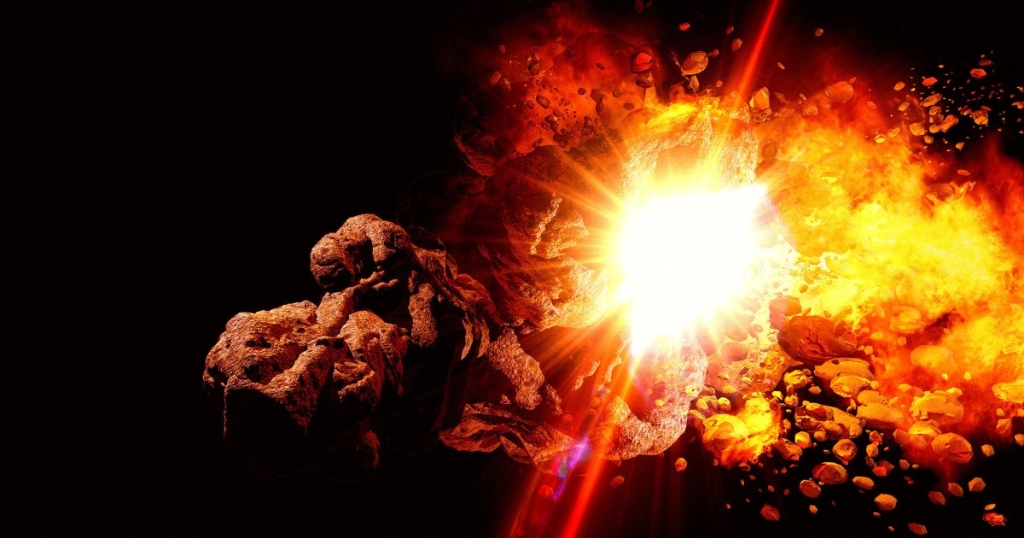
Nuclear Asteroid Defense: CERN Experiments Reveal Unexpected Resilience of Space Rocks
In a groundbreaking series of experiments that could redefine humanity’s planetary defense strategy, scientists from CERN, the University of Oxford, and nuclear defense startup Outer Solar System Company (OuSoCo) have discovered that asteroid materials become stronger when exposed to intense stress—a finding that challenges conventional wisdom about nuclear asteroid deflection.
The research, published in Nature Communications, comes at a critical time as NASA and the European Space Agency prepare to study Apophis, a massive asteroid measuring between 1,000 and 1,500 feet across, which will pass within 20,000 miles of Earth in April 2029—closer than many of our geosynchronous satellites.
The Chelyabinsk Wake-Up Call
The urgency of developing effective asteroid defense systems became painfully clear on February 15, 2013, when a 60-foot meteor exploded over Chelyabinsk, Russia. The blast released energy equivalent to 30 times the atomic bomb dropped on Hiroshima, injuring over 1,500 people and damaging thousands of buildings. This event served as a stark reminder that Earth faces real threats from space, and our current planetary defense capabilities remain limited.
Beyond DART: The Nuclear Option
While NASA’s successful Double Asteroid Redirection Test (DART) mission in 2022 demonstrated that spacecraft could redirect asteroids by crashing into them, this kinetic impactor approach has significant limitations. The method requires years of advance warning and works best on smaller asteroids. For larger threats or shorter warning times, nuclear deflection has long been considered a potential emergency option—though concerns about fragmentation have made it controversial.
CERN’s Super Proton Synchrotron Reveals Surprises
Using CERN’s Super Proton Synchrotron (SPS), researchers conducted experiments that subjected metal-rich meteorite samples to 27 intense pulses of proton beams at the HiRadMat facility. The team then analyzed the internal structure changes at the ISIS Neutron and Muon Source in the UK.
The results were unexpected. Rather than weakening or fragmenting, the meteorite material demonstrated increased yield strength and exhibited “self-stabilizing damping behavior.” In simpler terms, the space rock became tougher when stressed.
“This finding fundamentally changes our understanding of how asteroid materials behave under extreme conditions,” explained OuSoCo cofounder Melanie Bochmann. “It suggests that we may be able to use larger nuclear devices than previously thought without catastrophically breaking the asteroid into dangerous fragments.”
The Physics of Planetary Defense
The implications are profound for planetary defense strategy. Current models have assumed that using nuclear devices larger than a certain threshold would simply shatter an asteroid into multiple pieces, potentially creating multiple impactors that could be even more dangerous than the original threat.
However, if asteroid materials naturally strengthen under stress and can absorb energy through self-stabilizing mechanisms, this opens the door to more powerful deflection options. A larger nuclear device could transfer more momentum to the asteroid while the material’s inherent strength prevents catastrophic fragmentation.
Karl-Georg Schlesinger, cofounder of OuSoCo, emphasized the scientific challenge: “Planetary defense represents a scientific challenge. The world must be able to execute a nuclear deflection mission with high confidence, yet cannot conduct a real-world test in advance.” These laboratory experiments provide crucial data for developing reliable models.
The Apophis Opportunity
The upcoming 2029 flyby of Apophis represents an unprecedented opportunity for scientific study. As this massive asteroid passes closer to Earth than many satellites, both NASA and ESA will have the chance to gather detailed data about its composition, structure, and behavior.
“We plan to study more complex and rocky asteroid materials,” the researchers noted. “One example is a class of meteorites called pallasites, which consist of a metal matrix similar to the meteorite material we have already studied, with up to centimeter-sized magnesium-rich crystals embedded inside.”
This research could extend beyond planetary defense. Since pallasites are thought to originate from the core-mantle boundary of early planetesimals, understanding their behavior under stress could provide valuable insights into planetary formation processes that occurred billions of years ago.
The Technical Challenge
The experiments required sophisticated equipment and precise control. The proton beam pulses had to be calibrated to simulate the extreme conditions of a nuclear detonation without actually using nuclear weapons. The subsequent analysis at the neutron and muon source allowed researchers to examine structural changes at the microscopic level—changes that would be impossible to detect through conventional testing methods.
The self-stabilizing damping behavior observed suggests that asteroid materials may have evolved mechanisms to absorb and distribute energy from impacts—a natural form of planetary defense that has helped these objects survive billions of years in the harsh environment of space.
Strategic Implications
This research arrives at a crucial juncture for planetary defense policy. Current international frameworks for asteroid deflection remain largely theoretical, with nuclear options existing in a legal and diplomatic gray area due to concerns about weaponization of space and potential unintended consequences.
The CERN findings suggest that nuclear deflection might be more viable and controllable than previously believed, potentially making it a more acceptable option for international cooperation on planetary defense. However, the technology would still require significant development and testing before deployment.
Looking Forward
As humanity continues to develop its capabilities for space exploration and planetary defense, research like this CERN study represents the kind of fundamental science that could one day save our civilization. The combination of particle physics, materials science, and planetary defense creates a unique interdisciplinary field that draws on some of humanity’s most advanced scientific capabilities.
The next decade will be critical as we prepare for the Apophis encounter while continuing to develop and refine our planetary defense capabilities. Whether through kinetic impactors, nuclear deflection, or yet-to-be-discovered methods, the goal remains the same: ensuring that the next large asteroid to threaten Earth doesn’t catch us unprepared.
Tags: asteroid defense, nuclear deflection, CERN experiments, planetary protection, space rocks, Apophis asteroid, DART mission, meteorite research, planetary science, cosmic threats, nuclear weapons in space, asteroid resilience, SPS experiments, planetary formation, space safety
Viral Sentences:
- Scientists discover asteroids get STRONGER when you try to blow them up
- CERN’s particle accelerator reveals the surprising truth about nuclear asteroid defense
- The space rock that could wipe out civilization is coming in 2029—are we ready?
- Nuclear weapons in space might actually work better than we thought
- This meteorite experiment could save humanity from extinction
- Why blowing up an asteroid might be our best bet after all
- The physics breakthrough that changes everything about planetary defense
- Scientists just proved Bruce Willis might have been right all along
- CERN’s secret asteroid defense experiments revealed
- The cosmic material that laughs at nuclear explosions
- How particle physics could save the world from space rocks
- The asteroid is coming, and we might have the perfect weapon
- This space rock is tougher than we ever imagined
- The scientific discovery that makes Armageddon seem plausible
- Why NASA is secretly preparing for nuclear asteroid defense
,
Leave a Reply
Want to join the discussion?Feel free to contribute!