
Nobody knows how the whole system works – Surfing Complexity
The Rise of LinkedIn: A New Hub for Deep Tech Discourse in the Post-Twitter Era
The digital landscape has undergone a seismic shift since the decline of Twitter, and one of the most surprising developments has been the meteoric rise of LinkedIn as a vibrant platform for serious technological discourse. Once dismissed as a staid professional networking site, LinkedIn has transformed into a dynamic arena where industry veterans, thought leaders, and engineers engage in profound conversations about the complexities of modern technology.
This transformation is exemplified by a series of recent posts that have sparked intense debate about the nature of technological understanding in an era of increasing abstraction and automation. At the heart of this discussion lies a fundamental question: In a world where systems are built upon layers of complexity, can anyone truly claim to understand how the whole system works?
The Debate Begins: Simon Wardley’s Provocative Challenge
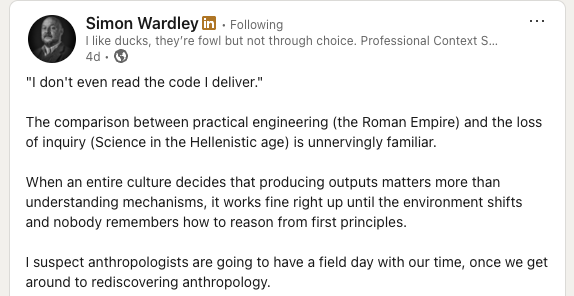
The conversation was ignited by Simon Wardley, a renowned technology strategist, who shared a deeply unsettling observation. He highlighted a growing trend in the tech industry: the construction of sophisticated systems without a comprehensive understanding of their underlying mechanisms. Wardley’s post resonated with many professionals who have witnessed firsthand the proliferation of “black box” technologies—systems so complex that even their creators struggle to explain their inner workings.
Wardley’s concern is not merely academic. He argues that this lack of understanding poses significant risks, particularly as these systems become increasingly critical to our infrastructure, economy, and daily lives. His post quickly gained traction, accumulating thousands of views and sparking a flurry of responses from across the tech community.
Adam Jacob’s Counterpoint: Embracing the New Paradigm
Adam Jacob, co-founder of Chef and a respected voice in the DevOps community, offered a nuanced response to Wardley’s concerns. Jacob acknowledged the validity of Wardley’s points but argued that the rise of artificial intelligence and advanced development frameworks represents a fundamental shift in how software is created. He contends that these tools, while abstracting away complexity, enable developers to achieve unprecedented levels of productivity and innovation.
Jacob’s perspective reflects a broader sentiment within the tech industry: that the benefits of these new tools outweigh the risks associated with reduced understanding of underlying mechanisms. He suggests that the role of the modern developer is evolving from one of deep technical expertise to one of orchestration and integration, leveraging powerful abstractions to build sophisticated systems.
Bruce Perens Weighs In: The Reality of Modern Complexity
Bruce Perens, a prominent open-source advocate and software developer, entered the fray with a perspective that bridges the gap between Wardley’s concerns and Jacob’s optimism. Perens argues that the scenario Wardley fears has, in many ways, already come to pass. He points out that modern CPU architectures, operating systems, and networking protocols contain such immense complexity that even seasoned developers often operate with incomplete mental models of how these systems truly function.
Perens’ contribution to the discussion is particularly valuable because it grounds the debate in the reality of modern software development. He suggests that while we should strive for deeper understanding, we must also acknowledge the practical limitations imposed by the sheer complexity of contemporary technology.
Louis Bucciarelli’s Timeless Wisdom: The Inherent Complexity of Technology
Adding historical depth to the conversation, Louis Bucciarelli, an MIT engineering professor, provided insights from his 1994 book Designing Engineers. Bucciarelli’s work, though predating the current AI revolution, offers a prescient analysis of the challenges inherent in understanding complex technological systems.
Through a compelling anecdote about a national conference on technological literacy, Bucciarelli illustrates the fundamental nature of technological complexity. He questions whether anyone truly understands how a telephone works, not just in terms of dialing a number, but in comprehending the intricate physics, algorithms, and corporate strategies that enable global communication.
Bucciarelli’s perspective is particularly relevant in today’s context, where systems like cloud computing, artificial intelligence, and the Internet of Things have added layers of complexity that would have been unimaginable in 1994. His work suggests that the challenge of understanding technology is not new, but rather an inherent characteristic of technological progress itself.
The Technical Interview Question That Reveals Our Limits
The discussion naturally led to a classic technical interview question: “What happens when you type a URL into your browser’s address bar and hit enter?” This question, often used to probe a candidate’s depth of knowledge, reveals the staggering complexity of even the most mundane digital interactions.
From the electrical signals generated by pressing a key to the intricate dance of DNS lookups, TCP handshakes, and HTTP requests, the journey of a single web request involves countless layers of abstraction and specialization. Few, if any, developers can claim to understand every aspect of this process, from the quantum mechanics of semiconductor physics to the high-level abstractions of modern web frameworks.
Brendan Gregg’s Approach: Embracing the Limits of Knowledge
The conversation took an interesting turn when Brendan Gregg, a renowned performance engineer, shared his approach to technical interviews. Gregg emphasizes the importance of identifying the limits of a candidate’s knowledge and observing how they respond when confronted with questions beyond their expertise.
This approach acknowledges a fundamental truth in the tech industry: no one understands the entire system all the way down. Gregg’s method values honesty and intellectual humility, recognizing that the ability to admit “I don’t know” is often more valuable than the ability to bluff through complex topics.
Synthesis: A Multifaceted Understanding of Technological Complexity
As the discussion unfolded on LinkedIn, it became clear that Wardley, Jacob, Perens, and Bucciarelli were all correct in their own ways. Their perspectives, while seemingly contradictory, actually represent different facets of the same fundamental challenge: how to navigate an increasingly complex technological landscape.
Wardley’s concerns about the dangers of building without understanding are valid and should not be dismissed. The history of technology is littered with examples of systems that failed catastrophically due to a lack of understanding of underlying principles. However, Jacob’s optimism about the potential of AI and advanced frameworks is equally justified. These tools have already demonstrated their ability to accelerate innovation and solve problems that would have been intractable just a few years ago.
Perens’ observation that we’ve already crossed the Rubicon of complexity is a sobering reminder of the practical limitations we face. And Bucciarelli’s historical perspective suggests that while the scale of complexity may have increased, the fundamental challenge of understanding technology has always been with us.
The Path Forward: Balancing Abstraction and Understanding
The consensus that emerges from this rich discussion is not a simple answer, but rather a call for a balanced approach to technological development. We must continue to push the boundaries of what’s possible with advanced tools and abstractions, while simultaneously striving to maintain a deeper understanding of the systems we build.
This balance might be achieved through several strategies:
-
Education and Training: Developing educational programs that emphasize both high-level concepts and low-level understanding, ensuring that new generations of technologists have a holistic view of the systems they work with.
-
Documentation and Transparency: Encouraging the creation of comprehensive documentation and open-source tools that make it easier for developers to peek under the hood when needed.
-
Interdisciplinary Collaboration: Fostering collaboration between specialists in different domains to create a more integrated understanding of complex systems.
-
Ethical Considerations: Incorporating ethical frameworks into the development process to ensure that the use of advanced tools and abstractions doesn’t lead to unintended negative consequences.
-
Continuous Learning: Promoting a culture of continuous learning and curiosity, where professionals are encouraged to explore beyond their immediate areas of expertise.
Conclusion: Embracing the Complexity of Our Digital Age
The rise of LinkedIn as a platform for serious technological discourse represents a silver lining in the post-Twitter era. It provides a space for nuanced discussions about the challenges and opportunities presented by our increasingly complex technological landscape.
The conversation sparked by Wardley, Jacob, Perens, and Bucciarelli reminds us that while we may never fully understand every aspect of the systems we build, we can strive for a deeper appreciation of their complexity. By embracing both the power of abstraction and the importance of understanding, we can navigate the challenges of our digital age with wisdom and foresight.
As we move forward, the tech community must continue to engage in these critical discussions, challenging our assumptions and pushing the boundaries of our knowledge. Only by doing so can we hope to build a future where technology serves humanity’s best interests, even as it grows ever more complex and powerful.
LinkedIn #TechDiscourse #SoftwareEngineering #ArtificialIntelligence #Complexity #Technology #Innovation #DevOps #OpenSource #SystemDesign #DigitalTransformation #FutureOfWork #TechLeadership #Engineering #Cybersecurity #CloudComputing #MachineLearning #WebDevelopment #TechTrends #DigitalAge
Nobody knows how the whole system works
The rise of LinkedIn as a social media site
Building things without understanding how they work
AI is changing the way software development gets done
Modern CPU architectures and operating systems contain significant complexity
The fundamental nature of complex technologies
Our knowledge of these systems will always be partial
The dangers of building without understanding underlying mechanisms
Magic in software development
Ruby on Rails and its use of magic
The evolution of the modern developer’s role
The reality of modern technological complexity
The inherent complexity of technology
Understanding how a telephone works
The complexity of typing a URL into a browser
The limits of human knowledge in technology
Brendan Gregg’s approach to technical interviews
The importance of admitting “I don’t know”
Balancing abstraction and understanding
Education and training in technology
Documentation and transparency in software development
Interdisciplinary collaboration in tech
Ethical considerations in technological development
Continuous learning in the tech industry
Navigating the challenges of our digital age
The power of abstraction in technology
The importance of understanding in software development
The future of technology and humanity
,


Leave a Reply
Want to join the discussion?Feel free to contribute!