
A horse’s whinny is unlike any other sound in nature
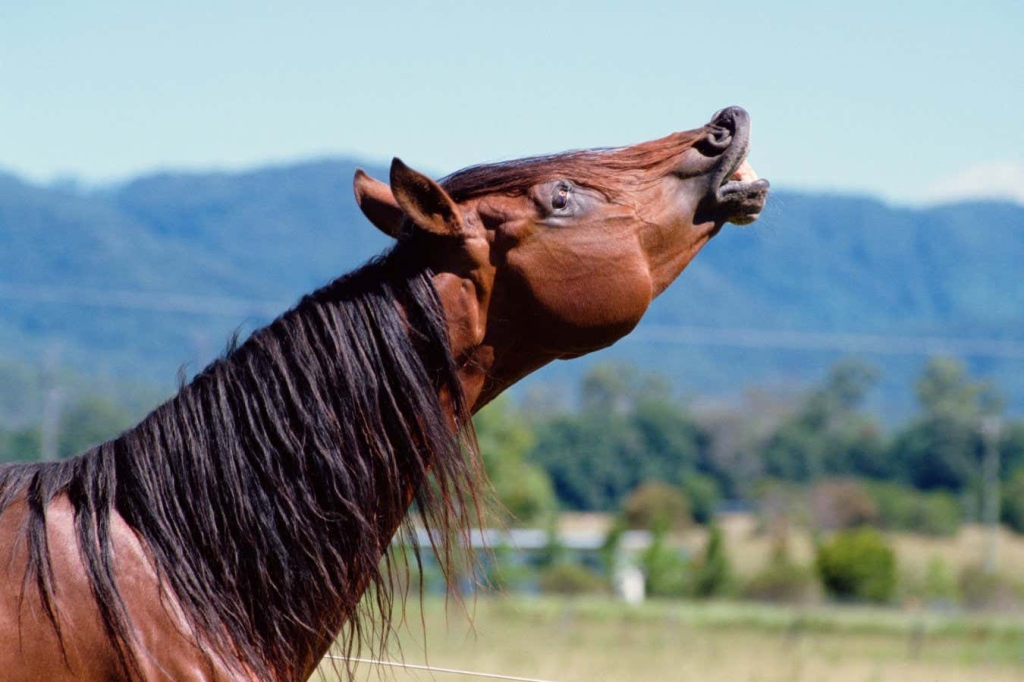
Title: The Equine Vocal Enigma: Scientists Unravel How Horses Produce Their Iconic Whinny
By [Your Name] | February 20, 2026
In a groundbreaking discovery that bridges centuries of human-horse coexistence, researchers have finally cracked the code behind one of nature’s most distinctive vocalizations—the horse’s whinny. This isn’t just any ordinary animal sound; it’s a marvel of acoustic engineering that has puzzled scientists for generations.
The Dual-Sound Mystery
For decades, equestrians, biologists, and casual observers have marveled at the complexity of a horse’s whinny. Unlike any other animal vocalization, the whinny contains two distinct frequencies produced simultaneously: a deep, resonant tone around 200 hertz (similar to a cow’s moo) and a piercing high-frequency whistle exceeding 1000 hertz. This phenomenon, known as biphonation, has remained one of nature’s best-kept secrets—until now.
“Horses have been our companions for over 4,000 years, yet we’re still uncovering the intricacies of how they communicate,” explains Tecumseh Fitch, lead researcher at the University of Vienna and one of the world’s foremost experts in bioacoustics. “This discovery represents a fundamental shift in our understanding of equine vocalization.”
The Laboratory Breakthrough
The research team’s journey to unravel this mystery began with an unconventional approach. Working with horse larynges obtained from a meat processing facility, the scientists embarked on a series of meticulous experiments that would ultimately reveal the secret mechanism.
Initial attempts to replicate the whinny proved frustrating. “When we first blew air through the larynges, we only heard the low-frequency component,” Fitch recalls. “It was like trying to solve a puzzle with half the pieces missing.” However, through careful manipulation and experimentation, the team discovered they could produce both frequencies using the larynx alone—a revelation that challenged previous assumptions about equine vocalization.
The Whistling Mechanism
The key to understanding the high-frequency component lies in a sophisticated aerodynamic process. When a horse whinnies, specialized muscles contract around the larynx, causing the glottis (the opening between the vocal folds) to narrow dramatically. This creates a slit-like aperture through which air is forced at high velocity.
“Think of it like blowing across the top of a bottle,” explains Fitch. “The faster the air moves through a narrow opening, the higher the pitch it produces.” This aerodynamic whistle mechanism is entirely different from how most animals produce sound, making horses unique among large mammals.
The Helium Experiment
To definitively prove their theory, the researchers conducted a series of experiments using helium gas—a classic technique in acoustic research. The results were unequivocal: while the low-frequency component remained unchanged, the high-frequency whistle shifted significantly upward when helium was used.
“The helium experiment was our smoking gun,” says Fitch. “It demonstrated conclusively that the high-frequency component behaves exactly like a whistle should, while the low-frequency component remains stable, just as we’d expect from vocal fold vibration.”
Beyond the Laboratory
The team didn’t stop at laboratory experiments. Using endoscopic cameras, they observed live horses during whinnying, capturing the precise muscular movements and anatomical changes that occur in real-time. These observations confirmed their laboratory findings and provided unprecedented insight into the dynamic nature of equine vocalization.
A Unique Place in the Animal Kingdom
While other animals can produce whistles—notably mice and rats—horses stand alone in their ability to combine laryngeal whistling with traditional vocal fold vibration. “Horses are the only mammal known to use the larynx to produce two frequencies simultaneously where one is a whistle,” Fitch emphasizes. “This makes them truly exceptional in the animal kingdom.”
Ben Jancovich, an independent researcher at the University of New South Wales who wasn’t involved in the study, calls the work “groundbreaking.” He notes that this is “the first strong, experimental evidence of an aerodynamic laryngeal whistle production in any animal outside the rodent family.”
The Evolutionary Advantage
While the research has definitively answered how horses produce their distinctive whinny, it has also raised new questions about why this ability evolved. The researchers speculate that the combination of low and high frequencies might serve several purposes: making the sound more noticeable over long distances, helping it cut through environmental noise, or conveying additional emotional or contextual information.
“These are fascinating hypotheses that we’re eager to explore,” says Fitch. “The dual-frequency nature of the whinny might provide horses with a more sophisticated communication system than we previously realized.”
Implications for Equine Science
This discovery has far-reaching implications for our understanding of horse behavior, welfare, and communication. By understanding the mechanics of the whinny, researchers can better interpret what horses are communicating through their vocalizations.
“For horse owners, trainers, and veterinarians, this knowledge could be invaluable,” notes Fitch. “Understanding the nuances of equine communication can lead to better care, improved training methods, and stronger human-horse relationships.”
Future Research Directions
The research team is already planning follow-up studies to explore several intriguing questions: How do different emotional states affect the balance between low and high frequencies? Can horses control which frequency dominates? How does this vocalization compare to other complex animal sounds?
“There’s still so much to learn,” Fitch says enthusiastically. “This discovery opens up an entirely new field of research into equine communication and cognition.”
The Bigger Picture
This breakthrough serves as a reminder that even in our modern age, nature still holds mysteries waiting to be uncovered. The fact that such a fundamental aspect of horse behavior remained unknown despite thousands of years of human-horse interaction underscores the complexity of animal communication.
As we continue to unravel these mysteries, we gain not only scientific knowledge but also a deeper appreciation for the sophistication of animal communication systems. The horse’s whinny, once thought to be a simple vocalization, has revealed itself to be a complex acoustic marvel—a testament to the wonders of evolution and the endless fascination of the natural world.
Tags: #HorseWhinny #EquineScience #Bioacoustics #AnimalCommunication #LaryngealWhistle #Biphonation #UniversityOfVienna #TecumsehFitch #HeliumExperiment #AnimalBehavior #VocalMechanics #EquestrianScience #NatureDiscovery #AcousticEngineering #WildlifeResearch #ViralScience #TrendingNow #MustRead #ScientificBreakthrough
Viral Sentences:
- “Scientists finally solve the 4,000-year-old mystery of how horses whinny!”
- “The horse’s whinny contains a secret whistle mechanism found nowhere else in nature!”
- “Helium gas reveals the hidden acoustic magic of equine vocalization!”
- “This discovery changes everything we thought we knew about horse communication!”
- “The only large mammal besides humans that can whistle using its larynx!”
- “A breakthrough that bridges ancient human-horse relationships with cutting-edge science!”
- “The aerodynamic whistle mechanism that makes horses truly unique in the animal kingdom!”
- “From laboratory experiments to live horse observations—the complete story of the whinny!”
- “Why the horse’s dual-frequency whinny might be nature’s most sophisticated animal call!”
- “The scientific discovery that’s making waves in the equestrian world and beyond!”
,

Leave a Reply
Want to join the discussion?Feel free to contribute!