
A huge cloud of dark matter may be lurking near our solar system
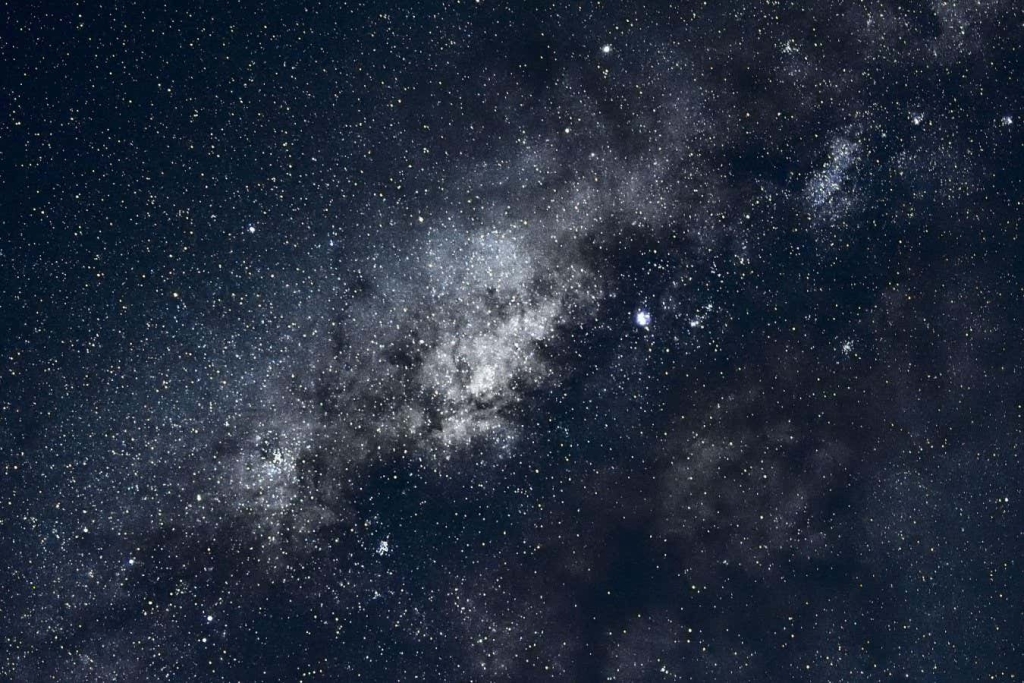
BREAKING: Scientists Detect Massive Dark Matter Cloud Lurking Near Our Solar System — And It Could Rewrite Everything We Know About the Universe
In a discovery that sounds straight out of a sci-fi blockbuster, astronomers have detected what appears to be a colossal cloud of dark matter lurking just over 3,000 light-years from Earth. This isn’t just any cosmic find—it could be the first confirmed sub-halo of dark matter ever observed in our galactic neighborhood, and it’s already sending shockwaves through the scientific community.
Dark matter, the invisible, elusive substance that makes up roughly 27% of the universe, has long been theorized to form vast halos around galaxies, with smaller sub-halos scattered throughout. But because dark matter doesn’t emit, absorb, or reflect light, these structures have remained frustratingly out of reach—until now.
The breakthrough came thanks to a cosmic detective tool: pulsars. These rapidly spinning neutron stars act like precise cosmic clocks, sweeping beams of light across the universe as they rotate. When two pulsars orbit each other, even the slightest gravitational tug from a massive object—like a dark matter sub-halo—can alter their dance. By analyzing these subtle changes, researchers led by Sukanya Chakrabarti at the University of Alabama in Huntsville uncovered something extraordinary.
“There’s one pair of pulsars and the pulsars around it—there’s something in this part of the sky that’s pulling all of these pulsars in this weird direction that we didn’t expect,” said Philip Chang, a team member from the University of Wisconsin-Milwaukee. The object in question is estimated to be 60 million times the mass of the sun and spans several hundred light-years across. Yet, when researchers cross-referenced its location with maps of stars, gas, and other visible matter, they found no matches. If it exists, it’s almost certainly dark matter.
This discovery is monumental for several reasons. First, it could be the only sub-halo of its size in our local galactic region. “There might only be one or two locally, but it depends on the model of dark matter,” explained Alice Quillen from the University of Rochester. Different models predict varying distributions of these clumps, and this find could help refine our understanding of dark matter’s true nature.
But the implications go even deeper. Chakrabarti and her team are now on a mission to map as many of these sub-halos as possible across the galaxy. “Our goal is to map out as many of these sub-halos as we can across the galaxy, and we’ve just started being able to do that. Then the ultimate goal is to understand the nature of dark matter,” she said.
The challenge? Pulsar binaries are rare, with only 27 pairs precise enough to measure gravitational acceleration. To expand their search, the team is exploring new methods to trace dark matter using more abundant cosmic objects. If successful, this could unlock a powerful new tool for probing one of the universe’s greatest mysteries.
As scientists continue to unravel the secrets of dark matter, this discovery serves as a reminder of how much we still have to learn about the cosmos. The invisible forces shaping our universe may be closer—and more influential—than we ever imagined.
Tags & Viral Phrases:
- Dark matter cloud detected near Earth
- Cosmic mystery solved with pulsars
- Invisible universe revealed
- 60 million solar masses of dark matter
- First confirmed dark matter sub-halo
- Rewriting the laws of physics
- Pulsars as cosmic detectives
- Hidden forces of the universe
- Groundbreaking dark matter discovery
- Universe’s invisible skeleton uncovered
- Science fiction becomes reality
- Dark matter mapped for the first time
- Pulsar pairs reveal cosmic secrets
- Galactic neighborhood holds dark secrets
- Dark matter halo breakthrough
- Cosmic clocks unlock universe’s mysteries
- Invisible matter finally detected
- Pulsars prove dark matter exists
- Dark matter sub-halo found 3,000 light-years away
- Scientists on the brink of dark matter breakthrough
,


Leave a Reply
Want to join the discussion?Feel free to contribute!