
After 20 Years, I Turned Off Google AdSense for My Websites
In the early days of the modern blogosphere, when RSS feeds were still a novelty and “Web 2.0” was the buzzword on every tech enthusiast’s lips, a young legal scholar named Eric Goldman decided to take a plunge into the wild, experimental world of online advertising. It was February 2005, and the digital landscape was a playground of possibility. Google AdSense had just launched, and bloggers everywhere were eager to monetize their passion projects. For Goldman, it wasn’t about striking it rich—it was about understanding the mechanics of the digital ad economy from the inside out.
“I wanted to make a little money and learn about the industry firsthand,” Goldman recalls. “If I was going to cover the nuances of online advertising, being an AdSense publisher would help me understand the issues from a publisher’s perspective.”
And what a time it was to dive in. The early days of AdSense were a gold rush. Some of Goldman’s first clicks paid a staggering $20 each—a far cry from the pennies-per-click reality that would come to define the industry. While he never became a millionaire from his blog, he did manage to earn around $1,000 a year at his peak. More importantly, he gained invaluable insights into how AdSense monetized content and how the digital advertising ecosystem functioned.
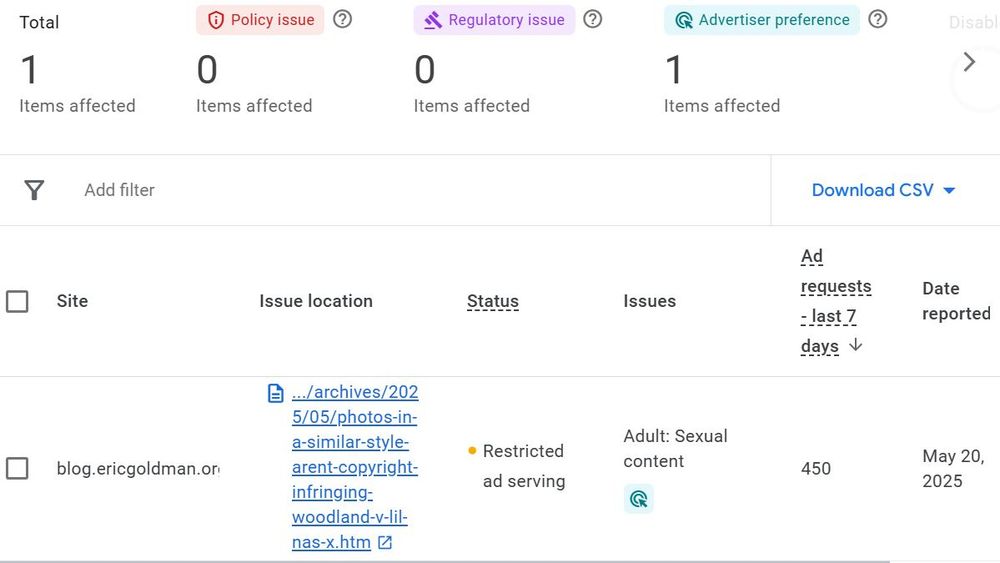
Fast forward two decades, and the landscape has shifted dramatically. What was once an exciting experiment has become a source of frustration and, ultimately, a decision to part ways. Today, Goldman earns a mere $100 a year from AdSense—a “de minimis” amount that hardly justifies the headaches. Worse still, he’s found himself repeatedly triggering Google’s content rules, a phenomenon he attributes to what he calls “Masnick’s Impossibility Theorem.” Named after Techdirt’s Mike Masnick, the theorem posits that content moderation at scale is fundamentally impossible to do well. For Goldman, this has meant constant battles with AdSense’s algorithms, which seem to flag his content for violations he can’t always anticipate or control.
But the issues go beyond algorithmic quirks. Readers have begun to complain about the intrusiveness and quality of the ads appearing on his blog. A couple of years ago, AdSense expanded its ad formats, overwhelming Goldman’s pages with clutter. In response, he reconfigured the settings to display just one modest square ad in the upper right corner. Yet, to his dismay, AdSense seemed to have a mind of its own, adding banner ads to the bottom of the page on web browsers and the top on mobile devices—ads he never approved and never wanted.
“I never saw most of the offending ads because of my adblocker,” Goldman admits. “But I shouldn’t have to constantly monitor AdSense’s changes.”
The final straw came when he realized that the ads could potentially classify his blog as “commercial” under various legal tests, exposing him to greater liability. With only $100 a year in ad revenue, the extra legal risk simply wasn’t worth it.
So, after 20 years of partnership, Goldman made the decision to delete all ericgoldman.org domains from AdSense. It’s a bittersweet moment, marking the end of an era. “It’s always a little bittersweet to end a 20-year-long vendor relationship,” he says. But for Goldman, the time has come to move on.
As he bids farewell to AdSense, Goldman leaves behind a legacy of curiosity, experimentation, and a deep understanding of the digital advertising landscape. His journey is a reminder of how much the internet has changed—and how the tools we once embraced can sometimes become the very things we need to let go.
Tags: Google AdSense, online advertising, blog monetization, content moderation, Masnick’s Impossibility Theorem, digital advertising, Eric Goldman, Web 2.0, ad intrusiveness, legal liability, tech nostalgia, blogging, AdSense experiment, adblocker, commercial vs. non-commercial content, digital ecosystem, 20-year journey, bittersweet farewell, tech evolution.
Viral Phrases: “The early days of AdSense were a gold rush,” “Masnick’s Impossibility Theorem,” “Content moderation at scale is fundamentally impossible,” “I shouldn’t have to constantly monitor AdSense’s changes,” “The time has come to move on,” “A bittersweet moment marking the end of an era,” “The tools we once embraced can sometimes become the very things we need to let go.”
,


Leave a Reply
Want to join the discussion?Feel free to contribute!