
After Earth’s Greatest Extinction, These Sea Monsters Conquered the Oceans
After Earth’s Greatest Extinction, These Sea Monsters Conquered the Oceans
In the wake of the most catastrophic extinction event in Earth’s history, a new era of oceanic dominance emerged. Roughly 250 million years ago, the planet was recovering from the Permian-Triassic extinction, which wiped out an estimated 96% of marine species and 70% of terrestrial vertebrates. But from the ashes of this devastation, a new breed of predator arose to conquer the world’s oceans with astonishing speed.
Recent discoveries in the fossil record have shed light on these ancient sea monsters, revealing a story of rapid global expansion and evolutionary success. The fossils, originally collected over 60 years ago from what is now an arid desert in northwestern Australia, have provided scientists with a unique window into this pivotal moment in Earth’s history.
At the time these creatures roamed the seas, the Australian landscape was vastly different. The region that is now a dry, inhospitable desert was once situated beside a shallow bay connected to a vast prehistoric ocean. This ancient marine environment served as the cradle for some of the earliest ocean predators, setting the stage for their eventual global conquest.
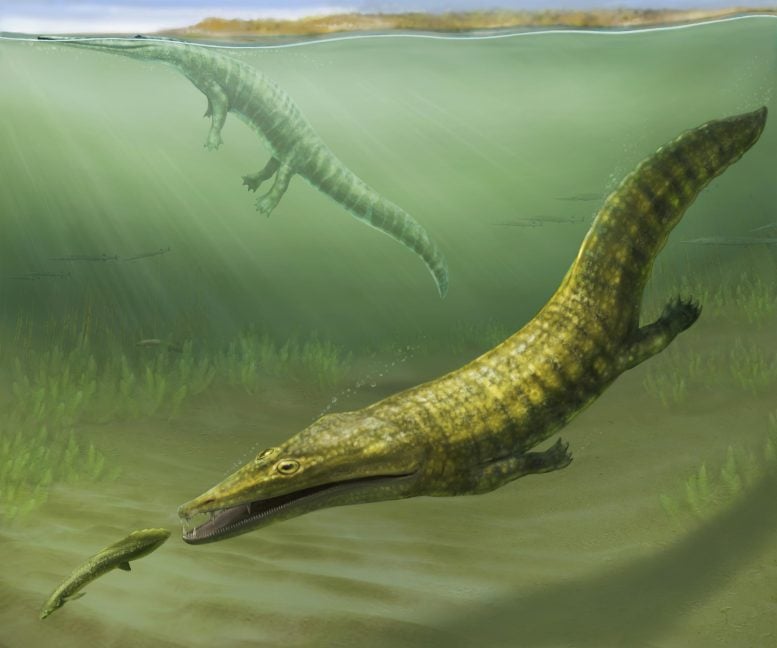
These sea monsters were not your typical marine reptiles. They were part of a group known as temnospondyls, ancient amphibians that had adapted to life in the water. With elongated bodies, powerful tails, and rows of sharp teeth, these creatures were perfectly suited to become the apex predators of their time.
The fossils discovered in Australia represent some of the earliest known examples of these marine amphibians. Their presence in this region suggests that they quickly spread across the globe following the Permian-Triassic extinction, taking advantage of the ecological niches left vacant by the mass die-off.
What makes this discovery particularly remarkable is the speed at which these creatures colonized the world’s oceans. In geological terms, their global expansion occurred almost overnight. This rapid dispersal speaks to the resilience and adaptability of these ancient amphibians, as well as the unique conditions that existed in the aftermath of Earth’s greatest extinction event.
The Permian-Triassic extinction, also known as the “Great Dying,” was likely caused by a combination of factors, including massive volcanic eruptions, climate change, and ocean acidification. These catastrophic events created a “clean slate” in the world’s oceans, allowing for the rapid evolution and diversification of new species.
For the temnospondyl amphibians, this presented an unprecedented opportunity. With many of their competitors and predators wiped out, they were able to exploit new food sources and habitats, quickly spreading to every corner of the globe. Their success in these early post-extinction oceans set the stage for the eventual rise of other marine reptiles, including ichthyosaurs and plesiosaurs, in the following Mesozoic Era.
The discovery of these Australian fossils has also provided valuable insights into the evolutionary history of amphibians. While modern amphibians are generally small and restricted to freshwater environments, these ancient relatives demonstrate the group’s potential for large size and marine adaptation. This finding challenges our understanding of amphibian evolution and highlights the diverse ecological roles these creatures have played throughout Earth’s history.
Moreover, the rapid global expansion of these sea monsters serves as a stark reminder of the profound impact that mass extinction events can have on the trajectory of life on Earth. In the wake of catastrophe, new opportunities arise for surviving species to diversify and conquer new environments. This pattern has repeated itself throughout Earth’s history, from the rise of mammals after the dinosaur extinction to the potential for new species to emerge in the face of current climate change and biodiversity loss.
As scientists continue to study these ancient fossils, they are not only uncovering the secrets of Earth’s past but also gaining valuable insights into the processes that shape the evolution of life on our planet. The story of these sea monsters serves as a testament to the resilience of life in the face of adversity and the incredible adaptability of species in the wake of global catastrophes.
In conclusion, the discovery of these ancient marine amphibians in Australia has provided a fascinating glimpse into a critical period of Earth’s history. Their rapid global expansion in the aftermath of the Permian-Triassic extinction demonstrates the profound impact that mass extinction events can have on the course of evolution, creating new opportunities for surviving species to diversify and conquer new environments. As we continue to face environmental challenges in the modern world, the story of these sea monsters serves as both a warning and an inspiration, reminding us of the incredible resilience of life and the potential for new forms of biodiversity to emerge from even the most catastrophic events.
Tags:
Ancient sea monsters
Permian-Triassic extinction
Marine amphibians
Fossil discoveries
Evolutionary history
Ocean predators
Global expansion
Resilience of life
Mass extinction events
Biodiversity
Climate change
Adaptation
Ecological niches
Prehistoric oceans
Temnospondyls
Marine reptiles
Ichthyosaurs
Plesiosaurs
Mesozoic Era
Australian fossils
Earth’s history
Evolutionary success
Catastrophic events
Ocean acidification
Volcanic eruptions
Diversification of species
Ecological roles
Modern amphibians
Freshwater environments
Large size adaptation
Marine adaptation
Evolutionary trajectory
Global catastrophes
Environmental challenges
New forms of biodiversity
Scientific discoveries
Paleontology
Marine biology
Earth sciences
Prehistoric life
Extinction recovery
Oceanic dominance
Ancient ecosystems
Fossil record
Geological history
Climate change impact
Species resilience
Adaptive radiation
Post-extinction environments
Ecological succession
Marine biodiversity
Evolutionary innovation
Prehistoric Australia
Shallow bay ecosystems
Ancient marine environments
Rapid dispersal
Apex predators
Sharp teeth adaptation
Elongated body evolution
Powerful tail development
Ecological opportunity
Evolutionary radiation
Post-catastrophe recovery
Life’s resilience
Environmental adaptation
Species diversification
Marine ecosystem recovery
Evolutionary breakthroughs
Ancient amphibian success
Ocean conquest
Global marine expansion
Prehistoric predator rise
Extinction aftermath
Biodiversity explosion
Marine life evolution
Ancient ecosystem dynamics
Fossil evidence
Scientific breakthrough
Evolutionary milestone
Prehistoric marine adaptation
Amphibian evolutionary potential
Marine ecological niches
Post-extinction opportunities
Rapid evolutionary success
Ancient marine biodiversity
Prehistoric ocean dominance
Evolutionary resilience
Catastrophic recovery
Marine life adaptation
Ancient predator expansion
Global ecological impact
Prehistoric marine revolution
Extinction-driven evolution
Marine ecosystem transformation
Ancient life adaptation
Evolutionary opportunity
Post-catastrophe biodiversity
Marine evolutionary success
Prehistoric ecological conquest,


Leave a Reply
Want to join the discussion?Feel free to contribute!