
AI evolves from efficiency tool to strategic HR partner, drives smarter talent development · TechNode
From Efficiency Tool to Strategic Partner: How AI is Reshaping the Future of HR
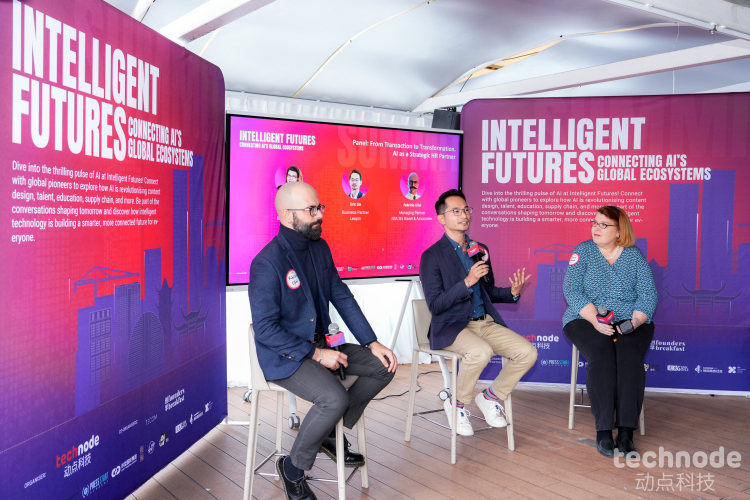
Last week in Hangzhou, the Intelligent Futures: AI’s Global Ecosystems conference, organized by TechNode and co-organized by TECOM and Founders Breakfast, brought together thought leaders to explore one of the most transformative questions facing modern organizations: How is AI evolving from a transactional tool into a true driver of organizational transformation?
The panel discussion “From Transaction to Transformation: AI as a Strategic HR Partner” featured an impressive lineup of experts who collectively painted a picture of AI’s expanding role in human resources and organizational development. Eric Lin from LeapIn, Jessica Gleeson of BrighterBeauty, and Fabrizio Ulivi from SBA Shi Bisset & Associates represented diverse professional backgrounds but shared a remarkably unified vision: AI is no longer just about automating tasks—it’s accelerating performance improvement, enhancing decision-making quality, and democratizing talent development across organizations.
The Efficiency Revolution: AI as a Capability Builder
The past 18 months have witnessed an explosion in AI adoption within companies. What began as simple automation of administrative workflows has evolved into something far more profound—AI is now enhancing employee capabilities and driving measurable business outcomes.
Fabrizio Ulivi highlighted one of AI’s most significant contributions: its ability to accelerate processes that traditionally consumed enormous amounts of organizational resources. In learning and development, for instance, AI can now generate personalized growth pathways that align precisely with individual employee capabilities and organizational needs. This isn’t just about saving time—it’s about improving the return on training investments by ensuring that every learning hour contributes directly to performance improvement.
Eric Lin provided a concrete example from the recruitment trenches that illustrated this efficiency revolution. Traditional HR teams spent countless hours manually sifting through resumes—a repetitive, mind-numbing task that drained human potential. Today, AI handles initial screening, freeing HR professionals from administrative drudgery and allowing them to focus on what truly matters: deep conversations with candidates, assessing cultural fit, and making nuanced judgments about human potential.
“HR professionals shouldn’t waste time on tasks like flipping through a resume in three seconds,” Lin emphasized. “Their real value lies in evaluating the match between people and the organization.” This shift represents a fundamental reimagining of HR’s role—from administrative gatekeepers to strategic talent partners.
The Bias Paradox: AI as a Mirror, Not a Solution
Perhaps the most thought-provoking moment of the discussion came when Jessica Gleeson addressed the widely debated question of whether AI can reduce bias in hiring and talent evaluation. Her perspective challenged conventional wisdom: AI doesn’t reduce bias—it helps organizations structure it.
Gleeson explained that every organization carries its own set of criteria about “what kind of people we need.” AI doesn’t eliminate these biases; instead, it helps companies articulate and execute their standards more clearly. “Bias isn’t the problem—the problem is being unaware of its existence,” she stated, reframing the entire conversation about AI and fairness.
However, Gleeson offered a crucial caveat that should give every HR leader pause. After using AI to filter candidates, organizations must ask themselves a critical reverse question: “Who is being filtered out by AI, and could their unique experience actually be more valuable?” This insight transforms AI from a decision-maker into what it should be—an assistive tool that enhances human judgment rather than replacing it.
The panel’s consensus was clear: human judgment remains irreplaceable, even in an AI-augmented world. The technology serves as a powerful amplifier of human capability, not a substitute for human wisdom.
Transforming Workplace Interactions: AI as a Support System
Jessica Gleeson believes that AI’s true power lies in its ability to improve the quality of human-to-human interactions. She described intelligent interview assistants that can listen in on interviews in real time and, based on predefined hiring criteria, prompt interviewers with follow-up questions. This seemingly simple enhancement allows interviewers to focus entirely on the candidate rather than juggling note-taking and question frameworks.
In performance coaching, AI can help coaches and coachees identify blind spots more quickly, analyze skill gaps, and generate structured objectives. “When AI helps humans prepare better,” Gleeson explained, “the interactions between people become more purposeful.” This represents a fundamental shift in how we think about technology in the workplace—not as a replacement for human connection, but as an enabler of deeper, more meaningful interactions.
HR as the Conscience of AI Ethics and Culture
As AI becomes increasingly integrated into the workplace, the panelists agreed that HR’s role is evolving dramatically. Beyond managing processes, HR will serve as the organization’s conscience and counterbalance—guiding culture, people development, and the responsible use of AI. They must balance business objectives with employee well-being, ensuring technology enhances rather than undermines organizational culture and the employee experience.
The message was unequivocal: AI is not a replacement for HR professionals or managers. Instead, it allows organizations to focus their time and resources on initiatives that genuinely improve performance. Efficiency is only the starting point; AI’s deeper value lies in helping organizations learn faster, make better decisions, and develop talent more equitably.
The Future is Human-Augmented, Not Human-Replaced
The panel’s insights reveal a future where AI and human capability exist in symbiosis rather than competition. Organizations that embrace this partnership—using AI to handle routine tasks while elevating human potential to focus on strategic, creative, and interpersonal work—will gain a significant competitive advantage.
The transformation from transaction to transformation isn’t just about technology adoption; it’s about reimagining what’s possible when human judgment is amplified by artificial intelligence. As one panelist noted, the organizations that will thrive in this new era are those that use AI not to replace humans, but to make humans better at being human.
Tags: AI in HR, artificial intelligence recruitment, workplace transformation, HR technology trends, bias in AI hiring, employee development, organizational transformation, AI ethics, future of work, talent acquisition, performance coaching, learning and development, human resources innovation, AI-powered recruitment, workplace efficiency, strategic HR, employee experience, AI decision-making, talent management, organizational culture
Viral Sentences: AI doesn’t reduce bias—it helps organizations structure it. HR professionals shouldn’t waste time on tasks like flipping through a resume in three seconds. The problem isn’t bias—it’s being unaware of its existence. When AI helps humans prepare better, the interactions between people become more purposeful. AI is not a replacement for HR or managers. The true power of AI lies in its ability to improve the quality of human-to-human interactions. Efficiency is only the starting point; AI’s deeper value lies in helping organizations learn faster.
,

Leave a Reply
Want to join the discussion?Feel free to contribute!