
ALS stole this musician’s voice. AI let him sing again.
The AI-Powered Comeback: How Technology Gave a Musician His Voice Back
In a story that blurs the lines between human resilience and technological innovation, musician Patrick Darling has made an extraordinary return to music after losing his ability to sing and play instruments to a degenerative disease. Using artificial intelligence, Darling has re-created his voice and composed new songs, marking what many are calling a watershed moment in the intersection of music and AI.
The Final Performance
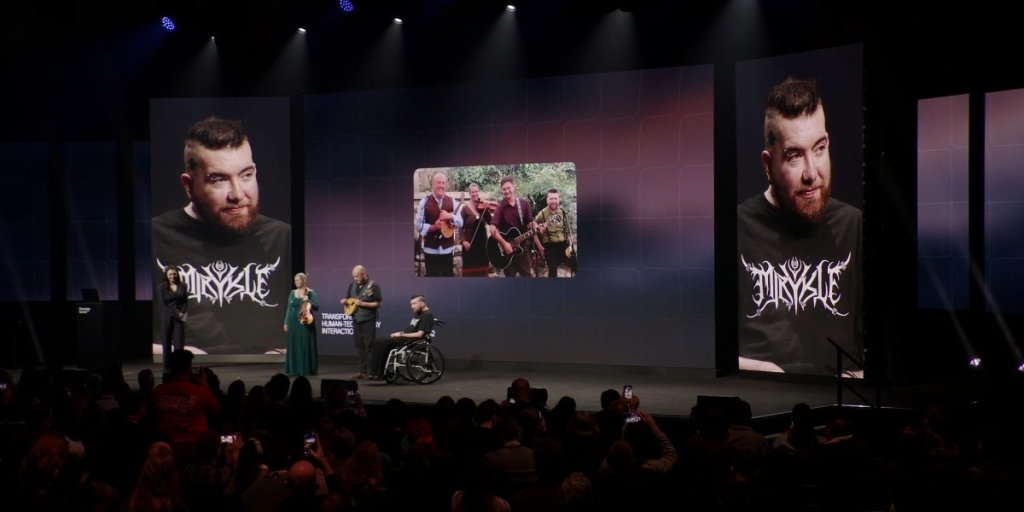
Darling’s last stage appearance was over two years ago, a bittersweet moment that marked the end of an era for both him and his bandmates. By that point, the disease had already robbed him of his ability to stand and play his instruments, and he was struggling to sing or even speak clearly. The performance was emotional, with his bandmates physically carrying him on stage for what they all knew would be their final show together.
“I sadly have lost the ability to sing and play my instruments,” Darling revealed during a recent event in London, speaking through his AI-generated voice clone. “Despite this, most of my time these days is spent still continuing to compose and produce my music. Doing so feels more important than ever to me now.”
A Life Dedicated to Music
Darling’s musical journey began in his teenage years when he was around 14 years old. What started as a passion quickly evolved into a lifelong dedication to music. Over the years, he mastered an impressive array of instruments including bass guitar, acoustic guitar, piano, melodica, mandolin, and tenor banjo.
“My biggest love, though, was singing,” Darling reflected during his presentation.
His musical path took a significant turn over a decade ago when he met Nick Cocking while still a university student. Cocking, who was leading an Irish folk outfit called the Ceili House Band, recognized Darling’s exceptional talent immediately. Darling joined the band as a singer and guitarist, and according to Cocking, he “elevated the musicianship of the band” from their very first performance together in April 2014.
The First Signs of Trouble
The decline was gradual at first, with subtle changes that might have gone unnoticed by casual observers. Cocking recalls the early warning signs becoming apparent during their performances and rehearsals. One particularly memorable incident occurred during a rainy night in Cardiff when the band had to walk across the city.
“He just kept slipping and falling, tripping on paving slabs and things like that,” Cocking remembers. At the time, it seemed like nothing more than clumsiness, but as the symptoms persisted and worsened, the reality became impossible to ignore.
The disease progressed methodically, affecting different parts of Darling’s body in succession. It began with his legs, forcing him to start sitting during performances by August 2023. Then it claimed his hands, robbing him of the ability to play guitar or banjo. Finally, it attacked his vocal cords and respiratory system, making it difficult to talk and breathe simultaneously.
By April 2024, the band had to physically carry Darling on stage for his final performance. “He called me the day after and said he couldn’t do it anymore,” Cocking recalls, his voice breaking with emotion. “By June 2024, it was done.”
The Voice Banking Solution
In what would prove to be a turning point, Darling was connected with a speech therapist who introduced him to the concept of “voice banking.” This process involves recording oneself speaking extensively, creating a database of vocal samples that can later be used to generate speech when natural speaking becomes impossible.
For many people facing similar challenges, voice banking provides a way to maintain some level of verbal communication through text-to-speech technology. However, for a musician like Darling, the implications went far beyond simple communication—it represented a potential pathway back to his true passion.
The AI Revolution in Music Creation
The breakthrough came when Darling’s voice recordings were fed into sophisticated AI algorithms capable of learning and replicating his unique vocal characteristics. The technology analyzed the nuances of his speech patterns, tone, pitch, and emotional inflections, creating what’s known as a “voice clone.”
But the innovation didn’t stop at voice replication. Advanced AI tools enabled Darling to use this digital voice to compose entirely new songs. The system could interpret his musical ideas, translate them into compositions, and perform them using his cloned voice, effectively allowing him to create music despite his physical limitations.
This technological intervention has transformed Darling’s creative process. No longer constrained by his physical condition, he can focus entirely on the artistic aspects of music creation. The AI handles the execution, bringing his musical visions to life with a voice that sounds remarkably like his own.
A New Chapter in Musical Expression
Darling’s story represents more than just a personal triumph over adversity—it signals a potential paradigm shift in how we think about musical creation and artistic expression. The technology that has given him back his voice could open doors for countless other musicians facing similar challenges, from degenerative diseases to temporary injuries.
The implications extend beyond individual cases. As AI voice cloning technology continues to advance, questions arise about authenticity, artistic ownership, and the nature of musical performance itself. Can a song composed and performed by AI using a cloned voice be considered the same as one created through traditional means? Does the emotional authenticity remain intact when the physical connection between artist and instrument is mediated by technology?
The Human Element
Despite the technological marvel at the heart of this story, those closest to Darling emphasize that the human element remains paramount. Cocking, reflecting on their years of collaboration, speaks of Darling’s musical intuition, his ability to elevate the entire band’s performance, and the deep personal connection they shared through their music.
“The musicianship he brought to the band was extraordinary,” Cocking says. “Even now, seeing him able to create again through this technology, it’s not just about the music—it’s about preserving who he is as an artist and as a person.”
Darling himself seems to view the technology as an extension of his artistic identity rather than a replacement for it. His continued dedication to composing and producing music, even in the face of overwhelming physical challenges, speaks to the fundamental role that creative expression plays in his life.
Looking Forward
As Darling continues to explore the possibilities offered by AI-assisted music creation, his story serves as both inspiration and a glimpse into the future of artistic expression. The technology that has given him back his voice is rapidly evolving, with implications that reach far beyond the realm of individual musicians.
For the music industry, this development raises important questions about the role of technology in creative processes, the preservation of artistic legacies, and the accessibility of musical expression for those facing physical limitations. For musicians and fans alike, it offers a compelling vision of how technology might enhance rather than replace the human elements of artistic creation.
Darling’s journey from losing his voice to finding it again through artificial intelligence is more than just a technological success story—it’s a testament to the enduring power of human creativity and the remarkable ways in which technology can serve as a bridge between limitation and expression.
The Ceili House Band may have played their final show together in the traditional sense, but through the fusion of human artistry and artificial intelligence, their musical journey continues in ways that none of them could have imagined just a few years ago. In Darling’s own words, “Doing so feels more important than ever to me now”—a simple statement that carries profound implications for the future of music and the limitless potential of human creativity when augmented by technology.
Tags & Viral Phrases
AI voice cloning technology, musician overcomes disability, technology gives back voice, artificial intelligence in music creation, degenerative disease doesn’t stop artist, voice banking breakthrough, AI-powered musical comeback, technology meets human resilience, musician’s extraordinary return, digital voice clone creates new songs, the future of music creation, human creativity enhanced by AI, musical innovation through technology, overcoming physical limitations with AI, voice replication technology, AI transforms music industry, preserving artistic expression through technology, musician’s journey from loss to innovation, the intersection of music and artificial intelligence, technology as a bridge to creativity, AI-assisted composition, voice cloning for artists, the new era of musical expression, human spirit meets technological advancement, AI gives musician second chance, revolutionary music technology, preserving legacy through AI, the democratization of music creation, technology empowers disabled artists, the future sounds human, AI and authentic artistic expression, musical innovation story, technology that changes lives, the evolution of creative tools, AI as artistic collaborator, the next generation of music production, human creativity amplified by technology, the power of voice banking, AI transforms creative industries, the resilience of the human spirit, technology preserving musical heritage, AI-enabled artistic expression, the future of accessible music creation, human ingenuity meets artificial intelligence, the new frontier of musical innovation, technology that gives back what was lost, AI and the preservation of artistic identity, the democratization of musical expression, technology as artistic enabler, the evolution of creative possibility, AI and the future of human creativity.
,

Leave a Reply
Want to join the discussion?Feel free to contribute!