
Amazon halts Blue Jay robotics project after less than 6 months
Amazon Halts Blue Jay Warehouse Robot Project Months After High-Profile Launch
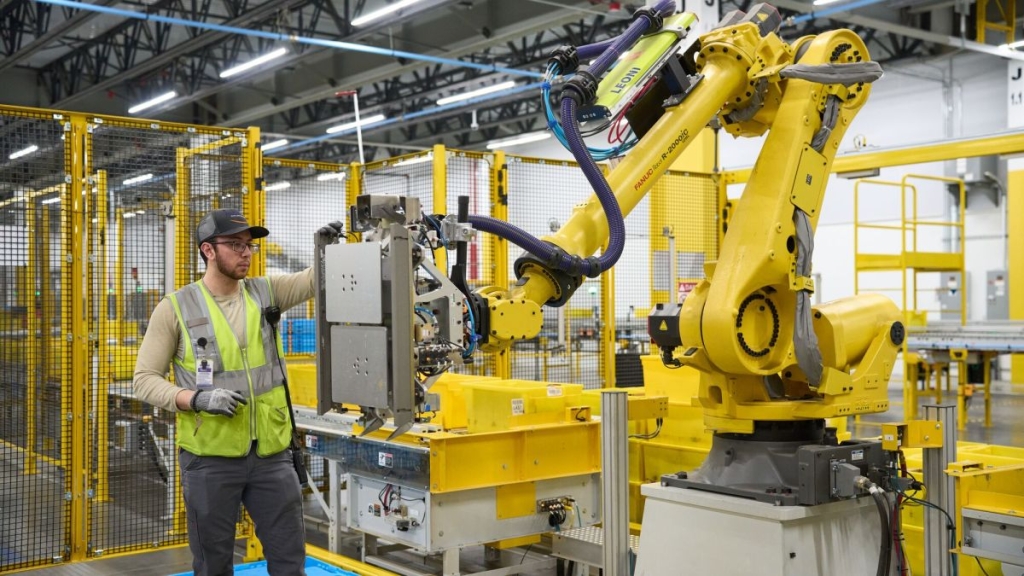
In a surprising turn of events, Amazon has pulled the plug on its ambitious Blue Jay warehouse robotics initiative, just months after showcasing the technology as a breakthrough in automated logistics. The multi-armed robot, designed to sort and transport packages with unprecedented efficiency, was unveiled in October 2025 as a centerpiece of Amazon’s same-day delivery operations. However, the e-commerce giant has now confirmed to TechCrunch that the project has been discontinued, raising questions about the challenges of deploying cutting-edge robotics at scale.
Blue Jay was introduced with considerable fanfare, with Amazon touting its ability to revolutionize warehouse operations. The robot, equipped with multiple arms, was engineered to handle the complex task of sorting and moving packages with precision and speed. At the time of its launch, Amazon revealed that Blue Jay had been developed in just about a year—a remarkably short timeline compared to the years typically required for such advanced robotics. The company credited this accelerated development to breakthroughs in artificial intelligence, which enabled the robot to adapt to the dynamic and unpredictable environment of a warehouse.
Despite the initial optimism, Amazon has now acknowledged that Blue Jay was always intended as a prototype. This clarification came after Business Insider first reported the project’s cancellation, and Amazon spokesperson Terrence Clark confirmed the decision to TechCrunch. Clark emphasized that while Blue Jay itself may not have made it to full-scale deployment, the underlying technology developed for the project is far from wasted. Instead, Amazon plans to repurpose the core innovations for other robotics “manipulation programs” across its vast network of fulfillment centers.
The decision to halt Blue Jay underscores the inherent risks and uncertainties in the rapidly evolving field of warehouse automation. Amazon, which has been a pioneer in integrating robotics into its operations since acquiring Kiva Systems in 2012, has long been at the forefront of this technological revolution. The company’s robotics program has grown exponentially, with over 1 million robots now deployed across its warehouses as of July 2025. These robots have played a crucial role in enhancing efficiency, reducing operational costs, and improving working conditions for employees.
However, the discontinuation of Blue Jay serves as a reminder that not every innovation will succeed, even for a company as resource-rich and technologically advanced as Amazon. The robotics industry is notoriously challenging, with developers often facing unforeseen technical hurdles, scalability issues, and the need to balance automation with human labor. In this context, Amazon’s willingness to experiment and pivot when necessary is a testament to its commitment to continuous improvement and innovation.
While Blue Jay may not have become a permanent fixture in Amazon’s warehouses, the company’s robotics efforts are far from slowing down. In fact, Amazon has been doubling down on its investments in automation, recently unveiling Vulcan, a two-armed robot designed for use in the storage compartments of its warehouses. Vulcan represents a significant leap forward in robotic capabilities, featuring one arm for rearranging and moving items within compartments and another equipped with a camera and suction cups for grabbing goods. What sets Vulcan apart is its ability to “feel” objects through advanced tactile sensing, a feature trained on real-world interaction data. This innovation highlights Amazon’s ongoing efforts to push the boundaries of what warehouse robots can achieve.
The cancellation of Blue Jay also raises broader questions about the future of automation in logistics. As companies like Amazon continue to invest heavily in robotics, the industry is likely to see a mix of successes and setbacks. The key will be learning from failures and leveraging the insights gained to drive future innovations. For Amazon, the lessons from Blue Jay will undoubtedly inform its approach to developing the next generation of warehouse robots, ensuring that the company remains at the cutting edge of automation technology.
In the end, Amazon’s decision to halt Blue Jay is not a sign of retreat but rather a strategic recalibration. By repurposing the technology and redirecting resources to other projects, Amazon is demonstrating its agility and resilience in the face of challenges. As the company continues to refine its robotics programs, the ultimate goal remains clear: to create a safer, more efficient, and more engaging work environment for its employees while delivering unparalleled service to its customers. The story of Blue Jay may have come to an end, but the broader narrative of Amazon’s robotics revolution is far from over.
Tags
Amazon, Blue Jay, warehouse robotics, automation, artificial intelligence, logistics, Vulcan, Kiva Systems, fulfillment centers, robotics innovation, same-day delivery, warehouse efficiency, tactile sensing, manipulation programs, prototype, scalability, warehouse automation, tech industry, e-commerce, operational efficiency.
Viral Sentences
- Amazon pulls the plug on Blue Jay robot just months after its high-profile launch.
- Blue Jay was developed in record time—just one year—thanks to AI breakthroughs.
- Amazon’s robotics program now boasts over 1 million robots in its warehouses.
- The company plans to repurpose Blue Jay’s technology for other robotics initiatives.
- Vulcan, Amazon’s latest robot, can “feel” objects with advanced tactile sensing.
- Amazon acquired Kiva Systems in 2012, laying the foundation for its robotics empire.
- The discontinuation of Blue Jay highlights the challenges of scaling cutting-edge robotics.
- Amazon’s robotics efforts aim to create safer, more efficient, and more engaging workplaces.
- The future of warehouse automation is a mix of successes, setbacks, and continuous innovation.
- Amazon’s agility in pivoting from Blue Jay underscores its commitment to technological advancement.
,


Leave a Reply
Want to join the discussion?Feel free to contribute!