
AMD Engineer Leverages AI To Help Make A Pure-Python AMD GPU User-Space Driver
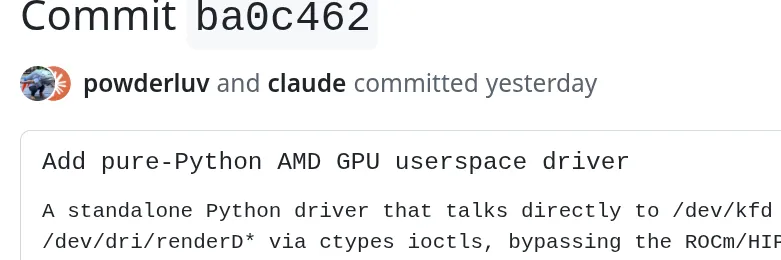
AMD’s VP of AI Software Crafts Revolutionary Pure-Python GPU Driver Using Claude Code
In a groundbreaking development that’s sending shockwaves through the tech industry, AMD’s Vice President of AI Software, Anush Elangovan, has successfully created a pure-Python AMD GPU user-space driver using Claude Code, marking a potential paradigm shift in how we approach GPU driver development.
The project, which began as a modest experiment, has rapidly evolved into a sophisticated piece of software that demonstrates the incredible potential of AI-assisted programming. Elangovan’s work showcases not just technical prowess but also a visionary approach to software development that could democratize access to GPU programming and accelerate innovation across the industry.
The Genesis of an AI-Powered Revolution
The inspiration for this project came from Tinygrad’s user-space AMD GPU driver implementation, but what Elangovan has accomplished goes far beyond simple imitation. By leveraging Claude AI’s capabilities, he’s created a user-space driver specifically designed for stress testing SDMA (System Direct Memory Access) and debugging compute/communications overlap.
What makes this achievement particularly remarkable is Elangovan’s declaration on social media platform X: “I didn’t open the editor once. [AI] Agents are the great equalizer in software. And Speed is the moat.” This statement encapsulates the revolutionary nature of the project – a high-level software component created without traditional coding methods.
Technical Deep Dive: What Makes This Driver Special
The Python-based driver communicates directly with /dev/kfd and /dev/dri/renderD* through ctypes ioctls, effectively bypassing the traditional ROCm/HIP user-space stack. This approach offers several advantages:
KFD Backend Architecture: The driver features a pluggable architecture that currently supports KFD backend, with plans for future bare-metal PCI (AM) backend implementation.
Comprehensive Feature Set: The driver includes:
- Complete KFD ioctl bindings for queue management, memory operations, and events
- GPU family registry supporting RDNA2/3/4 and CDNA2/3 architectures
- SDMA copy engine with linear copy capabilities and fence packets
- PM4 compute packet builder for dispatch operations and release_mem functionality
- Timeline semaphore for precise GPU-CPU synchronization
- Topology parser for /sys/devices/virtual/kfd/kfd
- ELF code object parser for efficient kernel loading
Testing and Validation: The driver has successfully passed 130 tests, including both unit and integration tests on MI300X/gfx942 hardware, demonstrating its robustness and reliability.
Evolution and Expansion
Since its initial development, the pure-Python driver has undergone significant enhancements. Over the past two days alone, it has gained:
- Multi-GPU support, enabling complex distributed computing scenarios
- Compute-bound kernel support, expanding its applicability to demanding workloads
- Additional functionality that continues to broaden its capabilities
The AI Factor: Claude Code’s Role
The use of Claude Code in this project represents a fascinating case study in AI-assisted development. By providing intelligent code suggestions, debugging assistance, and architectural guidance, Claude Code enabled Elangovan to focus on high-level design decisions while the AI handled many of the implementation details.
This collaboration between human expertise and AI capabilities suggests a future where software development becomes more accessible and efficient, potentially reducing the barrier to entry for complex system-level programming.
Industry Implications
The creation of this Python GPU driver has far-reaching implications for the tech industry:
Democratization of Driver Development: By demonstrating that complex GPU drivers can be created using high-level languages and AI assistance, this project could open doors for a new generation of developers to contribute to driver development.
Rapid Prototyping: The speed at which this driver was developed suggests that AI-assisted development could dramatically accelerate the pace of innovation in hardware-software interaction.
Education and Research: The Python-based approach makes the driver more accessible for educational purposes and research, potentially fostering greater understanding of GPU architectures and driver development.
Future Prospects
As work on this Python-based AMD GPU user-space driver continues, the tech community eagerly anticipates what comes next. Will this approach be extended to other hardware platforms? Could it lead to a new generation of more accessible, more maintainable drivers?
The project is currently being developed through a dedicated GitHub branch, and the open-source nature of the work suggests that the broader community may soon have the opportunity to contribute to and build upon this groundbreaking foundation.
What Anush Elangovan and Claude Code have demonstrated is not just a new tool or technique, but a glimpse into a future where the boundaries between human creativity and artificial intelligence in software development become increasingly blurred. As we stand on the brink of this new era, one thing is clear: the landscape of GPU driver development – and perhaps software development as a whole – will never be the same.
Tags:
AMD #Python #GPU #Driver #AI #ClaudeCode #ROCm #HIP #SDMA #Compute #SoftwareDevelopment #TechInnovation #MachineLearning #Hardware #OpenSource #FutureOfProgramming
Viral Phrases:
- AI agents are the great equalizer in software
- Speed is the moat
- Pure-Python GPU driver
- Bypassing traditional ROCm/HIP stack
- 130 tests passing on MI300X
- Multi-GPU support in Python
- Compute-bound kernel in pure Python
- Democratization of driver development
- Future of GPU programming
- AI-assisted software development
- Revolutionary approach to GPU drivers
- Breaking barriers in hardware programming
- The new era of software development
- Human-AI collaboration in coding
- Accessible GPU development
- Rapid prototyping revolution
- Educational breakthrough in GPU programming
- Open-source innovation
- Tech industry shockwave
- Paradigm shift in driver development
,
Leave a Reply
Want to join the discussion?Feel free to contribute!