
America Does Not Run on Dunkin, RFK Jr. Rages
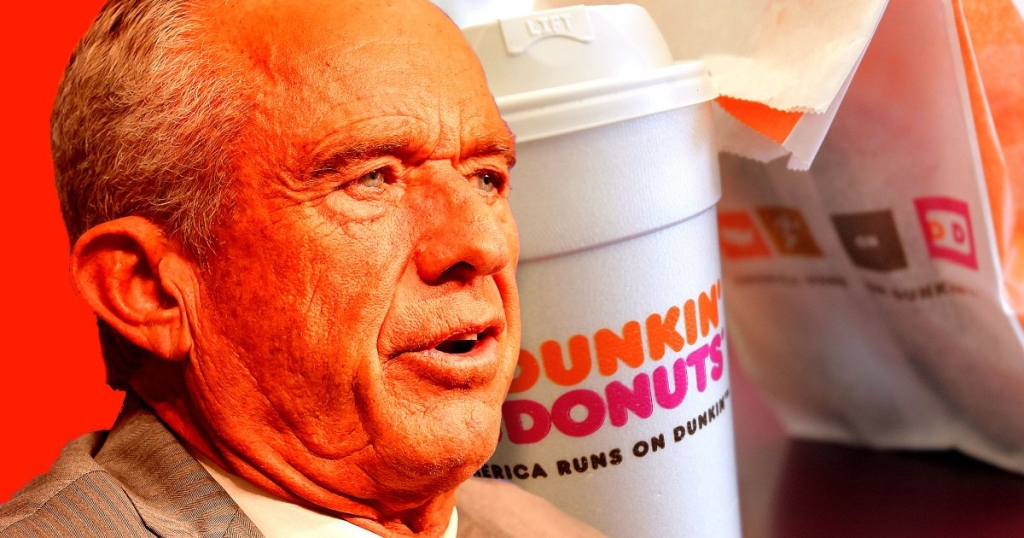
RFK Jr.’s Dunkin’ Donuts Crusade Sparks Massachusetts Rebellion
In a move that has ignited a cultural firestorm, Health and Human Services Secretary Robert F. Kennedy Jr. has declared war on America’s beloved coffee chains, with Dunkin’ Donuts—a Massachusetts institution—squarely in his crosshairs.
The Sugar Showdown That Shook Beantown
Speaking at a Texas event last week, Kennedy delivered what many consider fighting words to New England: “We’re going to ask Dunkin’ Donuts and Starbucks, ‘Show us the safety data that show that it’s OK for a teenage girl to drink an iced coffee with 115 grams of sugar in it,'” he declared, as reported by the Boston Globe. “I don’t think they’re gonna be able to do it.”
The response from Massachusetts was swift, fierce, and utterly predictable to anyone familiar with the state’s relationship with its signature coffee chain.
Governor Maura Healey fired the first shot across the bow with a defiant post on X featuring the revolutionary-era slogan “come and take it” emblazoned in bold letters. The message was clear: mess with Dunkin’, and you’re messing with Massachusetts.
“Donut Tread on Me”: The Meme That Captured a Movement
The controversy quickly transcended traditional political discourse, morphing into a full-blown cultural phenomenon. Social media erupted with creative expressions of resistance, most notably a viral meme that reimagined the iconic “Don’t Tread on Me” Gadsden flag with the Dunkin’ font spelling out “Donut Tread on Me.”
Ron Filipkowski, editor in chief of MeidasNews, captured the escalating tension perfectly: “This means war.”
The sentiment resonated deeply across the political spectrum. Ben Collins, CEO of The Onion and proud Massachusetts native, offered a characteristically blunt assessment: “This moron has no idea how much of a third rail this is. If he goes through with a public fight with Dunkin, he will never live this down. In the words of my people ‘f*** ya motha.'”
The Third Rail of American Politics
What makes Kennedy’s attack particularly ill-advised is the sacred status Dunkin’ holds in American culture. As one social media user pointedly observed: “Does he not know America runs on Dunkin’?”—a direct reference to the chain’s long-standing slogan that has become embedded in the national consciousness.
The backlash reveals a fundamental misunderstanding of American cultural touchstones. Fast food and coffee chains aren’t merely convenience stops; they’re woven into the fabric of daily life, community identity, and regional pride. Attacking Dunkin’ in Massachusetts is akin to challenging deep-dish pizza in Chicago or cheesesteaks in Philadelphia—it’s not just about the food; it’s about identity.
Kennedy’s Broader War on Processed Foods
This Dunkin’ controversy is just the latest front in Kennedy’s ambitious campaign to reform America’s food system. As Health Secretary, he has:
- Declared war on synthetic food dyes
- Unveiled new dietary guidelines promoting protein while reducing sugar
- Targeted the FDA’s “Generally Recognized As Safe” (GRAS) database
- Uncovered that over 100 substances of unknown safety were recently added to the list without FDA notification
The scale of this undertaking is staggering. According to recent research published in Nature, the vast majority of America’s food supply is “ultra-processed,” meaning any meaningful reform would require an immense regulatory effort and likely face fierce resistance from powerful corporate interests and lobbying groups.
The Trump Factor: When Fast Food Meets Policy
Complicating Kennedy’s mission is President Donald Trump’s well-documented love affair with fast food. Trump’s affinity for McDonald’s, KFC, and other quick-service restaurants has been extensively documented, creating an inherent tension between the administration’s health goals and the president’s personal preferences.
This contradiction was highlighted when Kennedy praised Coca-Cola for switching to cane sugar instead of high-fructose corn syrup—both of which are, fundamentally, sugar. He’s also celebrated restaurants like Florida Steak ‘n Shake for “RFK’ing the french fries” by switching from seed oils to beef tallow, demonstrating a somewhat inconsistent approach to food reform.
The Regulatory Tightrope
While nutrition experts agree that consuming beverages containing 115 grams of sugar is problematic, Kennedy faces a complex challenge. Marion Nestle, author and nutrition expert (unaffiliated with the corporation), offered a pragmatic perspective: “I would agree that the idea of drinking a product that has 115 grams of sugar in it is a very bad idea. I would not recommend it.”
However, she added a crucial caveat: “But, the reality of the food supply is that sugar is in everything. They want sugar out of everything? Fine, where’s the regulation? I want to see the regulation.”
This highlights the fundamental challenge Kennedy faces: while the goals may be laudable, the implementation requires navigating a complex web of regulatory, economic, and cultural factors that extend far beyond singling out individual companies.
The Cultural Stakes
The Dunkin’ controversy transcends health policy, touching on deeper questions about American identity, regional pride, and the role of government in personal choices. In Massachusetts, Dunkin’ isn’t just a coffee chain—it’s a cultural institution, a daily ritual, and a point of communal connection.
As this battle unfolds, Kennedy may find himself learning a hard lesson about American politics: some fights aren’t worth picking, especially when they involve institutions that have become synonymous with regional identity and daily life. The secretary’s crusade against sugar-laden coffee drinks may be scientifically sound, but culturally, he’s picked a fight he can’t win.
The question now is whether Kennedy will double down on his position or recognize that in the complex landscape of American food culture, sometimes the most effective reforms come through collaboration rather than confrontation. One thing is certain: in the court of public opinion, Kennedy has already lost Massachusetts.
Tags & Viral Phrases:
- “Donut Tread on Me”
- “America runs on Dunkin'”
- “This means war”
- “f*** ya motha”
- “come and take it”
- “115 grams of sugar”
- RFK Jr. vs. Dunkin’ Donuts
- Massachusetts rebellion
- The third rail of American politics
- Cultural institution under attack
- Sugar showdown
- Fast food nation resistance
- Kennedy’s food crusade
- The impossible regulatory tightrope
- When health policy meets cultural identity
,


Leave a Reply
Want to join the discussion?Feel free to contribute!