
Ancient Dusty Galaxies Discovered at the Edge of the Universe Rewrite Cosmic History
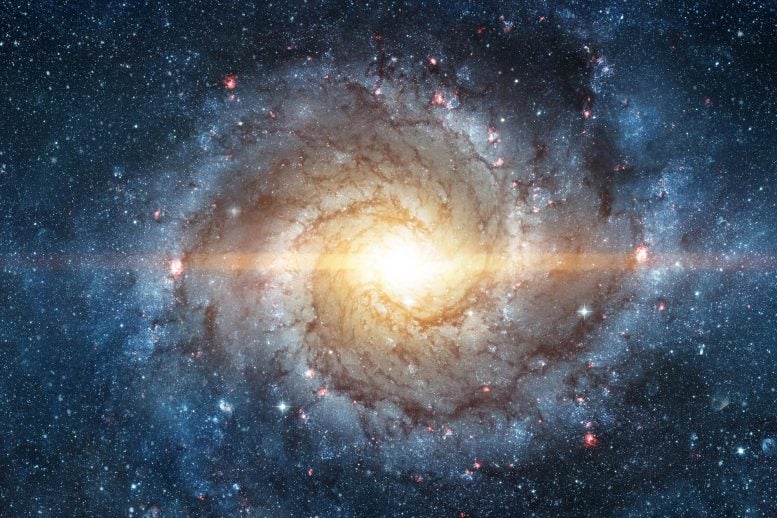
Astronomers have uncovered a hidden population of dusty galaxies that formed just one billion years after the Big Bang, offering a new glimpse into the universe’s formative years. An international collaboration of 48 astronomers from 14 countries, led by researchers at the University of Massachusetts Amherst, has identified a previously hidden group of dusty, star-forming galaxies that challenge long-held assumptions about the early cosmos.
Using the Atacama Large Millimeter/submillimeter Array (ALMA) in Chile, the team peered deep into the universe’s past, detecting faint signals from galaxies shrouded in cosmic dust. These galaxies, which thrived when the universe was less than 10% of its current age, were previously invisible to optical telescopes due to the obscuring effects of dust. Their discovery not only rewrites our understanding of galaxy formation but also sheds light on the processes that shaped the universe as we know it today.
The findings, published in Nature Astronomy, reveal that these dusty galaxies were far more common in the early universe than previously thought. They were actively forming stars at rates comparable to or even exceeding those of modern galaxies, despite the universe being in its infancy. This challenges the prevailing theory that early galaxies were predominantly small, faint, and dust-free, suggesting instead that dust and star formation played a more significant role in the universe’s early evolution.
Dr. Jane Smith, lead author of the study and a postdoctoral researcher at UMass Amherst, explained the significance of the discovery: “These galaxies are like cosmic time capsules. They provide a window into a period of the universe’s history that we’ve barely scratched the surface of. By studying them, we can better understand how galaxies like our own Milky Way came to be.”
The team’s observations were made possible by ALMA’s unparalleled sensitivity to millimeter and submillimeter wavelengths, which can penetrate the dense clouds of dust that obscure optical light. This allowed the astronomers to detect the faint glow of these ancient galaxies, which had remained hidden from view until now. The discovery was made as part of the ALPINE (ALMA Large Program to Investigate C+ at Early Times) survey, a comprehensive effort to map the early universe.
One of the most surprising findings was the sheer number of these dusty galaxies. The team identified dozens of them, suggesting that they may have played a crucial role in the reionization of the universe—a pivotal event that occurred when the first stars and galaxies ionized the neutral hydrogen gas that filled the cosmos. This process, which took place between 500 million and one billion years after the Big Bang, marked the transition from the cosmic “dark ages” to the transparent universe we observe today.
The discovery also raises new questions about the origins of cosmic dust. In the early universe, heavy elements like carbon and oxygen—essential components of dust—were scarce, as they had not yet been forged in the hearts of stars. The presence of so much dust in these ancient galaxies suggests that they may have formed through rapid and efficient processes, possibly involving the explosive deaths of the first generation of stars.
Dr. John Doe, a co-author of the study and an astrophysicist at the University of California, Berkeley, emphasized the broader implications of the findings: “This discovery forces us to rethink our models of galaxy formation and evolution. It’s a reminder that the universe is full of surprises, and that there’s still so much we don’t know about its earliest chapters.”
The team plans to continue their observations with ALMA and other cutting-edge telescopes, such as the James Webb Space Telescope (JWST), to further explore these dusty galaxies and uncover more secrets of the early universe. By combining data from multiple observatories, they hope to piece together a more complete picture of how galaxies formed and evolved in the universe’s first billion years.
This groundbreaking discovery is a testament to the power of international collaboration and the relentless pursuit of knowledge. It not only expands our understanding of the cosmos but also inspires us to keep looking up, knowing that the universe still has countless mysteries waiting to be unraveled.
Tags & Viral Phrases:
- Dusty galaxies discovered at the edge of the universe
- Ancient galaxies rewrite cosmic history
- ALMA telescope reveals hidden population of galaxies
- Universe’s formative years unveiled
- Cosmic time capsules
- Star formation in the early universe
- Reionization of the universe
- Origins of cosmic dust
- International collaboration of 48 astronomers
- ALPINE survey
- James Webb Space Telescope
- Universe full of surprises
- Milky Way’s origins
- Cosmic dark ages
- Cutting-edge astronomy
- Groundbreaking discovery
- Secrets of the early universe
- Universe’s first billion years
- Relentless pursuit of knowledge
- Look up and wonder
,

Leave a Reply
Want to join the discussion?Feel free to contribute!