
Ancient giant kangaroos could have hopped despite their huge size
Giant Kangaroos of the Pleistocene: The Hoppers That Defied Physics
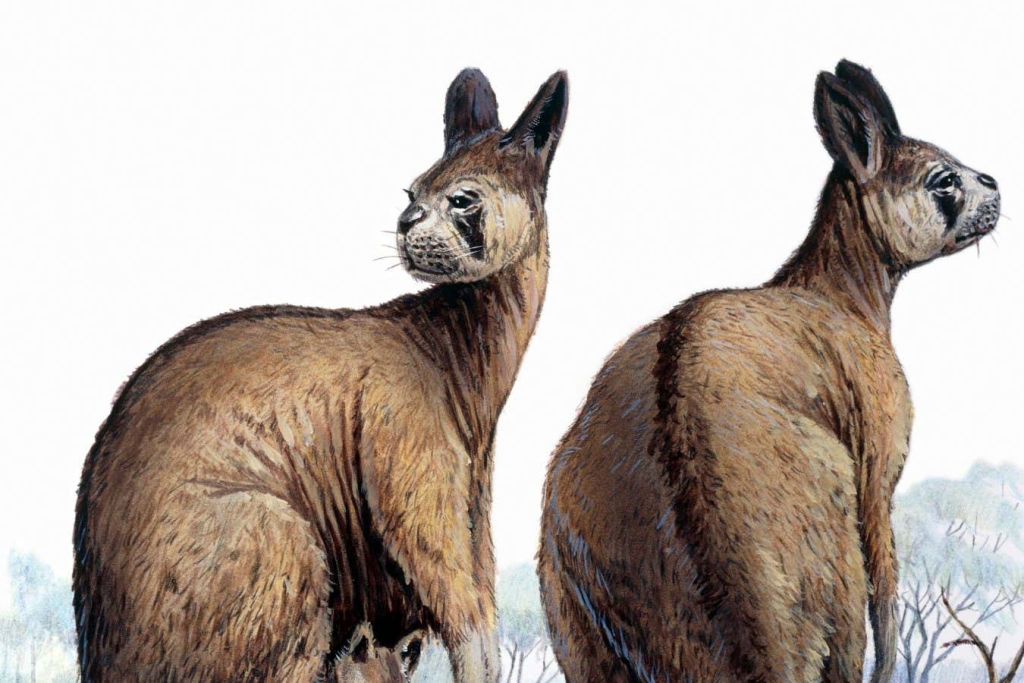
In a stunning revelation that’s hopping its way across the scientific community, researchers have uncovered evidence that Australia’s ancient megafauna might have been even more extraordinary than we ever imagined. The giant kangaroos that once roamed the Australian outback, standing at an imposing 2 meters tall and weighing up to 250 kilograms—more than twice the size of today’s largest red kangaroos—may have been capable of hopping despite their massive bulk.
This groundbreaking research, published in the prestigious journal Paleobiology, challenges decades of scientific consensus and rewrites what we thought we knew about these prehistoric marsupials. The study, led by Megan Jones at the University of Manchester, UK, suggests that these ancient giants weren’t just walking around on their hind legs as previously believed, but may have been able to perform the iconic kangaroo hop that has become synonymous with Australian wildlife.
The Sthenurines: Australia’s Prehistoric Powerhouses
When we think of giant kangaroos, we’re typically picturing the sthenurines—a group of extinct macropods that were truly the bodybuilders of the Pleistocene era. These weren’t your average marsupials; they were the ultimate evolutionary experiment in size and strength.
“The sthenurines are what most people are talking about when they talk about giant kangaroos,” explains Jones. “They’re the really weird ones.” And weird they were indeed. With their boxy skulls, single toe on each foot, and bodies that could reach 250 kilograms in weight, these creatures were unlike anything we see in modern Australia.
To put this in perspective, imagine a kangaroo that could look you directly in the eye while standing on all fours, with a body mass equivalent to a professional sumo wrestler. This was Procoptodon goliah, the largest kangaroo species ever to exist, which roamed Australia until approximately 40,000 years ago before disappearing in the wave of megafaunal extinctions that marked the end of the Pleistocene.
The Biomechanics of Bigness: Could They Really Hop?
For years, scientists assumed that these giant kangaroos were simply too massive to hop. The prevailing theory suggested they must have walked on their hind legs, similar to how humans walk, but with the distinctive upright posture of their smaller relatives. This made intuitive sense—after all, scaling up a modern kangaroo to twice its size would create enormous mechanical stresses on the bones and tendons.
The Achilles tendon, that crucial spring-like structure that allows kangaroos to store elastic energy and bounce efficiently from hop to hop, would be under catastrophic stress in a creature of such massive proportions. In modern kangaroos, this tendon operates dangerously close to its breaking point during normal locomotion. Scale that up, and you’d have a recipe for catastrophic failure.
But Jones and her team weren’t satisfied with assumptions. They embarked on an ambitious study, collecting bone measurements from 67 species of macropods—the family that includes all kangaroos, wallabies, and their relatives, both living and extinct. Their dataset included the bones of modern species and the ancient giants, allowing for direct comparisons of structure and function.
Engineering Analysis Reveals Ancient Secrets
The researchers focused on three key bones: the femur (thigh bone), tibia (shin bone), and calcaneus (the heel bone where the Achilles tendon attaches). By measuring these bones and combining the data with body mass estimates, they could calculate the size of the attached tendons and estimate the forces they could withstand.
What they discovered was remarkable. While it’s true that simply scaling up a modern kangaroo would create insurmountable mechanical problems, the ancient giants weren’t just scaled-up versions of their smaller cousins. They had evolved specific adaptations that made hopping mechanically feasible, even at their enormous size.
“These ancient kangaroos aren’t just scaled-up versions of today’s species,” Jones emphasizes. “They have shorter feet and a wider calcaneus, for example.” The wider calcaneus, in particular, was a game-changer. This broader heel bone would have helped distribute forces more effectively and could accommodate larger tendons capable of handling the enormous loads generated during hopping.
The calculations revealed that these adaptations would have allowed the bones to resist the bending moments involved in hopping and provided enough space for tendons large enough to handle the stresses. In other words, these giant kangaroos weren’t mechanically barred from hopping—they were engineered for it.
Hopping: A Tool in the Ancient Kangaroo’s Arsenal
Does this mean that giant kangaroos were bouncing around the Pleistocene landscape like oversized basketballs? Probably not. Jones is careful to clarify that while hopping was mechanically possible, it likely wasn’t their primary mode of locomotion.
“Hopping almost certainly wasn’t their primary mode of locomotion, but they might have used it for short bursts of speed,” she suggests. This makes perfect evolutionary sense. Hopping is an incredibly efficient way to cover large distances at speed, but it’s also energetically expensive. For a 250-kilogram animal, walking might have been the default, with hopping reserved for situations requiring rapid movement—perhaps to escape predators or cover ground quickly when feeding.
This finding adds another layer to our understanding of kangaroo locomotion. Far from being a single, rigid gait, hopping appears to be a flexible tool in the kangaroo’s evolutionary toolkit. Modern red kangaroos, for instance, can walk using their tail as a “fifth limb,” creating a pentapedal gait that’s unique in the animal kingdom. Tree kangaroos take this versatility even further, employing walking, hopping, bounding, quadrupedal movement, and bipedal locomotion depending on their environment and needs.
A New Picture of Ancient Australian Ecosystems
This research has profound implications for our understanding of Pleistocene Australia. The ability to hop, even if used sparingly, suggests these giant kangaroos were more agile and adaptable than previously thought. They weren’t just lumbering giants plodding across the landscape—they were capable of rapid movement when needed, potentially making them more competitive in the challenging environments of Ice Age Australia.
Benjamin Kear at Upsala University in Sweden, who wasn’t involved in the study, notes that “the study supports what is now a solidifying picture of the iconic kangaroo hop as a functionally adaptable component of a surprisingly variable gait repertoire.” This flexibility, he argues, has been key to the ecological success of macropods over millions of years of evolution.
The findings also raise intriguing questions about the extinction of these giant kangaroos. If they were more adaptable than we thought, what factors led to their disappearance approximately 40,000 years ago? Was it climate change, human hunting, or some combination of factors? The mechanical capability for hopping suggests these animals had evolved sophisticated solutions to the challenges of their environment, making their extinction all the more mysterious.
The Legacy of the Giant Kangaroos
Today, as we marvel at the red kangaroos bounding across the Australian outback, we’re witnessing the descendants of a lineage that once included creatures that seem almost mythical in their proportions. The giant kangaroos of the Pleistocene represent one of evolution’s most impressive experiments in size and specialization.
Their story is a testament to the power of evolutionary adaptation. These animals didn’t just grow bigger—they evolved new anatomical solutions to the problems posed by their increased size. Their wider heel bones, modified limb proportions, and potentially larger tendons represent a sophisticated engineering response to the challenges of gigantism.
As we continue to study these ancient giants, we’re reminded that evolution is full of surprises. What seems impossible at one scale may be entirely feasible with the right adaptations. The giant kangaroos of Australia’s past weren’t just bigger versions of modern animals—they were unique creatures with their own evolutionary solutions to the challenges of life as a massive marsupial.
Their legacy lives on in the kangaroos we see today, creatures that continue to fascinate us with their unique mode of locomotion and their remarkable adaptability. From the red kangaroos of the arid interior to the tree kangaroos of the tropical rainforests, the macropod lineage has proven itself to be one of evolution’s most successful and versatile experiments.
As Jones and her team continue their research, one thing is clear: the story of the giant kangaroos is far from over. Each new discovery adds another piece to the puzzle of how these magnificent creatures lived, moved, and ultimately disappeared from the Australian landscape. And with each piece, we gain a deeper appreciation for the complexity and wonder of evolutionary adaptation.
Tags & Viral Phrases:
- Giant kangaroos that could hop despite weighing 250kg
- Prehistoric marsupials that defied physics
- Pleistocene megafauna of Australia
- Procoptodon goliah: The 2-meter-tall kangaroo
- Kangaroo biomechanics and evolution
- Ancient animal locomotion secrets revealed
- How giant kangaroos evolved to hop
- The Achilles tendon of prehistoric kangaroos
- Sthenurines: Australia’s weirdest extinct animals
- Kangaroo hopping: More versatile than we thought
- Pleistocene Australia’s giant marsupials
- Evolutionary engineering of giant kangaroos
- Ancient kangaroo bones tell new stories
- The walking and hopping giants of prehistory
- How evolution solved the problem of gigantism
- Kangaroo locomotion: From walking to hopping
- The mechanical secrets of extinct megafauna
- Australia’s prehistoric animal kingdom
- How big kangaroos got and still hopped
- The surprising agility of giant kangaroos
- Kangaroo evolution: From tiny to titanic
- Prehistoric animal adaptations that changed everything
- The biomechanics breakthrough in paleontology
- Why giant kangaroos didn’t break their legs
- The engineering marvel of ancient marsupials
- How kangaroos became the ultimate hoppers
- The secret life of Pleistocene kangaroos
- Ancient Australia’s animal superstars
- The evolutionary toolkit of macropods
- How giant kangaroos moved across Ice Age Australia
- The mystery of Australia’s extinct megafauna
- Kangaroo hopping: Nature’s perfect design
- The surprising truth about giant kangaroo locomotion
- How evolution created the perfect hopper
- The biomechanics revolution in paleontology
- Ancient kangaroo adaptations that still amaze
- The walking, hopping, and bounding giants
- How giant kangaroos conquered the Australian landscape
- The engineering secrets of prehistoric movement
- Kangaroo evolution: Bigger, better, hopper
- The mechanical marvels of extinct marsupials
- How giant kangaroos changed our understanding of evolution
- The surprising versatility of ancient kangaroo movement
- The biomechanics of being a giant marsupial
- How kangaroos evolved to be the ultimate athletes
- The ancient secrets of efficient locomotion
- How giant kangaroos solved the problem of size
- The evolutionary innovations of Pleistocene marsupials
- Kangaroo locomotion: A story of adaptation and survival
,


Leave a Reply
Want to join the discussion?Feel free to contribute!