
Antarctica’s Gravity Hole Growing Stronger, Scientists Find
Antarctica’s Mysterious Gravity Hole: A 70-Million-Year-Old Puzzle Tied to Climate Change
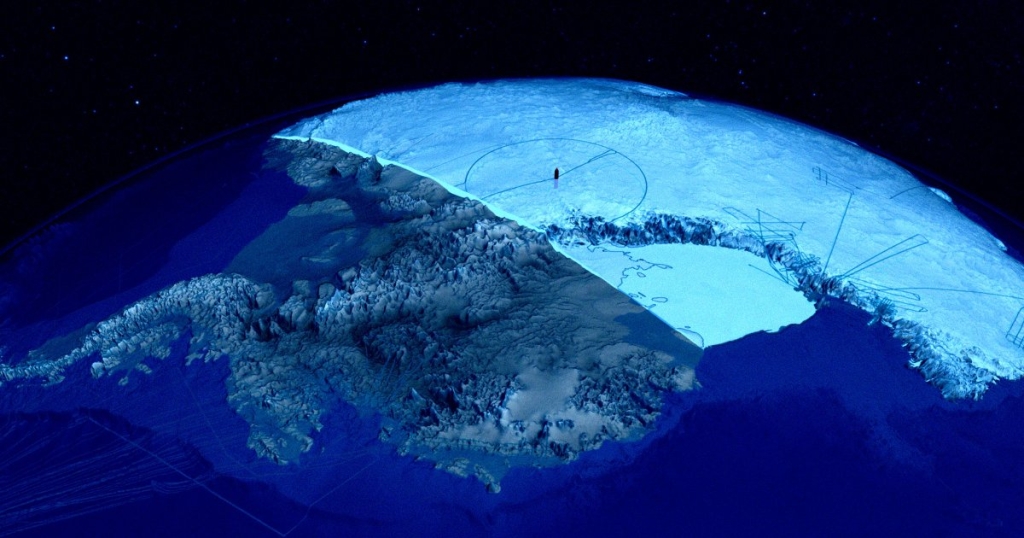
Deep beneath Antarctica’s frozen surface lies a scientific enigma that has puzzled geophysicists for decades: a vast region where Earth’s gravitational pull is measurably weaker than anywhere else on the planet. This “gravity hole,” spanning thousands of kilometers beneath the Antarctic ice sheet, represents one of our planet’s most intriguing geophysical anomalies—and new research suggests it may hold the key to understanding both ancient climate shifts and future sea level changes.
The Hidden Force Beneath the Ice
While most people associate Antarctica with extreme cold and ice, few realize that beneath this frozen continent flows a slow-motion geological dance that directly affects how gravity works. The phenomenon occurs because dense rock deep within Earth’s mantle is slowly sinking in certain regions, creating areas where the gravitational field weakens measurably.
“Think of it like a bowl of thick honey,” explains Dr. Alessandro Forte, geophysics professor at the University of Florida and lead researcher on the groundbreaking study. “When you push down on one part, the honey around it rises slightly. Similarly, when dense rock sinks deep within Earth, it creates depressions in the gravitational field above.”
This isn’t just a theoretical curiosity—the Antarctic gravity hole represents a real, measurable deviation in Earth’s gravitational field, detectable by sensitive instruments and satellite measurements. Scientists have known about these anomalies for years, but the connection to climate change remained elusive until now.
A Window Into Earth’s Deep Past
To unravel this mystery, Forte and his colleague Dr. Petar Glišović from the Paris Institute of Earth Physics employed an innovative approach that essentially performed a CT scan of our entire planet. Instead of X-rays, they used earthquake waves—nature’s own illumination system for probing Earth’s interior.
“Earthquakes provide the ‘light’ that illuminates the interior of the planet,” Forte explains. By analyzing seismic data from thousands of earthquakes recorded globally over decades, the researchers could map how rock structures move deep beneath Antarctica’s surface.
Their computer models reconstructed the gravity hole’s evolution over an astonishing 70 million years—a timespan that stretches back to the age of dinosaurs. What they discovered was remarkable: the gravity hole has been steadily strengthening throughout this entire period, growing more pronounced with each passing million years.
The Climate Connection
The timing of this strengthening gravity hole coincides precisely with major climate transitions in Antarctica’s history. Around 34 million years ago, the continent underwent a dramatic transformation from a relatively warm region with forests to the frozen wasteland we know today. This transition marked the beginning of extensive ice sheet formation—and the researchers found that the gravity hole’s strengthening accelerated during this exact period.
“We’re seeing a remarkable correlation between deep Earth processes and surface climate changes,” notes Glišović. “The strengthening of the gravity hole appears to have created conditions that allowed Antarctic ice sheets to grow more extensively than they otherwise would have.”
The mechanism works through subtle but powerful effects. As dense rock sinks deeper into the mantle, it creates slight changes in Earth’s shape and gravitational field. These changes, in turn, affect how ice accumulates and flows across the continent. The gravity hole essentially creates a “low-pressure zone” in the gravitational field, which may influence atmospheric circulation patterns and precipitation distribution over Antarctica.
Implications for Sea Level and Climate Science
This discovery opens up entirely new avenues for understanding climate change and sea level rise. If deep Earth processes can influence ice sheet growth over millions of years, they may also play a role in how ice sheets respond to current warming trends.
“The question we’re pursuing now is whether the strengthening gravity hole could be influencing modern sea level changes,” Forte says. “If we can establish this connection, it would represent a fundamental shift in how we understand the relationship between Earth’s interior and its climate system.”
The research also provides crucial context for current climate change discussions. While human activities are undoubtedly driving rapid warming today, the Antarctic ice sheet’s behavior is influenced by forces operating on timescales far beyond human experience. Understanding these deep-time processes helps scientists better predict how ice sheets might respond to ongoing climate change.
The Technical Marvel Behind the Discovery
The study’s methodology represents a triumph of computational geophysics. Processing earthquake data from thousands of seismic stations worldwide, the team created a three-dimensional map of Earth’s interior beneath Antarctica with unprecedented resolution.
“We essentially created a time-lapse movie of Earth’s interior over 70 million years,” says Glišović. “Each earthquake provided another frame in this geological movie, allowing us to see how the deep structure beneath Antarctica has evolved.”
The computational requirements were staggering—processing petabytes of seismic data required months of supercomputer time and sophisticated algorithms to filter out noise and extract meaningful signals about deep Earth structure.
What This Means for the Future
As climate scientists grapple with predicting future sea level rise, this research suggests they may need to consider factors far deeper than atmospheric CO2 levels. The interplay between Earth’s interior dynamics and surface climate represents a complex system that operates across vastly different timescales.
“If we can better understand how Earth’s interior shapes gravity and sea levels, we gain insight into factors that may matter for the growth and stability of large ice sheets,” Forte emphasizes. This understanding could prove crucial for improving climate models and sea level projections that inform policy decisions worldwide.
The discovery also highlights how much remains unknown about our planet. Despite centuries of scientific study, Earth continues to reveal new secrets about how its various systems interact—from the molten core to the frozen poles.
Beyond Antarctica: Global Implications
While the study focused on Antarctica, gravity holes exist in other parts of the world, including beneath the Indian Ocean. Understanding how these features evolve and influence surface conditions could provide insights into climate patterns globally.
The research methodology itself could be applied to study other regions, potentially revealing similar connections between deep Earth processes and climate phenomena elsewhere on the planet. This could revolutionize our understanding of how plate tectonics, mantle convection, and climate interact over geological timescales.
A New Era of Earth System Science
This research exemplifies the emerging field of Earth system science, which recognizes that our planet’s various components—solid Earth, oceans, atmosphere, and ice—are deeply interconnected in ways we’re only beginning to understand.
“The traditional approach to studying climate focused primarily on atmospheric and oceanic processes,” notes Forte. “But we’re learning that we can’t fully understand climate change without considering the solid Earth beneath our feet.”
As scientists continue to probe these connections, discoveries like the Antarctic gravity hole remind us that Earth remains a dynamic, evolving system—one whose behavior we’re still working to comprehend fully.
Tags: Antarctica, gravity hole, climate change, geophysics, seismic waves, mantle dynamics, ice sheets, sea level rise, Earth’s interior, geological timescales, climate science, planetary science, seismology, computational modeling, deep Earth processes, environmental science, global warming, Antarctic research, gravity anomalies, Earth system science
Viral Sentences:
- Scientists just discovered Earth’s gravity is weaker under Antarctica—and it’s been getting weaker for 70 million years
- The secret to Antarctica’s ice growth might lie 3,000 kilometers beneath our feet
- Earthquake waves reveal Earth’s hidden climate control system
- This gravity hole could change everything we know about sea level rise
- Dinosaurs witnessed the birth of Antarctica’s mysterious gravity anomaly
- Deep Earth movements are secretly shaping our climate future
- Scientists use earthquakes as X-rays to scan Earth’s interior
- Antarctica’s gravity hole: nature’s own climate engineering project
- The missing piece in climate science? It’s buried under Antarctic ice
- How Earth’s molten core controls the frozen continent above
- This discovery proves Earth is still full of geological surprises
- Climate change isn’t just about the atmosphere—it’s about what’s beneath our feet
- The gravity hole that’s been hiding in plain sight for millions of years
- Why Antarctica’s ice sheet might owe its existence to a weakening gravitational field
- The 70-million-year-old mystery finally solved by earthquake data
,


Leave a Reply
Want to join the discussion?Feel free to contribute!