
Artemis 2 Crew Become First Humans to Travel Beyond Earth Orbit Since the 1970s
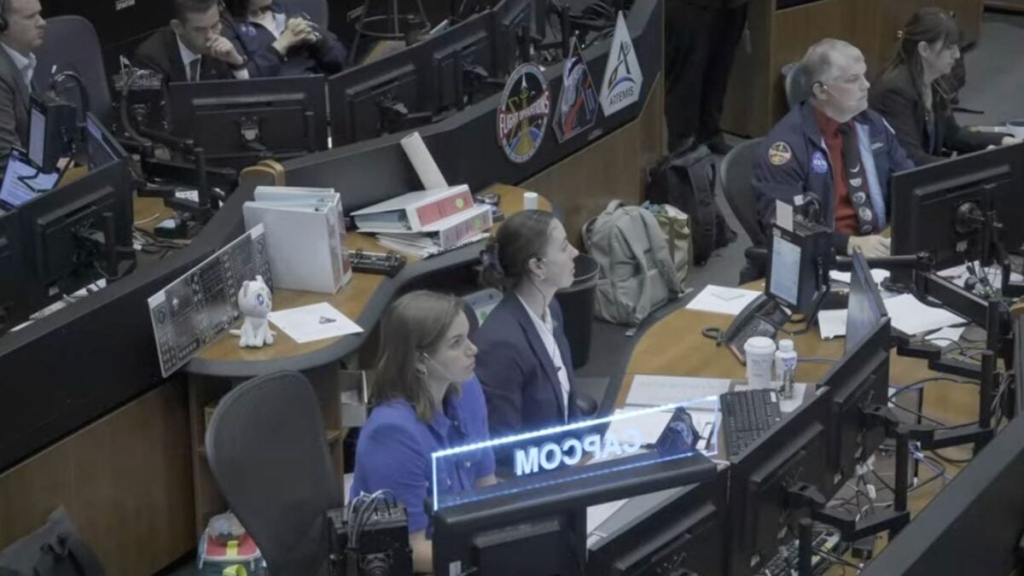
The Artemis 2 astronauts are officially on their way to the Moon, marking humanity’s first crewed journey beyond low-Earth orbit in over half a century. At 7:57 p.m. ET, the Orion spacecraft executed a flawless translunar injection burn, propelling itself toward our celestial neighbor with a velocity change of nearly 1,300 feet per second. This historic maneuver lasted just under six minutes and demonstrated that Orion can independently navigate itself to the Moon—a capability that will be essential for future lunar landings.
Unlike Artemis 1, where the Space Launch System’s upper stage handled the TLI burn while still attached to Orion, this mission showcased the spacecraft’s autonomous capabilities. NASA Administrator Jared Isaacman and flight controllers closely monitored engine performance, guidance, and navigation data throughout the burn, confirming everything proceeded exactly as planned without any major issues.
“We firmly felt the power of your perseverance during every second of that burn,” Canadian astronaut Jeremy Hansen communicated from orbit. “Humanity has once again shown what we are capable of, and it’s your hopes for the future that carry us now on this journey around the Moon.”
The journey to this moment has been nothing short of extraordinary. The SLS rocket and Orion spacecraft launched from Kennedy Space Center in Cape Canaveral, Florida, at 6:35 p.m. ET on Wednesday, carrying NASA astronauts Reid Wiseman, Victor Glover, Christina Koch, and Canadian Space Agency astronaut Jeremy Hansen. While the launch itself was picture-perfect, the 24 hours leading up to it weren’t without challenges.
Ground teams faced a couple of small technical issues during pre-launch preparations, experienced a brief partial loss of communication with Orion shortly after liftoff, and discovered a problem with the spacecraft’s toilet system. NASA’s engineering teams responded swiftly to each anomaly, resolving them efficiently and ensuring the mission could proceed without delay.
Now that Orion is moonbound, the spacecraft will execute a smaller trajectory correction burn to fine-tune its path before entering the Moon’s gravitational sphere of influence on the fifth day of flight—expected to be Sunday. At that critical juncture, the Moon’s gravity will become stronger than Earth’s, creating a gravitational slingshot effect that will carry Orion around the far side of the Moon.
The Artemis 2 crew will have approximately 24 hours on Monday to observe and photograph portions of the lunar surface that no human has ever seen with their own eyes. This unprecedented opportunity will provide valuable scientific data and breathtaking imagery that will inspire generations to come.
Perhaps the most elegant aspect of this mission architecture is what happens after the lunar flyby. When Orion emerges from behind the Moon on Tuesday, it will already be on a free-return trajectory—a gravity-assisted path that naturally guides the spacecraft back to Earth without requiring additional propulsion. Between Tuesday and Friday, only three small correction burns will be necessary to maintain the proper course. Earth’s gravity will handle the rest, pulling Orion home for a planned splashdown.
This mission represents far more than a technical achievement. It’s a testament to human perseverance, international collaboration, and our collective ambition to push beyond the boundaries of what’s possible. The Artemis program, with Artemis 2 as its crewed debut, lays the foundation for sustainable lunar exploration, scientific discovery, and ultimately, the journey to Mars.
As Orion continues its voyage, mission control will maintain constant communication, monitoring every aspect of the spacecraft’s systems and the crew’s wellbeing. The astronauts themselves will conduct various scientific experiments, test life support systems, and evaluate the performance of the spacecraft in deep space conditions.
The significance of this moment cannot be overstated. For the first time in 52 years, humans are traveling beyond Earth orbit with the explicit purpose of returning to the Moon—not just to visit, but to stay. The lessons learned from Artemis 2 will inform every subsequent mission, including the historic Artemis 3, which aims to land the first woman and first person of color on the lunar surface.
As we watch this mission unfold, we’re not just witnessing a spacecraft traveling to the Moon—we’re watching the future of space exploration take shape in real-time. The Artemis generation is here, and they’re carrying with them the hopes, dreams, and aspirations of billions of people back on Earth.
Gizmodo will continue to provide comprehensive coverage of the Artemis 2 mission through our live blog, bringing you real-time updates, analysis, and insights as humanity makes its triumphant return to deep space. This is history in the making, and you have a front-row seat to one of the most significant achievements in human exploration.
#Artemis2 #NASA #MoonMission #SpaceExploration #OrionSpacecraft #LunarTrajectory #DeepSpace #HumanSpaceflight #ArtemisProgram #NASAHistory #MoonReturn #SpaceTechnology #EngineeringMarvel #SpaceRace #FutureOfSpace #LunarOrbit #FreeReturnTrajectory #SpaceInnovation #CosmicJourney #BeyondEarth #SpaceAchievement #MoonBound #Orion #SLS #SpaceLaunchSystem #ArtemisGeneration #SpaceDiscovery #MoonLanding #SpaceMission #NASAArtemis #SpaceHistory,


Leave a Reply
Want to join the discussion?Feel free to contribute!