
Artemis II Mission Launches Successfully
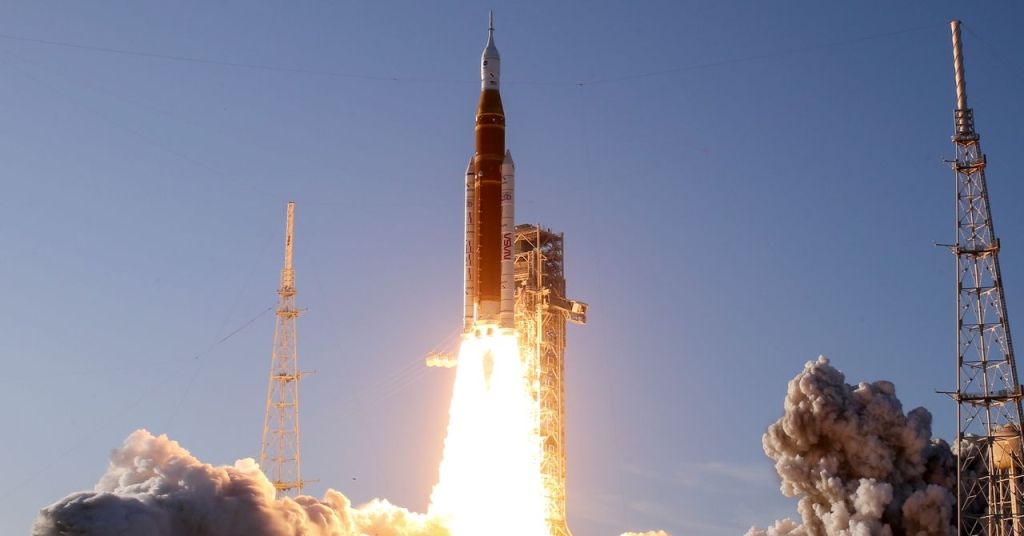
NASA’s Artemis II Mission Blasts Off: Humanity’s Bold Return to the Moon Begins
In a breathtaking display of human ingenuity and determination, NASA’s Space Launch System (SLS) rocket thundered to life at 6:36 PM Cape Canaveral time, propelling the Artemis II crew toward their historic journey around the Moon. The flawless launch marks the beginning of humanity’s most ambitious lunar exploration program since the Apollo era, setting the stage for permanent human presence on our celestial neighbor.
The massive SLS rocket, standing taller than the Statue of Liberty, lifted off without a single hitch, carrying the Orion spacecraft and its four-member crew on a mission that will span approximately 10 days. As the rocket’s engines roared to life, producing over 8.8 million pounds of thrust, it painted the Florida sky with a brilliant plume of fire and smoke, visible for miles along the Space Coast.
A Mission Decades in the Making
This launch represents the culmination of years of meticulous planning, engineering innovation, and unwavering commitment from thousands of NASA personnel and contractors. The mission’s timing is particularly poignant, coming exactly 53 years after Apollo 17’s final lunar landing in December 1972, which marked the end of the original Moon exploration era.
The Artemis II crew comprises NASA astronauts Reid Wiseman (commander), Victor Glover (pilot), Christina Koch, and Canadian Space Agency astronaut Jeremy Hansen. This diverse team makes history as the first crewed lunar mission to include both a woman and a person of color, representing a significant step forward in making space exploration more inclusive and reflective of humanity as a whole.
The Journey Ahead
During the initial phase of the mission, Orion will complete its journey into Earth orbit, where the crew will spend the first few hours conducting critical systems checks and ensuring all spacecraft systems are functioning optimally. Throughout the first day, they’ll perform extensive navigation tests and verify communication systems with Mission Control in Houston.
The mission’s trajectory is carefully calculated to maximize scientific return while ensuring crew safety. Around the third or fourth day, Orion will begin its trajectory toward the Moon, crossing into the lunar gravitational sphere of influence. This transition point is crucial, as it marks the moment when the Moon’s gravity begins to exert a stronger pull on the spacecraft than Earth’s.
The Most Dangerous Phase
As Orion approaches the far side of the Moon, the crew will enter what NASA engineers consider the most perilous phase of the mission. For approximately 50 minutes, the spacecraft will pass behind the Moon, cutting off all communication with Earth due to the Moon’s mass blocking radio signals. During this critical window, the crew must rely entirely on their training and the spacecraft’s autonomous systems.
However, this communication blackout also presents a unique opportunity. The Artemis II crew will capture unprecedented images and data from the lunar far side using technology far more advanced than anything available during the Apollo missions. Their high-resolution cameras and sophisticated scientific instruments will provide insights into lunar geology, surface composition, and potential resources that could support future lunar bases.
Technological Marvel
The Orion spacecraft, roughly the size of a large passenger van, represents the pinnacle of modern space engineering. Unlike the cramped Apollo capsules, Orion provides significantly more space for the crew, with improved life support systems, enhanced radiation protection, and state-of-the-art computing capabilities. The spacecraft can support the crew for up to 21 days in space, though Artemis II’s 10-day duration falls well within these parameters.
The SLS rocket itself is a technological masterpiece, incorporating both proven technologies from the Space Shuttle program and cutting-edge innovations. Its core stage, powered by four RS-25 engines, burns through 700,000 gallons of super-cold propellant in just over eight minutes during the initial ascent phase. The rocket’s two solid rocket boosters provide additional thrust during the critical first two minutes of flight.
The Return Journey
After completing their lunar flyby, the crew will begin their return journey to Earth, utilizing a technique called “free return trajectory.” This maneuver takes advantage of the gravitational fields of both Earth and the Moon to guide the spacecraft home without requiring additional fuel burns, making the mission more efficient and safer.
NASA estimates that by the 10th day of flight, Orion will be approaching Earth for reentry. The capsule will hit Earth’s atmosphere at approximately 25,000 miles per hour, experiencing temperatures of up to 5,000 degrees Fahrenheit. Advanced heat shield technology, developed specifically for the Artemis program, will protect the crew during this intense phase of the mission.
Historical Significance
While Artemis II won’t include a lunar landing—that milestone is reserved for Artemis III, planned for 2026—the mission serves as a crucial proving ground for the technologies and procedures that will enable future surface operations. The data collected during this flight will inform everything from spacesuit design to surface habitat construction, laying the groundwork for sustained lunar presence.
The ultimate goal of the Artemis program extends far beyond simple exploration. NASA envisions establishing the first permanent lunar bases, potentially at the Moon’s south pole where water ice deposits could provide vital resources for life support and fuel production. These bases would serve as stepping stones for even more ambitious missions to Mars and beyond, representing humanity’s first permanent foothold in the solar system.
Launch Window and Contingency Planning
The launch window opened precisely at 6:24 PM Eastern Time on Wednesday, April 1, with a two-hour extension available if needed. NASA’s meticulous planning included five additional launch opportunities over the following days, demonstrating the agency’s commitment to mission success while maintaining flexibility for weather conditions or technical considerations.
The flawless execution of the launch sequence—from the final countdown through main engine cutoff and Orion separation—demonstrates the maturity of NASA’s launch operations and the reliability of the SLS rocket system. Every milestone was achieved exactly as planned, with the Orion spacecraft successfully entering its initial orbit and beginning its systems checkout procedures.
Looking Forward
As the Artemis II crew embarks on their journey, they carry with them not just the hopes of NASA, but the aspirations of all humanity. Their mission represents our collective desire to explore, to understand our place in the cosmos, and to push the boundaries of what’s possible. The success of Artemis II will pave the way for Artemis III’s historic lunar landing, followed by increasingly complex missions that will establish humanity’s permanent presence on the Moon.
The next 10 days will be watched closely by millions around the world, as this mission demonstrates that the dream of returning to the Moon is not just alive, but thriving. With each passing hour, the Artemis II crew moves us closer to a future where humans live and work on other worlds, expanding our civilization beyond the cradle of Earth.
Tags & Viral Phrases:
NASA Artemis II, Moon mission 2024, first woman and person of color to the Moon, SLS rocket launch, Orion spacecraft journey, lunar orbit mission, historic space exploration, return to the Moon, NASA’s bold new era, space technology breakthrough, Artemis program progress, human spaceflight milestone, lunar far side exploration, sustainable Moon presence, Mars mission preparation, space agency achievement, crewed lunar flyby, technological marvel in space, interplanetary future begins, space exploration history made.
,

Leave a Reply
Want to join the discussion?Feel free to contribute!