
Astronomers are filling in the blanks of the Kuiper Belt
New Kuiper Belt Discovery Hints at Hidden Solar System History
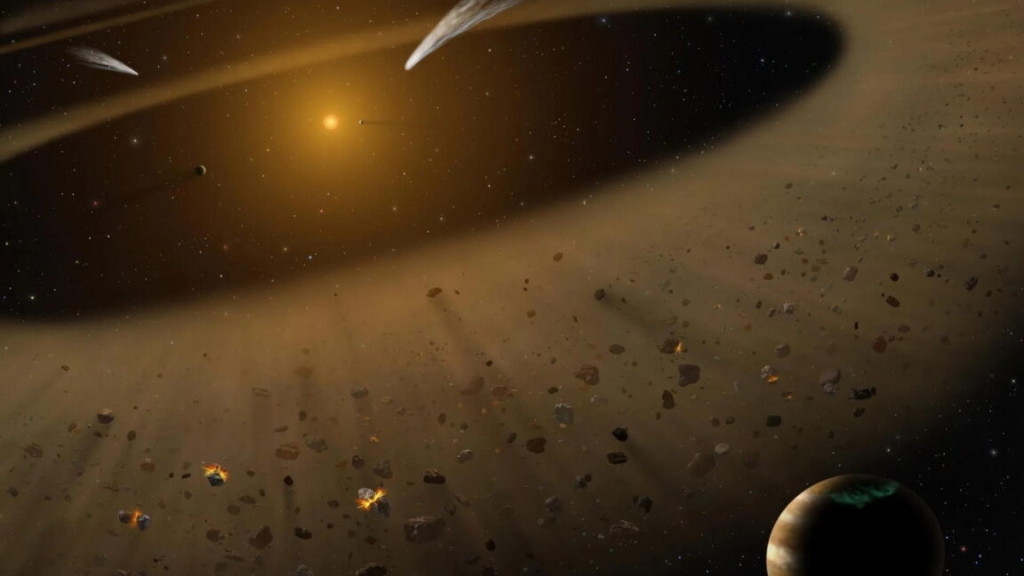
Astronomers have uncovered tantalizing new evidence of previously unknown structures within the Kuiper Belt—the vast, icy region beyond Neptune that serves as a frozen time capsule from the early solar system. The discovery, which builds upon groundbreaking research from 2011, suggests our cosmic neighborhood may be far more complex than previously imagined.
The “Snowplow Effect” That Shaped Our Solar System
The story begins with Neptune’s dramatic migration through the early solar system. According to researchers, the ice giant behaved much like a snowplow clearing a highway—but with a crucial difference.
“Imagine a snowplow driving along a highway, and lifting up the plow,” explains one astronomer. “It leaves a clump of snow behind. That same sort of idea is what left the clump of cold classicals behind. That is the kernel.”
This elegant metaphor describes how Neptune, as it migrated outward from the sun billions of years ago, gravitationally influenced countless objects in its path. The planet essentially “shepherded” these icy bodies along with it, but when Neptune made a sudden “jump” in its orbital position, it broke its gravitational hold on many of them. These objects then settled into what astronomers now call the “kernel”—a distinctive cluster of Kuiper Belt Objects (KBOs) that maintains its Neptune-sculpted pattern to this day.
A Tenfold Increase in Data Reveals New Mysteries
Last year, a team led by Siraj and his advisors at Princeton University set out to map the Kuiper Belt with unprecedented precision. Their approach was revolutionary: they developed a new algorithm to analyze 1,650 KBOs—roughly ten times the number of objects studied in the 2011 research led by Jean-Robert Petit that first identified the kernel structure.
The results were both confirming and surprising. The team’s analysis consistently verified the existence of the original kernel, but also revealed something entirely new: a possible “inner kernel” located at approximately 43 astronomical units (AU) from the sun. (One AU equals the distance from Earth to the sun, about 93 million miles.)
“You have these two clumps, basically, at 43 and 44 AU,” Siraj explains. “It’s unclear whether they’re part of the same structure, but either way, it’s another clue about, perhaps, Neptune’s migration, or some other process that formed these clumps.”
The Hunt for Planet Nine Intensifies
The Kuiper Belt isn’t just a scientific curiosity—it’s become ground zero in the search for what might be our solar system’s most elusive world: Planet Nine, also known as Planet X. First proposed in 2016 by Caltech astronomers Mike Brown and Konstantin Batygin, this hypothetical giant planet would orbit far beyond the Kuiper Belt, potentially at several hundred AU from the sun.
Some scientists believe that the gravitational influence of Planet Nine, if it exists, could explain the strangely clustered orbits observed in certain Kuiper Belt objects. These unusual orbital patterns suggest that something massive is gravitationally sculpting the outer reaches of our solar system, though direct evidence of Planet Nine remains frustratingly elusive.
Next-Generation Telescopes Promise Breakthroughs
The pace of discovery is accelerating rapidly. Next-generation observatories like the Vera C. Rubin Observatory, scheduled to begin operations in the coming years, promise to revolutionize our understanding of the Kuiper Belt. These powerful telescopes will be capable of detecting thousands of additional KBOs, potentially revealing whether the newly discovered “inner kernel” is a real structure or merely an observational artifact.
As Siraj notes, “In the coming years, as Rubin and other telescopes discover thousands more KBOs, the nature and possible origin of these mysterious structures in the belt may become clearer, potentially opening new windows into the tumultuous origins of our solar system.”
Reconstructing Solar System History
The implications of these discoveries extend far beyond simple cartography of the outer solar system. By studying the distribution and orbital characteristics of Kuiper Belt objects, astronomers are essentially reconstructing the early history of our planetary neighborhood.
These icy bodies represent primordial material that has remained largely unchanged since the solar system’s formation 4.6 billion years ago. Their current arrangement tells the story of planetary migrations, gravitational interactions, and cataclysmic events that shaped the architecture of our cosmic home.
The kernel structures, in particular, provide compelling evidence for Neptune’s outward migration—a process that likely played a crucial role in determining the final configuration of our solar system. Understanding this migration helps answer fundamental questions about why our planetary system looks the way it does, and whether similar processes might be common in other star systems throughout the galaxy.
The Broader Context
The Kuiper Belt research represents part of a larger scientific revolution in planetary astronomy. Just as the discovery of exoplanets has transformed our understanding of planetary systems, detailed studies of our own solar system’s distant regions are revealing that our cosmic neighborhood is far more dynamic and complex than the simple model of eight planets orbiting in neat circles that most of us learned in school.
Every new KBO discovery, every unexpected orbital pattern, and every mysterious structure adds another piece to the puzzle of solar system formation. The kernel, the possible inner kernel, and the ongoing search for Planet Nine are all chapters in an unfolding story that promises to keep astronomers busy for decades to come.
As observational technology continues to advance and new computational techniques allow scientists to extract more meaning from existing data, we can expect many more surprises from the frozen frontier of the Kuiper Belt. What seems mysterious today may well become foundational knowledge tomorrow, as we continue to decode the messages written in ice and rock at the edge of our solar system.
Tags
Kuiper Belt, Neptune migration, Planet Nine, solar system formation, astronomical discovery, Kuiper Belt Objects, KBOs, Vera C. Rubin Observatory, planetary science, outer solar system, celestial mechanics, astronomical algorithms, solar system history, ice giants, trans-Neptunian objects, orbital dynamics, astronomical research, Princeton University, kernel structure, planetary migration
Viral Phrases
- “Snowplow effect” shaped our solar system
- Neptune’s dramatic migration revealed
- Hidden structures in the Kuiper Belt
- 1,650 KBOs analyzed—ten times previous research
- Mysterious “inner kernel” discovered at 43 AU
- Planet Nine search intensifies
- Frozen time capsule from early solar system
- Next-generation telescopes promise breakthroughs
- Decoding messages written in ice and rock
- Dynamic and complex cosmic neighborhood
- Primordial material unchanged for 4.6 billion years
- Ground zero in search for Planet Nine
- Gravitational sculpting of outer solar system
- Revolutionary algorithm maps Kuiper Belt
- Tantalizing evidence of unknown structures
- Cosmic home’s tumultuous origins
- Icy bodies tell story of planetary migrations
- Scientific revolution in planetary astronomy
- Surprises from frozen frontier await
- New windows into solar system’s past
,


Leave a Reply
Want to join the discussion?Feel free to contribute!