
Astronomers Discover Strange “Inside-Out” Planetary System That Defies Cosmic Rules
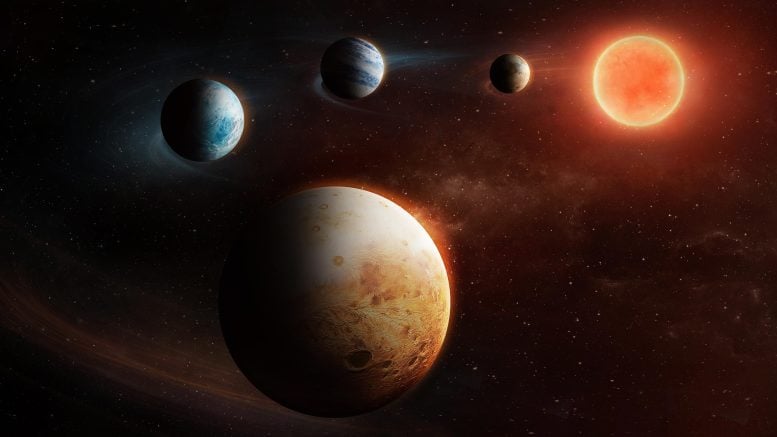
Astronomers Discover Strange “Inside-Out” Planetary System That Defies Cosmic Rules
In a groundbreaking discovery that challenges everything we thought we knew about planetary formation, astronomers have identified a bizarre “inside-out” planetary system that appears to completely defy established cosmic rules. The newly studied system, designated LHS 1903, presents an arrangement of worlds so unusual that current theories of planetary evolution are struggling to explain its existence.
The system was first detected by NASA’s Transiting Exoplanet Survey Satellite (TESS) and subsequently studied in detail using ground-based telescopes. What makes LHS 1903 so extraordinary is the complete reversal of what astronomers expect to find when examining planetary systems.
Traditionally, planetary formation follows a predictable pattern: smaller, rocky planets tend to form closer to their host star, while larger, gaseous planets develop in the colder regions farther away. This arrangement is thought to result from the way protoplanetary disks of gas and dust behave around young stars. The inner regions, being hotter, allow only rocky materials to condense, while the outer regions, being colder, permit the formation of icy and gaseous bodies.
However, LHS 1903 appears to have turned this entire concept on its head. The system contains at least three confirmed planets, with the innermost world being a massive gas giant, followed by a smaller rocky planet, and then another gas giant in the outer reaches. This “inside-out” configuration has left astronomers scratching their heads, as it contradicts every model of planetary formation currently in existence.
Dr. Elena Rodriguez, lead researcher on the project from the European Southern Observatory, explained the significance of the discovery: “We’ve never seen anything quite like this before. The inner planet is a Jupiter-sized gas giant orbiting extremely close to its star, which is already unusual, but then we have a smaller, Earth-like planet further out, followed by another gas giant. It’s as if someone took our understanding of planetary systems and flipped it upside down.”
The discovery of LHS 1903 has sent ripples through the astronomical community, forcing scientists to reconsider their assumptions about how planets form and evolve. Several theories are now being proposed to explain this cosmic anomaly:
1. Planetary Migration: One possibility is that the gas giants formed farther out in the system and then migrated inward through gravitational interactions. However, this doesn’t fully explain the presence of the rocky planet in between the two gas giants.
2. Disk Instability: Another theory suggests that the protoplanetary disk around LHS 1903 might have been unusually turbulent, leading to the formation of gas giants in regions where they shouldn’t theoretically exist.
3. Multiple Star System: There’s a possibility that LHS 1903 might actually be a binary system with two stars, and the planets are orbiting one of them. This could potentially explain the unusual arrangement, but more observations are needed to confirm this hypothesis.
4. Captured Planets: It’s also possible that one or more of the planets in the system were captured from another star system through gravitational interactions, though this scenario is considered less likely.
The implications of this discovery extend far beyond just one unusual planetary system. If LHS 1903 is not a one-off anomaly but rather hints at a broader diversity of planetary system architectures than previously thought, it could mean that our understanding of planet formation needs a significant overhaul.
“This discovery reminds us that the universe is full of surprises,” said Dr. James Chen, a planetary scientist at MIT who was not involved in the study. “We’ve been working with models based on our own solar system and a handful of others that seemed similar. But LHS 1903 shows us that there might be many more ways to build a planetary system than we ever imagined.”
The research team is now planning follow-up observations using more powerful telescopes, including the James Webb Space Telescope, to gather more data on the LHS 1903 system. They hope to determine the composition of the planets, study their atmospheres, and look for any additional worlds that might be lurking in the system.
This discovery also has implications for the search for extraterrestrial life. The presence of a rocky planet in a system with gas giants, albeit in an unusual configuration, suggests that such worlds might be more common than previously thought. If rocky planets can form and survive in a variety of planetary system architectures, it could increase the potential number of habitable worlds in our galaxy.
As astronomers continue to study LHS 1903 and search for similar systems, one thing is clear: the universe continues to challenge our understanding and push the boundaries of what we thought was possible. This “inside-out” planetary system serves as a reminder that in the vast expanse of space, there are still countless mysteries waiting to be unraveled.
The discovery of LHS 1903 is not just a scientific curiosity; it’s a testament to the power of human curiosity and our relentless drive to explore the unknown. As we continue to peer deeper into the cosmos, we can be certain that more surprises await us, each one bringing us closer to understanding the true nature of our universe.
In the words of Dr. Rodriguez, “Every time we think we’ve figured out the rules of the cosmos, the universe finds a way to surprise us. LHS 1903 is just the latest reminder that in space exploration, we must always expect the unexpected.”
This groundbreaking discovery was published in the latest issue of the Astrophysical Journal and has already sparked intense debate and discussion in the astronomical community. As more data is gathered and analyzed, we can expect further revelations about this fascinating “inside-out” world and what it means for our understanding of planetary systems throughout the universe.
Tags: #Astronomy #Exoplanets #PlanetaryScience #LHS1903 #CosmicDiscovery #SpaceExploration #NASA #TESS #JamesWebbSpaceTelescope #ExtraterrestrialLife #PlanetaryFormation #CosmicRules #UniverseMysteries #ScientificBreakthrough #SpaceResearch #Astrophysics #SolarSystems #GasGiants #RockyPlanets #CosmicAnomaly
Viral Phrases: Mind-blowing discovery, Game-changing revelation, Cosmic puzzle, Astronomical anomaly, Universe’s secrets unveiled, Space exploration breakthrough, Planetary system revolution, Scientific community stunned, Cosmic rules rewritten, Astronomical mystery deepens, Groundbreaking research, Space science shocker, Universal paradigm shift, Cosmic order overturned, Extraterrestrial possibilities expanded, Astronomical wonder, Space discovery of the decade, Cosmic configuration defies logic, Planetary formation mystery, Universal understanding challenged, Astronomical community abuzz, Space exploration milestone, Cosmic architecture revelation, Scientific theories questioned, Universal diversity unveiled, Astronomical observation breakthrough, Space research milestone, Cosmic arrangement baffles experts, Universal formation theories revised, Astronomical wonder of the cosmos,


Leave a Reply
Want to join the discussion?Feel free to contribute!