
Binance Controls 65% of CEX Stablecoin Reserves – What It Means for Liquidity
Binance Tightens Grip on Crypto Market as It Controls 65% of All Stablecoin Reserves on Centralized Exchanges
In a striking demonstration of its market dominance, Binance now controls an astonishing 65% of all stablecoin reserves sitting on centralized exchanges (CEXs), according to the latest data. With approximately $47.5 billion in USDT and USDC alone, the exchange has cemented its position as the undisputed liquidity powerhouse of the crypto ecosystem.
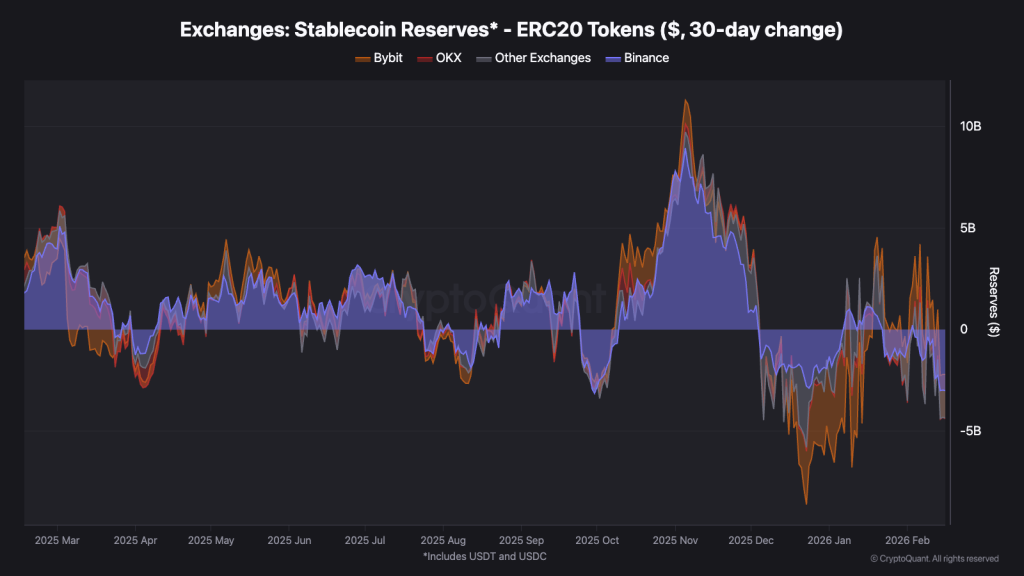
This massive concentration of stablecoin liquidity comes at a pivotal moment. While broader market outflows have cooled to around $2 billion monthly—a sharp decline from the $8.4 billion seen during late 2025’s market turbulence—Binance has quietly consolidated its control over the stablecoin supply. In the high-stakes world of cryptocurrency, where liquidity equals power, Binance is stacking an unprecedented amount of both.
The Numbers Tell the Story
The scale of Binance’s lead is staggering. The exchange’s stablecoin holdings have surged 31% over the past twelve months, climbing from $35.9 billion to the current $47.5 billion. This growth trajectory accelerated following the BUSD wind-down, with liquidity rapidly rotating into USDT and USDC.
But the most revealing statistic is the market share breakdown. While Binance commands 65% of CEX stablecoin reserves, its nearest competitor, OKX, holds a mere 13%. Coinbase trails with approximately 9%, and Bybit sits at around 6%. This isn’t just a lead—it’s a structural gap that continues to widen.
Recent reserve reports show Binance’s total reserves, including crypto assets, exceeding $155 billion. When liquidity shifts on Binance, the entire market feels it. That’s how dominant its position has become.
Why Capital Is Consolidating, Not Exiting
The market dynamics behind this consolidation reveal a crucial insight: money isn’t fleeing crypto—it’s seeking safety and efficiency. During the peak of late 2025’s panic, redemptions hit $8.4 billion. Now, outflows have stabilized at around $2 billion monthly, suggesting rotation rather than abandonment.
Investors appear to be making a calculated decision. Instead of spreading funds across multiple smaller venues, capital is clustering around platforms offering the deepest liquidity and fastest execution. In tight market conditions, traders prioritize minimizing slippage and ensuring reliable trade execution over diversification.
This behavior reflects a fundamental truth about market stress: perceived safe havens attract the bulk of capital flows. Binance’s massive liquidity pools, sophisticated trading infrastructure, and proven track record during volatile periods make it the natural destination for risk-conscious traders.
The Competitive Landscape
The competitive disparity is stark when examining individual exchange reserves:
- Binance: $47.5 billion (65% market share)
- OKX: $9.5 billion (13% market share)
- Coinbase: $5.9 billion (8% market share)
- Bybit: $4.0 billion (5% market share)
This concentration creates a self-reinforcing cycle. As more liquidity flows to Binance, it becomes the preferred venue for large trades, attracting even more volume and liquidity. Smaller exchanges struggle to compete on execution quality, leading to further capital migration.
The implications extend beyond simple market share. Binance’s dominance gives it outsized influence over stablecoin issuance, trading pair availability, and even the pricing dynamics across the entire crypto market. When Binance adjusts its liquidity parameters or fee structures, the effects ripple through every connected exchange and trading venue.
What This Means for Market Stability and Innovation
Binance’s control over 65% of CEX stablecoin reserves raises important questions about market stability and the future of crypto exchange competition. On one hand, deep liquidity provides crucial market stability, reducing volatility and ensuring traders can execute large orders without significant price impact. The concentration also drives operational efficiencies and technological innovation as Binance invests heavily in infrastructure to maintain its lead.
However, this level of centralization creates potential systemic risks. A technical issue, regulatory action, or security breach affecting Binance could have cascading effects across the entire crypto market given the volume of assets concentrated on the platform. The concentration also raises concerns about market fairness and the barriers to entry for new exchanges attempting to compete.
The Regulatory Perspective
Regulators worldwide are increasingly focused on exchange concentration and stablecoin reserves. Binance’s dominant position makes it a prime target for regulatory scrutiny, particularly regarding its custody practices, reserve transparency, and potential market manipulation concerns. The exchange’s ability to influence stablecoin supply and demand gives it considerable market power that regulators are likely to examine closely.
Looking Ahead: The Future of Crypto Liquidity
As the crypto market matures, the trend toward liquidity consolidation appears likely to continue. Institutional investors particularly favor deep, reliable liquidity pools, and Binance’s dominance in this area positions it strongly for the next wave of institutional adoption.
However, the market may also see innovation in decentralized exchange models and cross-exchange liquidity protocols that could challenge the centralized exchange model. The question remains whether technological disruption or regulatory intervention will be the primary force reshaping this concentration of power.
What’s clear is that Binance’s control over stablecoin reserves represents more than just a market statistic—it’s a fundamental reshaping of how crypto liquidity operates. In a market built on decentralization principles, the concentration of such massive liquidity in a single entity creates both opportunities and risks that will define the next chapter of crypto market evolution.
Tags & Viral Phrases
- Binance monopoly
- Stablecoin dominance
- Crypto liquidity king
- 65% market control
- Exchange power play
- Liquidity concentration crisis
- Binance empire expands
- Stablecoin war winner
- Market manipulation fears
- Crypto centralization problem
- Exchange liquidity arms race
- Binance untouchable
- Stablecoin reserves seized
- Crypto market monopoly
- Liquidity is power
- Binance unstoppable growth
- Exchange market share battle
- Stablecoin supply control
- Crypto trading dominance
- Market structure revolution
- Liquidity concentration warning
- Binance market dictator
- Stablecoin empire building
- Exchange competition collapse
- Crypto liquidity monopoly
- Binance market takeover
- Stablecoin reserve control
- Exchange power consolidation
- Crypto market centralization
- Liquidity dominance achieved
,


Leave a Reply
Want to join the discussion?Feel free to contribute!