
BMW Deploys Humanoid Robots in Manufacturing Across Europe for the First Time
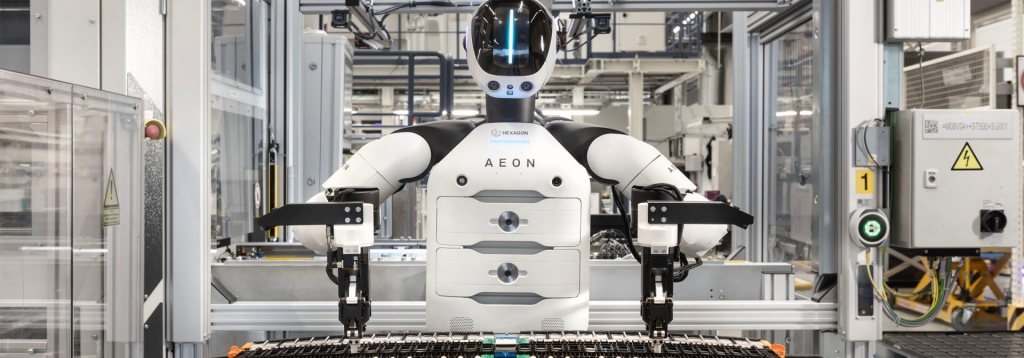
BMW’s Leipzig Plant Debuts AEON: Europe’s First Humanoid Robot on Factory Floor
In a landmark moment for European manufacturing, BMW Group has deployed its first humanoid robot on a German production line, marking a significant milestone in the convergence of artificial intelligence and industrial automation. The AEON robot, developed by Hexagon Robotics, is now operational at BMW’s Leipzig plant, representing not just a technological achievement but a strategic shift in how European industry approaches the integration of physical AI systems.
From South Carolina to Saxony: The Evolution of BMW’s Humanoid Strategy
The Leipzig deployment didn’t emerge in isolation. It represents the culmination of lessons learned from a ten-month pilot at BMW’s Spartanburg, South Carolina plant in 2025, where Figure AI’s Figure 02 robot worked alongside human operators on the BMW X3 assembly line. During that trial, the humanoid robot logged 10-hour shifts and moved over 90,000 components across the production of more than 30,000 vehicles.
The success of that American pilot created the blueprint for Europe’s entry into humanoid robotics manufacturing. Leipzig was selected not randomly, but because it represents BMW’s most technologically advanced production facility in Germany, combining battery production, injection molding, press shop, body shop, and final assembly under one roof. This comprehensive manufacturing environment provides the ideal proving ground for validating physical AI across diverse production scenarios.
AEON: Engineering Philosophy Meets Industrial Reality
What distinguishes AEON from other humanoid robots entering the market is its deliberate design philosophy. Arnaud Robert, President of Hexagon Robotics, articulated this approach clearly at a recent Munich event: “We’re not in the dancing business—we’re in the working business.” This industrial pragmatism permeates every aspect of AEON’s design.
Standing at 1.65 meters tall and weighing 60 kilograms, AEON moves on wheels rather than bipedal legs—a choice that might seem counterintuitive for a “humanoid” robot but reflects rigorous testing that demonstrated wheels’ superior efficiency on factory-grade flat floors. The robot achieves speeds of 2.5 meters per second and can autonomously swap its own battery in just 23 seconds, enabling continuous 24/7 operation without human intervention.
The robot’s 22 integrated sensors—including peripheral cameras, time-of-flight systems, infrared sensors, SLAM cameras, and microphones—provide complete 360-degree spatial awareness. This sensor suite enables AEON to perform quality inspection tasks that would be impossible for conventional stationary robots, effectively giving it situational awareness that rivals human workers.
Phased Implementation: Testing, Learning, Scaling
BMW’s approach to AEON deployment follows a deliberately phased strategy. Initial test deployment occurred in December 2025, followed by a planned test run in April 2026, before launching into a full pilot phase in summer 2026. During this pilot, two AEON units will operate simultaneously across two distinct use cases: high-voltage battery assembly and component manufacturing for exterior parts.
This measured rollout reflects BMW’s understanding that humanoid robotics in manufacturing represents uncharted territory, even for an automotive giant with extensive automation experience. The company has established a Centre of Competence for Physical AI in Production to consolidate expertise and create standardized evaluation pathways for technology partners, moving from laboratory testing through pilot phases to full deployment.
The Digital Infrastructure Foundation
AEON’s success depends not just on its hardware capabilities but on the digital infrastructure BMW has systematically built across its production network. The company has dismantled traditional data silos, replacing them with a uniform data platform that ensures all information is consistent, standardized, and accessible in real-time. This architectural foundation enables AI agents to operate autonomously and learn continuously from their environment.
The robot runs on NVIDIA Jetson Orin onboard computers and was trained extensively through simulation using NVIDIA’s Isaac platform—a methodology that allowed Hexagon to develop core locomotion capabilities in weeks rather than months. The project also leverages Microsoft Azure for scalable model development and Maxon’s specialized actuators for precise motion control.
Why This Matters Beyond BMW’s Factory Walls
The implications of BMW’s Leipzig deployment extend far beyond a single automotive plant. Deloitte’s 2026 State of AI in the Enterprise report, surveying over 3,200 senior leaders across 24 countries, found that 58% of companies are already using physical AI in some capacity, with that figure projected to reach 80% within two years. Asia Pacific currently leads in early implementation, making BMW’s European deployment particularly significant for the continent’s industrial competitiveness.
Milan Nedeljković, BMW’s Board Member for Production, captured the strategic importance: “The symbiosis of engineering expertise and artificial intelligence opens up completely new possibilities in production.” This statement reflects a fundamental shift in manufacturing philosophy—from viewing automation as isolated robotic cells to understanding physical AI as an integrated system that can adapt, learn, and collaborate with human workers.
The European Industrial Response
BMW’s deployment creates a critical inflection point for European manufacturing. For years, discussions about humanoid robots in industrial settings remained theoretical or confined to demonstrations and trade shows. Leipzig transforms that conversation by subjecting the technology to the unforgiving standards of real-world production: reliability requirements measured in 99.9% uptime, safety standards that protect human workers, and economic metrics that demand clear return on investment.
The question is no longer whether humanoid robots belong on factory floors—BMW has answered that definitively. The pressing question now is how quickly the rest of European industry will follow. With labor shortages affecting multiple sectors, aging populations creating workforce challenges, and global competitors accelerating their automation strategies, the pressure to adopt physical AI systems is intensifying.
Looking Forward: The Path to Scale
As the summer 2026 pilot phase begins, several factors will determine whether humanoid robots like AEON represent a transformative technology or an interesting experiment. First is scalability—can the systems maintain performance as deployment expands from two units to dozens or hundreds across multiple facilities? Second is adaptability—how quickly can the robots learn new tasks and adjust to changing production requirements? Third is economic viability—do the productivity gains and operational efficiencies justify the substantial investment in hardware, software, and integration?
BMW’s systematic, infrastructure-first approach suggests awareness of these challenges. By building the digital foundation before deploying physical AI, the company has created conditions for success that many competitors may lack. The Centre of Competence structure also indicates plans for knowledge sharing and capability building across the organization, rather than treating humanoid robotics as a standalone project.
The Leipzig deployment represents more than a technological milestone—it’s a statement about European manufacturing’s capacity to compete in an era where physical AI is becoming as fundamental to industrial operations as electricity or computer networks. As other European manufacturers watch BMW’s experiment unfold, the pressure to develop comparable capabilities will only intensify. The factory floor, once the domain of specialized industrial robots performing repetitive tasks, is evolving into a collaborative space where humans and humanoid robots work side-by-side, each leveraging their unique strengths in service of manufacturing excellence.
Tags: #BMW #AEON #HumanoidRobots #Manufacturing #PhysicalAI #HexagonRobotics #LeipzigPlant #IndustrialAutomation #AutomotiveManufacturing #NVIDIA #AIinProduction #FactoryOfTheFuture #EuropeanIndustry #Robotics #SmartManufacturing
Viral Phrases: “The robot that works while humans sleep” “Wheels over legs: The industrial efficiency choice” “From dancing bots to working machines” “Europe’s AI manufacturing awakening” “The 23-second battery swap revolution” “Sensors that see everything, all the time” “Phased rollout: Testing the future” “Data silos dismantled, AI unleashed” “The €0.58B question: Is it worth it?” “BMW’s Leipzig: Ground zero for European AI manufacturing”
,
![Here’s Alicia Keys at Apple Grand Central for 50th anniversary experience [Gallery]](https://techno-news.org/wp-content/uploads/2026/03/Alicia-Keys-50th-150x150.jpg "Here’s Alicia Keys at Apple Grand Central for 50th anniversary experience [Gallery]")
Leave a Reply
Want to join the discussion?Feel free to contribute!