
Body Horror Robot Turns Human Into Centaur
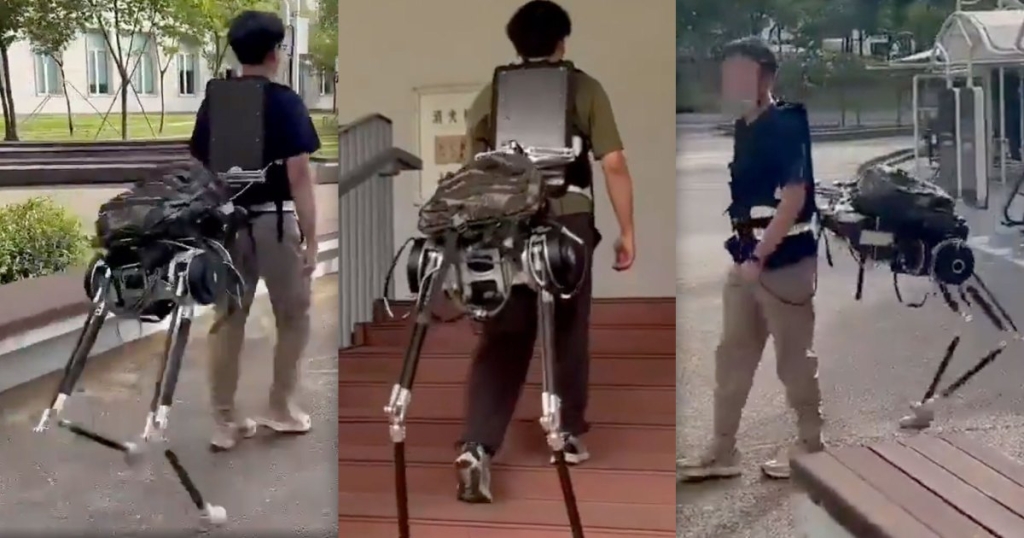
Meet the CentaurBot: The Two-Legged Robot That Walks Behind You Like a Mechanical Steed
Imagine strolling across a university campus, your backpack feeling as light as a feather, while a two-legged robot trots faithfully behind you like a loyal steed from Greek mythology. No, this isn’t a scene from a futuristic movie—it’s the latest innovation from engineers in Shenzhen, China, who have created a centaur-inspired robot designed to carry your load while you walk, climb stairs, or navigate rough terrain.
The Myth Meets Modern Engineering
The team at Southern University of Science and Technology has taken inspiration from the legendary centaur—a creature with the upper body of a human and the lower body of a horse. But instead of creating a full humanoid robot, they’ve designed a simpler, more practical solution: a two-legged robot that attaches to your back and walks behind you, carrying up to 44 pounds of gear.
In video demonstrations released alongside their research paper in the International Journal of Robotics Research, an engineer can be seen walking normally across campus with this mechanical companion striding behind him. The robot’s spindly legs might look a bit awkward at first glance, but they prove their worth when the terrain gets challenging.
Why Two Legs Beat Four Wheels
At first glance, you might wonder: why not just use a wheeled cart or a robotic dog? The answer lies in versatility. While wheeled solutions work great on flat surfaces, they become useless when you encounter stairs, curbs, or uneven ground. The centaur robot’s legs allow it to navigate stairs as easily as its human partner, maintaining pace and balance across diverse terrains.
The researchers found that their system significantly reduces the “metabolic cost” of carrying heavy loads. In other words, you expend much less energy walking with the CentaurBot than you would carrying an equivalent weight in a traditional backpack. The robot effectively distributes the load, taking pressure off your shoulders and back.
More Than Just a Dumb Pack Mule
What makes this system particularly clever is its interactive nature. The robot doesn’t just passively carry weight—it actively assists the wearer. Through a specialized human-robot interface, the CentaurBot can generate horizontal forces in the direction of movement, essentially giving you a gentle push forward as you walk. This creates a symbiotic relationship where both human and machine work together to move efficiently.
The engineers argue that while fully autonomous robots like Boston Dynamics’ Spot are being explored for load-carrying tasks, they come with significant limitations. These include the need for prior mapping of environments, limited battery life when carrying heavy payloads, and challenges in navigating completely unstructured terrain. The CentaurBot sidesteps these issues by keeping a human in the loop.
The Internet Reacts: Skepticism and Snark
As with any innovative technology, the CentaurBot has faced its share of criticism, particularly from the Reddit community. Some users were quick to point out that humanity has had effective load-carrying solutions for centuries.
“I feel like a shopping cart would almost always be a better solution,” one Redditor commented, suggesting the robot might only be useful in very specific scenarios—like carrying light sacrifices to a volcano with conveniently placed charging stations.
Others raised safety concerns. “Imaging running with that thing carrying a load and then tripping and breaking your back as it collapses on to you with force,” another user warned. “It’s like driving a car from the hood.”
The most common critique? “Have you guys heard of the rickshaw?” This pointed observation highlights that human-powered transportation solutions have existed for generations, making some question whether the CentaurBot is truly revolutionary or just a high-tech reinvention of existing concepts.
The Bigger Picture: Exoskeletons and Human Enhancement
The CentaurBot represents just one approach in the growing field of wearable robotics and exoskeletons. From military applications to industrial workplaces, engineers are finding new ways to augment human physical capabilities. Nike recently unveiled sneakers with integrated exoskeletons designed to boost leg performance, showing how this technology is moving from industrial settings into everyday consumer products.
The appeal is clear: as our population ages and we push the boundaries of human endurance, technologies that can extend our physical capabilities become increasingly valuable. Whether it’s helping workers in factories reduce fatigue, enabling hikers to carry more supplies, or assisting people with mobility challenges, wearable robotics offer a bridge between human intelligence and mechanical strength.
The Road Ahead
While the CentaurBot might seem like a solution looking for a problem to some critics, its development represents an important step in human-robot collaboration. The technology could find applications in military logistics, search and rescue operations, outdoor recreation, and assisting people with physical limitations.
The key advantage over fully autonomous solutions is reliability. A human operator can make judgment calls, navigate unexpected obstacles, and ensure the safe transport of valuable or sensitive cargo. Meanwhile, the robot handles the heavy lifting—literally.
As battery technology improves and robotics become more sophisticated, we can expect to see more hybrid solutions that combine human intelligence with robotic strength. The CentaurBot might not replace the humble shopping cart or the traditional backpack, but it represents an intriguing exploration of how we can work alongside machines to overcome our physical limitations.
Whether this particular design becomes widely adopted remains to be seen, but the underlying concept—using wearable robotics to enhance human capabilities—is likely here to stay. After all, if we can’t build a better human, why not build better tools for the humans we have?
Tags: #CentaurBot #WearableRobotics #Exoskeleton #HumanRobotCollaboration #LoadCarrying #ShenzhenInnovation #FutureOfMobility #Robotics #GreekMythologyInspired #TechInnovation
Viral Phrases: “mechanical steed,” “robot that walks behind you,” “two-legged wonder,” “mythical meets modern,” “the future of carrying stuff,” “robotic pack mule,” “Greek mythology meets engineering,” “walking with a mechanical shadow,” “the centaur approach,” “arms race in wearable tech,” “robotic sidekick,” “the next evolution in backpacks,” “sci-fi becomes reality,” “engineering meets mythology,” “the robot that follows your lead”
,

Leave a Reply
Want to join the discussion?Feel free to contribute!