
BTC difficulty jumps 15% largest increase since 2021, despite price slump
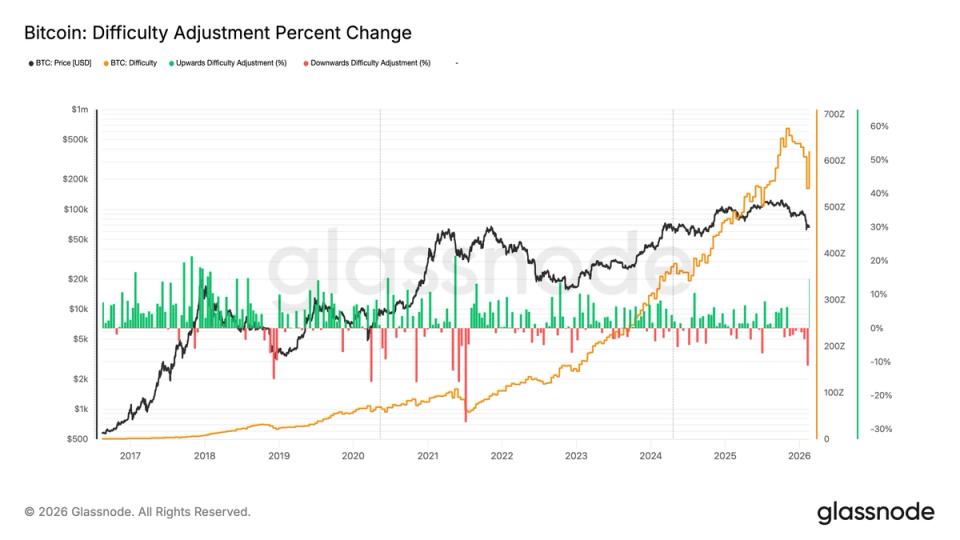
Bitcoin Mining Difficulty Surges to All-Time High Amid Hashrate Recovery and Industry Shifts
Bitcoin’s mining difficulty has skyrocketed to an unprecedented 144.4 trillion, marking a staggering 15% increase—the largest single adjustment since the 2021 China mining ban that sent shockwaves through the crypto industry. This dramatic recalibration comes as the network’s hashrate stabilizes after a turbulent period that saw the worst drawdown since late 2021.
The Perfect Storm: Weather, Economics, and Industry Evolution
The timing couldn’t be more dramatic. Just weeks after a brutal winter storm in the United States forced major mining operations to scale back, the Bitcoin network has responded with its most aggressive difficulty adjustment in years. This recalibration mechanism, which occurs every 2,016 blocks (approximately every two weeks), ensures that new blocks continue to be mined roughly every 10 minutes, maintaining the network’s stability regardless of computational power fluctuations.
The difficulty surge follows a 12% decline that occurred after severe weather conditions disrupted mining operations across North America. During the peak of the crisis, the bitcoin hashrate plummeted from 1.1 zettahash per second (ZH/s) to 826 exahash per second (EH/s), representing the most significant setback since the China mining ban sent the industry into chaos.
A Tale of Two Extremes: Hashrate and Hashprice
The Bitcoin mining ecosystem is experiencing a fascinating paradox. While the hashrate has rebounded impressively to 1 ZH/s, hashprice—the estimated daily revenue miners earn per unit of hashrate—remains at multi-year lows of just $23.9 per petahash per second (PH/s). This disconnect between computational power and profitability is creating unprecedented pressure on mining operations worldwide.
The numbers tell a compelling story. When bitcoin reached its all-time high of around $126,500 in October, the hashrate also peaked at 1.1 ZH/s. However, as prices tumbled to as low as $60,000 in February, the hashrate dropped to 826 EH/s. Since then, the price has partially recovered to around $67,000, but the hashrate’s journey back to 1 ZH/s reveals the complex dynamics at play in the mining sector.
The UAE’s Mining Empire: A $344 Million Windfall
While many miners struggle with razor-thin margins, some well-positioned players are thriving. The United Arab Emirates has emerged as a mining powerhouse, sitting on roughly $344 million in unrealized profit from its mining operations. This success story highlights how access to low-cost energy and favorable regulatory environments can create significant advantages in the competitive mining landscape.
The UAE’s mining success demonstrates that despite the challenging market conditions, large-scale operators with access to cheap, reliable energy continue to mine aggressively. These well-capitalized entities are helping keep the hashrate elevated and resilient, even amid subdued bitcoin prices that would normally force smaller operators to shut down their equipment.
The Great Migration: Bitcoin Miners Turn to AI
Perhaps the most significant trend emerging from this difficulty adjustment is the accelerating shift of mining companies toward artificial intelligence and high-performance computing. Several publicly listed mining companies are reallocating their energy and computing capacity away from Bitcoin mining and toward more profitable AI data center operations.
Bitfarms (BITF) has made headlines by announcing a complete rebrand that removes “bitcoin” from its name as it increases its focus on AI infrastructure. This strategic pivot reflects a broader industry trend where traditional mining companies are recognizing the superior economics of AI computing compared to Bitcoin mining.
Riot Platforms (RIOT) is facing pressure from activist investor Starboard to expand further into AI data center operations. The stock jumped nearly 7% following Starboard’s urging, demonstrating investor enthusiasm for mining companies that can successfully pivot to AI infrastructure.
The Technical Mechanics Behind the Surge
Understanding the significance of this difficulty adjustment requires diving into the technical details. Bitcoin’s difficulty adjustment mechanism is one of the network’s most brilliant innovations. Every 2,016 blocks, the network automatically recalibrates to ensure that blocks continue to be produced approximately every 10 minutes, regardless of changes in the total computational power securing the network.
This self-regulating mechanism means that as more miners join the network and contribute computational power, the difficulty increases proportionally. Conversely, when miners leave the network, the difficulty decreases. The recent 15% increase indicates that a substantial amount of computational power has returned to the network, or that the network anticipates continued growth in mining activity.
Market Implications and Future Outlook
The convergence of these factors—the dramatic difficulty increase, the hashrate recovery, the shift toward AI, and the persistent profitability challenges—creates a complex landscape for the Bitcoin mining industry. Several key implications emerge:
First, the network’s resilience is evident. Despite significant disruptions from weather events and shifting industry dynamics, the Bitcoin network continues to function smoothly, with the difficulty adjustment mechanism ensuring stability.
Second, the industry is clearly evolving. The migration of mining companies toward AI infrastructure suggests that the future of these operations may look very different from their current form. Companies that can successfully navigate this transition may emerge as leaders in both the crypto and AI sectors.
Third, the profitability challenges facing miners are likely to persist in the near term. With hashprice at multi-year lows and difficulty at all-time highs, only the most efficient operations with access to cheap energy will remain profitable.
Conclusion: A Network in Transition
Bitcoin’s record-breaking difficulty adjustment represents more than just a technical recalibration—it’s a snapshot of an industry in the midst of profound transformation. The network’s ability to absorb massive shocks, from weather events to industry-wide strategic shifts, demonstrates the robustness of its design.
As mining companies navigate the challenging economics of Bitcoin mining while exploring opportunities in AI and high-performance computing, the industry’s landscape continues to evolve. The companies that can successfully balance these competing demands—maintaining profitable Bitcoin mining operations while building AI infrastructure—may define the next chapter of the crypto mining story.
The 15% difficulty increase to 144.4 trillion is not just a number; it’s a testament to the network’s resilience, a challenge to miners’ profitability, and a signal of the industry’s ongoing evolution. As Bitcoin continues its journey toward mainstream adoption, the mining sector’s ability to adapt to these changing conditions will play a crucial role in shaping the future of the entire cryptocurrency ecosystem.
Tags: Bitcoin mining difficulty, hashrate recovery, AI data centers, cryptocurrency mining, Bitcoin network, mining profitability, United Arab Emirates mining, Bitfarms rebrand, Riot Platforms, Starboard investor, winter storm impact, hashprice lows, zettahash per second, exahash per second, petahash per second, cryptocurrency industry transformation, mining sector evolution, Bitcoin economics, computational power, network stability
Viral Sentences:
- Bitcoin mining difficulty hits ALL-TIME HIGH of 144.4 trillion in shocking 15% surge!
- Major winter storm forces Bitcoin miners to scale back operations across North America
- United Arab Emirates sits on $344 MILLION in unrealized mining profits
- Bitcoin mining companies abandon crypto for AI: The great migration begins!
- Bitfarms drops “Bitcoin” from its name as it pivots to AI infrastructure
- Activist investor pressures Riot Platforms to expand into AI data centers
- Bitcoin hashrate recovers to 1 ZH/s despite prices hovering around $67,000
- Mining profitability crushed as hashprice hits MULTI-YEAR lows at $23.9 PH/s
- Largest Bitcoin difficulty adjustment since 2021 China mining ban shakes industry
- Winter storm causes WORST Bitcoin hashrate drawdown since 2021
- Bitcoin mining companies face existential crisis as AI offers better economics
- Network recalibrates every 2,016 blocks to maintain 10-minute block production
- Well-capitalized miners with cheap energy dominate as smaller players exit
- Bitcoin mining difficulty mechanism proves resilient amid industry disruption
- The future of mining: Bitcoin today, AI infrastructure tomorrow?
,

Leave a Reply
Want to join the discussion?Feel free to contribute!