
BTC, ETH, XRP fall as U.S., Iran negotiators fail to reach war resolution
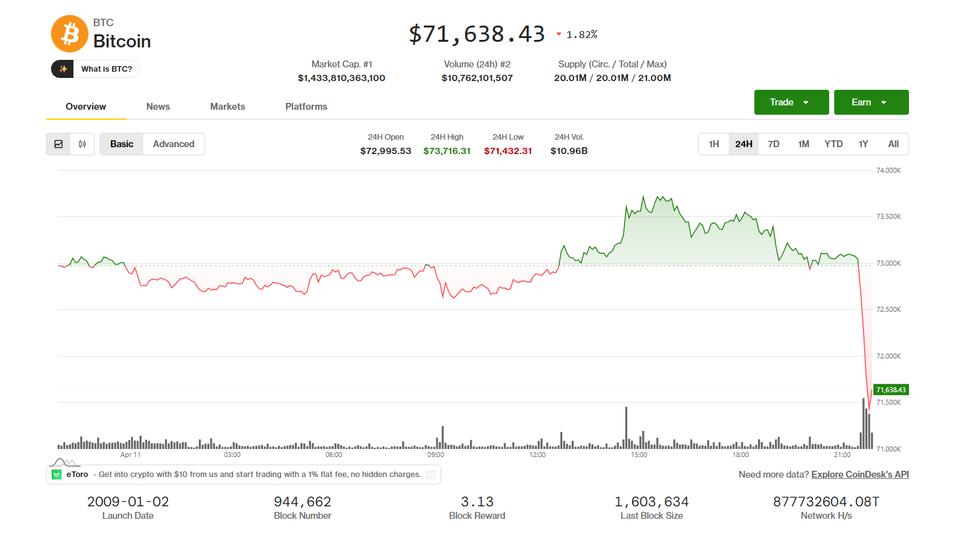
Bitcoin and Crypto Markets Slide 2% After Failed U.S.-Iran Ceasefire Talks
The cryptocurrency market experienced a sharp downturn late Saturday evening U.S. time, with Bitcoin and major altcoins all shedding approximately 2% following the announcement that U.S. and Iranian negotiators had failed to reach an extended ceasefire agreement. The market reaction underscores the persistent sensitivity of digital assets to geopolitical tensions and global macroeconomic developments.
Market Reaction to Diplomatic Breakdown
Bitcoin, the world’s largest cryptocurrency by market capitalization, traded around $71,600 at press time, marking a notable decline from its recent highs. The flagship digital asset’s price movement reflected broader market sentiment as investors reassessed risk exposure amid escalating geopolitical uncertainty.
Ethereum, the second-largest cryptocurrency, mirrored Bitcoin’s downward trajectory, falling to approximately $2,200 per ETH. The smart contract platform’s native token experienced similar volatility as traders adjusted positions in response to the diplomatic impasse.
XRP, the digital asset associated with Ripple Labs, slid to $1.33, while the broader CoinDesk 20 index, which tracks the performance of the largest cryptocurrencies, similarly fell to 1,188.52. Each of these major cryptocurrencies experienced declines of just under 2% in the immediate aftermath of Vice President J.D. Vance’s press conference announcing the failed negotiations.
The Pakistan Summit and Its Aftermath
The diplomatic efforts unfolded in Pakistan on Saturday, where U.S. and Iranian representatives convened to negotiate terms following the United States’ nearly six-week military campaign against Iran. The talks represented a critical juncture in efforts to de-escalate tensions that have gripped the Middle East and sent ripples through global financial markets.
Vice President Vance, speaking at a press conference following the negotiations, delivered a sobering assessment of the diplomatic efforts. “We’ve not reached an agreement,” he stated plainly, setting the stage for continued uncertainty in both traditional and cryptocurrency markets.
The timing of the announcement—late Saturday evening U.S. time—meant that cryptocurrency markets, which operate 24/7 unlike traditional stock exchanges, immediately reflected the news. This round-the-clock trading characteristic of digital assets often amplifies their sensitivity to breaking news and geopolitical developments.
Key Sticking Points in Negotiations
According to Vance, the negotiations encountered several critical obstacles that prevented the parties from reaching consensus. The U.S. delegation maintained firm positions on several non-negotiable elements, particularly concerning Iran’s nuclear ambitions.
“We’ve made very clear what our red lines are, what things we are willing to accommodate them on and what we’re not willing to accommodate them on, and we’ve made that as clear as we possibly could,” Vance explained during the press conference.
The most significant sticking point centered on nuclear weapons development. The U.S. insisted that Iran would “not seek a nuclear weapon and they will not seek the tools that would enable them to quickly achieve a nuclear weapon.” This hardline stance on nuclear proliferation appears to have been a primary factor in the negotiations’ failure.
Market Analysis and Expert Commentary
Cryptocurrency market analysts have noted the increasing correlation between geopolitical events and digital asset price movements. The immediate 2% decline across major cryptocurrencies following the failed ceasefire announcement demonstrates how quickly sentiment can shift in the crypto markets.
“Bitcoin and other cryptocurrencies have increasingly become viewed as risk assets,” explained one market analyst who requested anonymity. “When geopolitical tensions rise or diplomatic efforts fail, we often see capital flow out of these assets as investors seek safer havens.”
The timing of this diplomatic failure is particularly noteworthy given Bitcoin’s recent price action. The cryptocurrency had been trading near multi-month highs before the announcement, suggesting that the market had been pricing in at least some optimism regarding the negotiations.
Historical Context and Market Behavior
This isn’t the first time that cryptocurrency markets have reacted sharply to geopolitical developments. Digital assets have historically shown heightened sensitivity to international tensions, trade disputes, and diplomatic breakdowns. The 24/7 nature of crypto trading means that markets can respond immediately to news events, often before traditional markets open.
The current situation bears some similarities to previous instances where Middle East tensions have impacted risk assets. However, the cryptocurrency market’s relatively small size compared to traditional financial markets means that large price movements can occur with relatively modest shifts in capital flows.
Technical Analysis and Support Levels
From a technical perspective, Bitcoin’s decline to the $71,600 range represents a test of key support levels. Traders and analysts will be watching closely to see whether this level holds or if further selling pressure emerges in the coming days.
The $72,000 level had previously acted as strong resistance for Bitcoin, and its inability to maintain levels above this threshold following the geopolitical news suggests that bearish sentiment may be gaining traction in the short term.
Ethereum’s decline to $2,200 similarly represents a critical technical level. The altcoin had been attempting to establish a new trading range above $2,300, but the geopolitical uncertainty appears to have disrupted this momentum.
Broader Market Implications
The synchronized decline across major cryptocurrencies suggests a broad-based risk-off sentiment rather than sector-specific concerns. This unified market movement indicates that traders are reassessing their exposure to digital assets amid heightened geopolitical risks.
The CoinDesk 20 index’s decline to 1,188.52 represents a notable pullback from recent highs and may signal a broader correction if the geopolitical situation continues to deteriorate or if additional negative catalysts emerge.
Looking Ahead
Market participants will be closely monitoring developments in U.S.-Iran relations in the coming days. Any signs of renewed diplomatic efforts or, conversely, escalation of tensions could drive further volatility in cryptocurrency markets.
Additionally, traders will be watching for macroeconomic data releases and central bank communications that could provide further direction to risk assets, including cryptocurrencies. The interplay between geopolitical risks and monetary policy considerations will likely continue to influence market sentiment.
The cryptocurrency market’s reaction to the failed ceasefire talks serves as a reminder of the complex interplay between global events and digital asset prices. As the market matures, understanding these relationships becomes increasingly important for investors and traders navigating the volatile world of cryptocurrencies.
Tags:
Bitcoin price drop, cryptocurrency market crash, U.S. Iran negotiations, geopolitical crypto impact, Bitcoin falls 2%, Ethereum decline, XRP slides, CoinDesk 20 index, crypto market volatility, J.D. Vance press conference, Middle East tensions, nuclear proliferation crypto, digital asset risk, 24/7 crypto trading, Bitcoin support levels, Ethereum technical analysis, crypto risk-off sentiment, global events cryptocurrency, Bitcoin $71,600, Ethereum $2,200
Viral Sentences:
Crypto markets tank as U.S.-Iran talks collapse; Bitcoin drops 2% in minutes. Bitcoin bleeds 2% after failed ceasefire; traders brace for more pain. Ether slides to $2,200 as geopolitical fears grip crypto markets. XRP crashes to $1.33 amid broad crypto market sell-off. CoinDesk 20 index plunges below 1,200 as risk assets get hammered. Vance delivers bad news: no deal with Iran, crypto pays the price. Bitcoin support at $71,600 tested as geopolitical storm clouds gather. Crypto traders caught off guard as late-night news triggers massive sell-off. Ethereum fails to hold $2,300 as broader market weakness spreads. XRP joins crypto bloodbath following diplomatic breakdown in Pakistan. Digital gold loses its luster as traditional safe havens attract capital. 24/7 crypto markets react instantly to geopolitical developments, amplifying volatility. Nuclear concerns sink crypto prices as U.S. maintains hardline stance. Bitcoin whales liquidate positions as uncertainty clouds market outlook. Altcoins follow Bitcoin lower as risk appetite evaporates overnight. Crypto winter returns? Markets slide as diplomatic hopes fade. Technical levels crumble as selling pressure overwhelms buyers. Institutional investors reassess crypto exposure amid escalating global tensions. Weekend crypto carnage: major coins all down 2% or more. Market makers scramble to provide liquidity as bid-ask spreads widen.
,


Leave a Reply
Want to join the discussion?Feel free to contribute!