
Carbon Robotics built an AI model that detects and identifies plants
Carbon Robotics Unleashes AI That Instantly Recognizes Any Plant, Transforming Weed Control Forever
In the quiet fields where farmers have long squinted at the soil, deciding which green shoots are crops and which are invaders, a technological revolution is taking root. Seattle-based Carbon Robotics has just announced the Large Plant Model (LPM), an artificial intelligence system so advanced it can identify virtually any plant species instantly—even ones it has never seen before.
This isn’t just another incremental upgrade in agricultural tech. This is the moment when farming’s oldest problem—distinguishing friend from foe among millions of green shoots—gets solved by machines that think more like humans than like traditional computers.
The Problem That Has Haunted Farmers for Millennia
For thousands of years, weed control has been the silent killer of crop yields. Farmers have relied on chemical herbicides, backbreaking manual labor, or imprecise mechanical cultivation. Each method comes with brutal trade-offs: chemicals poison soil and water, manual labor is prohibitively expensive, and mechanical methods damage crops and leave many weeds standing.
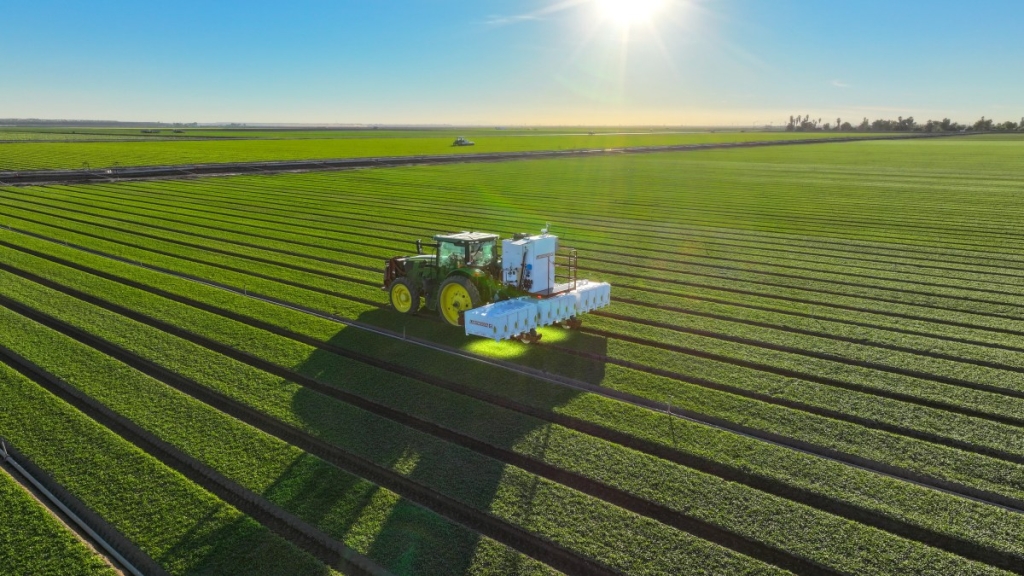
Carbon Robotics entered this battlefield in 2018 with a radical solution: autonomous robots that use high-precision lasers to kill weeds without touching the soil or crops. Their LaserWeeder machines roll through fields, identifying weeds with computer vision and zapping them with concentrated light.
But there was a catch. Every time a new weed species appeared—or even when familiar weeds looked different due to soil conditions or growth stages—the system needed retraining. This meant farmers waited 24 hours or more while engineers created new data labels and updated the AI.
The Large Plant Model Changes Everything
The LPM shatters that limitation. Trained on over 150 million photos and data points collected from more than 100 farms across 15 countries, this neural network understands plants at a fundamental level. It doesn’t just memorize what weeds look like; it grasps the essence of plant structure, species relationships, and growth patterns.
Paul Mikesell, Carbon Robotics’ founder and CEO, explains the breakthrough: “The farmer can live in real time and say, ‘Hey, this is a new weed. I want you to kill this,’ and that was something that had never been done before. There’s no new labeling or retraining because the Large Plant Model understands, at a much deeper level, what it’s looking at and the type of plant.”
This means a farmer can point their phone at an unfamiliar weed, snap a photo, and within seconds tell their LaserWeeder robots to eliminate it—no waiting, no technical expertise required.
The Technology Behind the Magic
Mikesell’s background prepared him perfectly for this challenge. Before founding Carbon Robotics, he built neural networks at Uber and worked on Meta’s Oculus virtual reality systems. He understood how to create AI that could generalize from massive datasets rather than simply memorizing patterns.
The LPM’s training data comes from real-world deployment. As LaserWeeder robots operate across diverse farms—from the cornfields of Iowa to the vineyards of France—they capture millions of images of plants in every condition imaginable. This global dataset gives the AI an unprecedented understanding of plant diversity.
“We have over 150 million labeled plants now in our training set,” Mikesell said. “We have enough data now that we should be able to look at any picture and decide what kind of plant that is, what species it is, what it’s related to, what its structure is like, without having ever even seen that particular plant before.”
How Farmers Will Use This Revolutionary Tool
The implementation is elegantly simple. Existing LaserWeeder systems will receive the LPM through a software update. Farmers access the robot’s user interface, which displays photos the machine has collected. They simply select which plants to kill and which to protect.
Want to eliminate a new invasive species that just arrived in your county? Point, click, and the robots start zapping. Need to protect a rare beneficial plant that’s showing up in your fields? Same process, opposite selection.
This real-time adaptability means farmers can respond to changing conditions immediately rather than waiting for technical support or software updates. It’s like giving every farmer a plant identification expert who works 24/7 and never makes mistakes.
The Economic and Environmental Impact
The implications extend far beyond convenience. Chemical herbicide use has plateaued in recent years as weeds develop resistance and environmental concerns mount. Manual labor shortages have made traditional weed control increasingly difficult and expensive.
Laser weeding offers a clean alternative: no chemicals leaching into groundwater, no soil compaction from tractors, no crop damage from mechanical cultivators. The robots work autonomously, day and night, in any weather condition that allows visibility.
Carbon Robotics has already raised over $185 million from investors including Nvidia NVentures, Bond, and Anthos Capital. This funding has enabled them to build a robust fleet of machines now operating across three continents.
The Future of Farming Has Arrived
What Carbon Robotics has achieved represents more than technological progress—it’s a fundamental shift in how humans interact with agriculture. For the first time, farmers can deploy intelligent machines that understand the biological complexity of their fields and adapt instantly to new challenges.
The LPM continues to evolve as more data flows in from deployed systems. Each new farm, each new weed species, each new growing condition makes the AI smarter. It’s a virtuous cycle: more deployment leads to better AI, which enables more deployment.
This technology arrives at a critical moment. Global food demand continues rising while agricultural labor becomes scarcer. Climate change introduces new weed species to regions where they’ve never existed before. Traditional farming methods strain under these pressures.
Carbon Robotics’ solution doesn’t just address today’s problems—it anticipates tomorrow’s challenges. When climate change brings new invasive species to your fields next season, your LaserWeeder will already know how to handle them.
The End of Weed Control as We Know It
The agricultural industry has been waiting for this moment. The combination of autonomous robotics, precision laser technology, and truly intelligent AI creates a solution that’s more effective, more sustainable, and more adaptable than anything that came before.
Farmers who adopt this technology gain more than weed control—they gain a partner that understands their fields as well as they do, perhaps even better. They gain the ability to respond instantly to threats, protect beneficial plants, and optimize their operations with unprecedented precision.
The Large Plant Model isn’t just another AI tool. It’s the culmination of decades of agricultural frustration, technological innovation, and environmental necessity. It’s the moment when farming finally catches up to the digital age—not by replacing farmers, but by giving them superpowers they’ve always dreamed of.
As these intelligent machines roll through fields worldwide, they carry with them the promise of a future where weed control is no longer a losing battle, but a precisely managed aspect of sustainable agriculture. The age of AI-powered farming has officially begun, and Carbon Robotics just raised the bar for what’s possible.
Tags
CarbonRobotics #LaserWeeder #AIinAgriculture #LargePlantModel #AutonomousFarming #SustainableAgriculture #WeedControl #AgriculturalTechnology #PrecisionFarming #FutureOfFarming #AgTechInnovation #NeuralNetworks #MachineLearning #Robotics #SmartFarming #EnvironmentalSustainability #FoodSecurity #ClimateChangeAgriculture #DigitalFarming #AgriculturalAI
Viral Sentences
Farmers can now tell robots to kill new weeds instantly without any technical expertise or waiting periods. The Large Plant Model understands plants at a fundamental level, recognizing species it has never seen before. Over 150 million plant images trained this revolutionary AI system across 15 countries and 100+ farms. Chemical-free weed control arrives as lasers replace herbicides in autonomous farming revolution. Seattle startup raises $185 million to build robots that think like plant experts. Real-time plant identification transforms agriculture forever, ending 10,000 years of weed control frustration. AI that learns instantly from a single photo changes everything about how we farm. The future of sustainable agriculture rolls through fields on autonomous laser-equipped robots. Farmers gain superpowers as machines identify and eliminate weeds with human-like intelligence. Climate change brings new challenges, but AI-powered robots adapt instantly to any plant species.
,


Leave a Reply
Want to join the discussion?Feel free to contribute!