
ChatGPT just crossed a big line by introducing ads
ChatGPT Rolls Out Ads: The First Major AI Chatbot Embraces Advertising
Just under a month after its initial announcement, ChatGPT has officially begun rolling out advertisements for users on its free and Go tiers. For now, these ads will only appear for users aged 18 and older in the United States. With this move, ChatGPT becomes the first major AI chatbot to introduce advertising into its conversational interface, marking a significant shift in how artificial intelligence platforms will be monetized going forward.
Ads Will Now Appear in Your ChatGPT Conversations
In mid-January, OpenAI rolled out its cheapest Go tier globally. Starting at just $8 per month in the US, this tier offers higher messaging and file upload limits along with longer memory and context window than the free tier. Back then, OpenAI also confirmed its plans to introduce ads in ChatGPT conversations. These ads are now going live for ChatGPT free and Go users in the United States.
To start, OpenAI is treating the rollout as a limited test, designed to “learn, listen, and make sure we get the experience right.” The company has emphasized that this is an experimental phase where they’ll gather user feedback and refine the ad experience before any broader implementation.
“We’re starting to roll out a test for ads in ChatGPT today to a subset of free and Go users in the U.S.,” OpenAI announced on social media. “Ads do not influence ChatGPT’s answers. Ads are labeled as sponsored and visually separate from the response. Our goal is to give everyone access to ChatGPT for free with…”
For now, ChatGPT Plus, Pro, Business, Enterprise, and Education tiers will remain ad-free. This tiered approach means that only users on the free and Go plans will encounter advertisements, while those willing to pay for premium subscriptions can continue using the service without commercial interruptions.
The company also confirms that ads will not influence ChatGPT’s responses, and advertisers will not have access to user conversations. Each advert will be clearly labeled as sponsored, so users can easily distinguish between AI-generated responses and paid content. However, OpenAI says it will maintain a clear separation between ads and ChatGPT’s responses to preserve the integrity of the conversational experience.
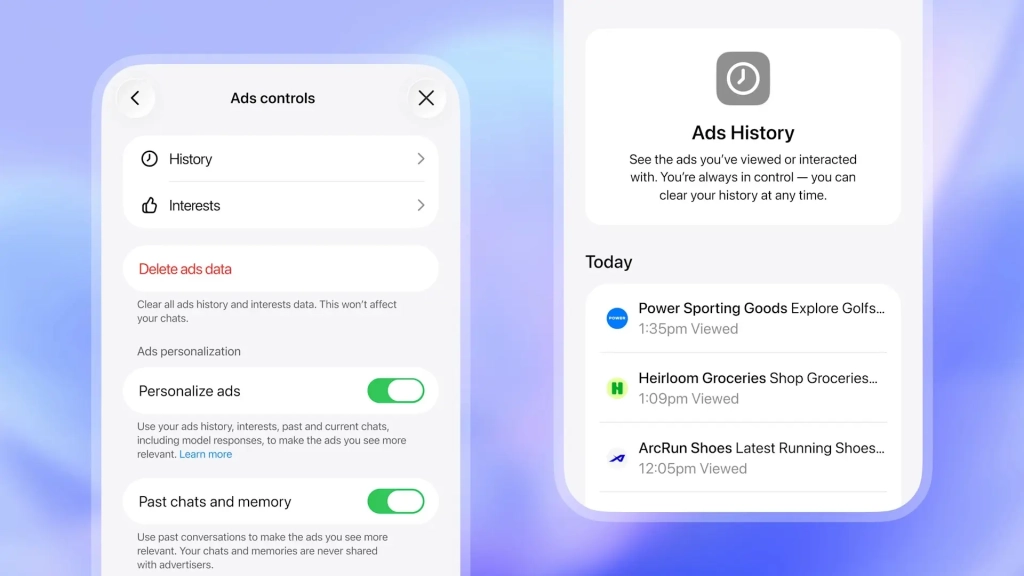
Users will have control over their ad experience. You can dismiss any ads that you see in ChatGPT, share feedback with OpenAI, and even delete any ad data linked to your account. This level of transparency and user control is crucial as OpenAI navigates this new territory in AI monetization.
Ads Will Fund Further ChatGPT Expansions
For advertisers, OpenAI will provide them with information on the number of views and clicks, but that’s about it. Its reporting data will not be as in-depth as what Meta or Google offer to their advertising partners. This more limited approach to analytics reflects OpenAI’s cautious entry into the advertising space, prioritizing user privacy over granular targeting capabilities.
Ads will be tied to user searches and conversation topics. For example, if you’re chatting with ChatGPT about toys, it may surface relevant ads from advertisers specializing in children’s products. This contextual advertising approach aims to make ads more relevant and less intrusive, though it raises questions about how much conversation content is being analyzed for ad targeting purposes.
With ads, OpenAI wants to expand access to ChatGPT features to more people while funding the extra resources required to maintain and improve the platform. The company has positioned this move as necessary to sustain free access while continuing to invest in AI research and development.
By introducing ads, ChatGPT has crossed a line many users assumed AI chatbots would avoid, at least for now. While OpenAI insists ads won’t influence responses or compromise privacy, their arrival marks a clear shift in how conversational AI will be funded going forward. For free users especially, this feels less like a small experiment and more like the beginning of a new, ad-supported era for AI.
This development raises important questions about the future of AI monetization. Will other AI chatbots follow ChatGPT’s lead? How will users respond to ads in what was previously an ad-free experience? And what does this mean for the broader AI industry as companies seek sustainable business models for increasingly expensive technology?
The introduction of ads to ChatGPT represents a pivotal moment in the evolution of artificial intelligence. It signals that even the most advanced AI systems need traditional revenue streams to survive and grow. As users adapt to this new reality, the success or failure of ChatGPT’s advertising experiment could shape how AI companies approach monetization for years to come.
Tags: ChatGPT ads, OpenAI advertising, AI chatbot monetization, ChatGPT free tier, ChatGPT Go tier, AI advertising, conversational AI, artificial intelligence ads, ChatGPT sponsored content, AI platform monetization, OpenAI business model, ChatGPT revenue, AI chatbot advertising, ChatGPT ad rollout, AI monetization strategy
Viral Phrases: “ChatGPT crosses the line,” “The end of ad-free AI,” “AI chatbots embrace advertising,” “ChatGPT’s bold monetization move,” “The future of AI is ad-supported,” “OpenAI’s advertising experiment,” “ChatGPT users face ads,” “AI monetization revolution,” “The ad-supported AI era begins,” “ChatGPT’s advertising watershed moment”
,


Leave a Reply
Want to join the discussion?Feel free to contribute!