
ChatGPT Now Has Ads for Free and Go Tier Users
ChatGPT Introduces Ads: OpenAI’s Bold Move Sparks Debate in the AI Industry
In a move that’s sending shockwaves through the tech world, OpenAI has officially announced that advertisements will begin appearing in ChatGPT for users on free and Plus subscription tiers starting today. This strategic shift marks a significant pivot for the AI giant, which has long maintained a relatively ad-free experience across its platform.
According to OpenAI’s official announcement, the advertising rollout will initially target U.S. users who are logged in and over 18 years of age. The company has been careful to emphasize that this change will not affect minors, nor will it impact users on higher-tier subscriptions including Pro, Business, Enterprise, and Education plans.
Why Now? The Economics Behind the Decision
OpenAI’s decision to introduce ads comes as the company faces mounting pressure to achieve profitability. Despite ChatGPT’s explosive growth and widespread adoption, the free and Plus tier options require “significant infrastructure and ongoing investment,” according to company statements. The computational costs associated with running large language models at scale have proven to be substantial, and OpenAI is now turning to advertising as a means to offset these expenses.
For users unwilling to see ads, OpenAI has presented two clear alternatives: upgrading to a Plus or Pro plan, or opting to receive fewer daily free messages in exchange for an ad-free experience. This tiered approach suggests that OpenAI is testing the elasticity of user willingness to pay for premium features.
How the Ads Will Work
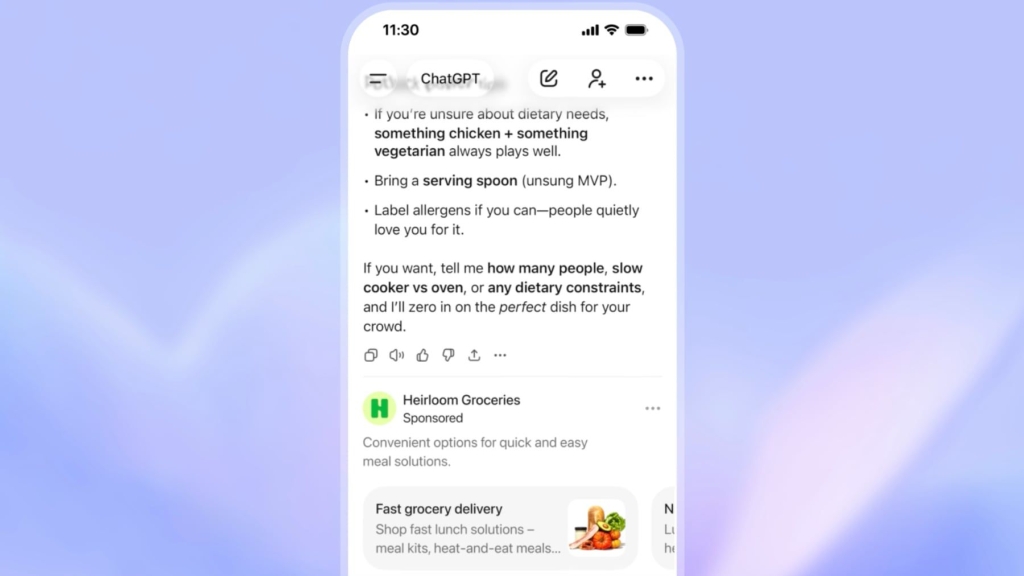
The advertising experience within ChatGPT will be distinctly separated from the AI’s responses. Ads will be clearly labeled as “sponsored” content and presented in a format that’s visually distinct from ChatGPT’s conversational answers. This separation is crucial, as OpenAI has explicitly stated that advertisements will not influence the answers that ChatGPT provides.
By default, the system will show ads based on several factors: the current conversation topic, past chat history, and previous interactions with advertisements. For instance, a discussion about cooking techniques might trigger ads for meal kit delivery services or kitchen appliance retailers. However, OpenAI has drawn clear boundaries around sensitive topics, promising that ads will not appear for health-related queries, mental health discussions, or political content.
Privacy and Data Protection Measures
In an era of heightened privacy concerns, OpenAI has attempted to address potential user anxieties by implementing several protective measures. Advertisers will receive only aggregate data such as the number of views or clicks their ads receive, but will not have access to individual chat histories, user memories, or personal information.
Users will have control over their advertising experience through several features: the ability to dismiss unwanted ads, share feedback on ad relevance, and access information explaining why particular advertisements were shown. Additionally, users can delete their ad data and disable personalization features entirely, though doing so may result in less relevant ad content.
Industry Reaction and Competition
The announcement has sparked immediate reactions across the tech industry. Notably, OpenAI’s competitor Anthropic seized the moment to differentiate itself, promising to keep its Claude chatbot ad-free. During the Super Bowl, Anthropic even aired a commercial directly calling out OpenAI’s ad plans, with the company stating that “a conversation with Claude” is not the right place for advertisements.
This move by OpenAI represents a significant strategic shift in the AI assistant market. While many free digital services rely on advertising for revenue, the introduction of ads into what many users consider a utility or tool rather than a content platform represents uncharted territory.
The User Experience Question
The central question now facing OpenAI is whether users will accept this new reality or seek alternatives. The company is positioning this as a test phase, emphasizing its commitment to “learn, listen, and get the ad experience right.” OpenAI believes that ads in ChatGPT can be “uniquely valuable for people,” suggesting confidence that well-targeted, relevant advertisements could enhance rather than detract from the user experience.
However, the success of this strategy remains uncertain. Users who have grown accustomed to an ad-free AI experience may find the introduction jarring, potentially driving some to explore alternatives or upgrade to paid tiers. The coming months will likely reveal whether OpenAI’s bet on advertising integration pays off or becomes a point of friction with its user base.
What This Means for the Future of AI
OpenAI’s decision to introduce ads could signal a broader trend in the AI industry. As companies struggle with the high costs of developing and maintaining sophisticated AI systems, advertising may emerge as a necessary revenue stream for many platforms. This could fundamentally alter how users interact with AI assistants, potentially making the distinction between AI tools and traditional digital platforms increasingly blurred.
The move also raises questions about the long-term business models for AI companies. Will advertising become the standard for free AI services, or will we see a continued divide between ad-supported and premium, ad-free experiences? OpenAI’s experiment may provide valuable insights for the entire industry as it grapples with these questions.
As ChatGPT users in the United States begin encountering advertisements in their daily interactions with the AI, all eyes will be on user adoption rates, feedback, and ultimately, whether this bold move helps OpenAI achieve the profitability it seeks without alienating the millions of users who have made ChatGPT a daily tool for work, creativity, and information gathering.
Tags
ChatGPT ads, OpenAI advertising, AI monetization, ChatGPT Plus, AI industry news, tech business models, artificial intelligence revenue, ChatGPT subscription, Anthropic Claude, AI competition, digital advertising, tech privacy concerns, AI user experience, OpenAI profitability, ChatGPT free tier, AI market trends, technology business strategy, ChatGPT updates, AI advertising debate, tech industry disruption
Viral Phrases
ChatGPT goes commercial, AI gets real about money, OpenAI’s ad gamble, The end of free AI?, Ads in your AI conversations, ChatGPT’s big monetization move, AI industry shakeup, OpenAI vs Anthropic battle, Your AI assistant now has sponsors, The price of artificial intelligence, ChatGPT’s revenue revelation, AI tools enter advertising era, OpenAI’s bold business bet, The future of free AI services, ChatGPT users face new reality, AI monetization mystery solved, OpenAI’s profit puzzle, ChatGPT’s advertising awakening, The AI assistant that sells you stuff, OpenAI’s revenue revolution
,

![AI in Xcode, folds in iPhones [Cult of Mac podcast No. 6]](https://techno-news.org/wp-content/uploads/2026/02/Cult-of-Mac-podcast-6-AI-coding.jpg.webp-150x150.webp "AI in Xcode, folds in iPhones [Cult of Mac podcast No. 6]")
Leave a Reply
Want to join the discussion?Feel free to contribute!