
Chemical Signature Hidden in Lunar Rocks Hints at Oxygen in The Ancient Moon : ScienceAlert
Moon’s Hidden Chemistry Revealed: Scientists Uncover Clues to Earth’s Origins in Ancient Lunar Rock
In a groundbreaking discovery that could reshape our understanding of Earth’s early history, an international team of physicists and geoscientists has detected a rare chemical signature in Moon rocks that offers unprecedented insight into the conditions that shaped both our planet and its celestial companion billions of years ago.
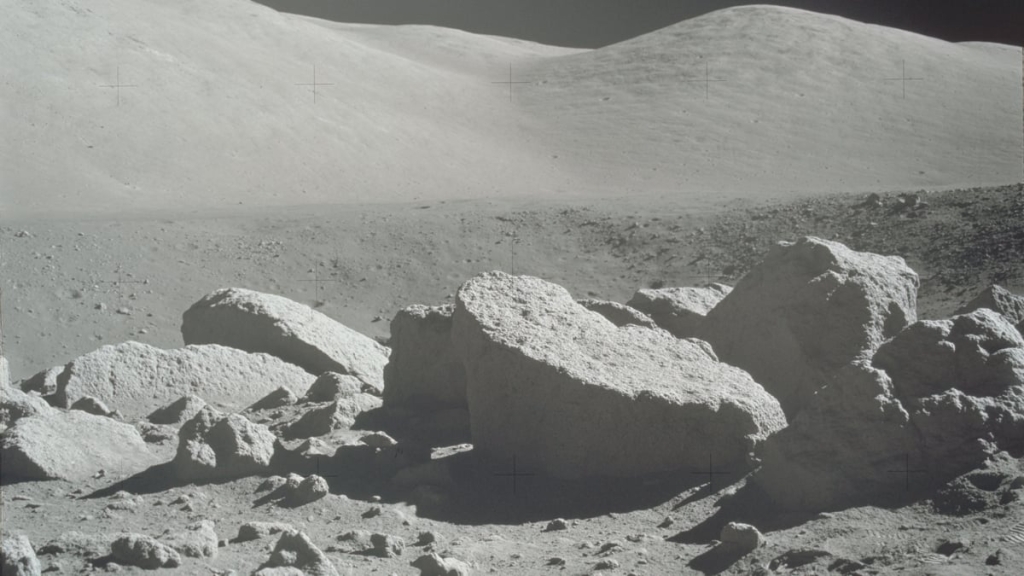
The research, published in Nature Communications in March 2026, centers on an analysis of ilmenite—a mineral composed of iron, titanium, and oxygen—found in a lunar sample collected during NASA’s final Apollo mission in 1972. Using cutting-edge electron microscopy, the team discovered that approximately 15% of the titanium in this ilmenite exists in an unexpected chemical state: instead of the typical +4 charge (where titanium loses four electrons), some atoms carry only a +3 charge, known as trivalent titanium.
This finding confirms long-held geological suspicions and opens a new window into the Moon’s ancient chemistry. Trivalent titanium forms only under conditions where oxygen is scarce—a crucial detail that could help scientists reconstruct the chemical environment of the early Moon when this rock crystallized approximately 3.8 billion years ago.
“The Moon preserves a record of geological conditions that Earth has lost,” explains Advik D. Vira, a graduate student in physics at Georgia Institute of Technology and co-author of the study. “Unlike Earth, the Moon lacks plate tectonics and a substantial atmosphere to recycle elements over billions of years. This makes it an invaluable time capsule for understanding our solar system’s early history.”
The implications extend far beyond lunar geology. Since the prevailing theory suggests that the Moon formed from debris after a Mars-sized object collided with the early Earth, understanding the Moon’s chemical evolution provides critical context for Earth’s own formation and development.
The research team, which includes Emily First, an assistant professor of geology at Macalester College, identified over 500 existing analyses of lunar ilmenite that could contain similar trivalent titanium signatures. This vast dataset, combined with planned experiments to quantify the relationship between trivalent titanium abundance and oxygen availability, could revolutionize our understanding of not just the Moon, but other oxygen-poor planetary bodies throughout the solar system.
Looking ahead, the team anticipates that these methods will prove invaluable for analyzing samples from upcoming Artemis missions, which aim to return humans to the lunar surface, as well as from China’s Chang’e-6 mission, which successfully retrieved samples from the Moon’s far side in 2024.
“Our findings suggest that ilmenite could become a powerful tool for reconstructing the history of ancient magmas from the Moon,” notes First. “By understanding how oxygen availability in magma affects trivalent titanium formation, we can potentially decode the chemical conditions present during different periods of lunar evolution.”
This research represents more than just a technical achievement in analytical chemistry—it offers a pathway to recovering information about Earth’s earliest chapters that have been erased by our planet’s dynamic geological processes. As scientists continue to probe these ancient lunar samples with increasingly sophisticated techniques, we may finally uncover definitive answers about how our home planet came to be.
Tags & Viral Phrases:
Moon rock analysis, ancient lunar chemistry, Apollo 17 samples, trivalent titanium discovery, Earth’s origins, lunar geology breakthrough, oxygen-poor environments, planetary formation, electron microscopy advances, Artemis mission implications, Chang’e-6 far side samples, geological time capsule, early solar system conditions, cutting-edge space research, scientific discovery 2026, Moon formation theory, ilmenite mineral study, planetary science revolution, Earth-Moon connection, billion-year-old chemistry
,


Leave a Reply
Want to join the discussion?Feel free to contribute!