
China Gives Rare Look At 11,000-Ton Destroyer Built For Electronic Warfare
China’s Yanan Destroyer Makes Rare Public Debut, Firing Electronic Warfare Missiles Near Taiwan
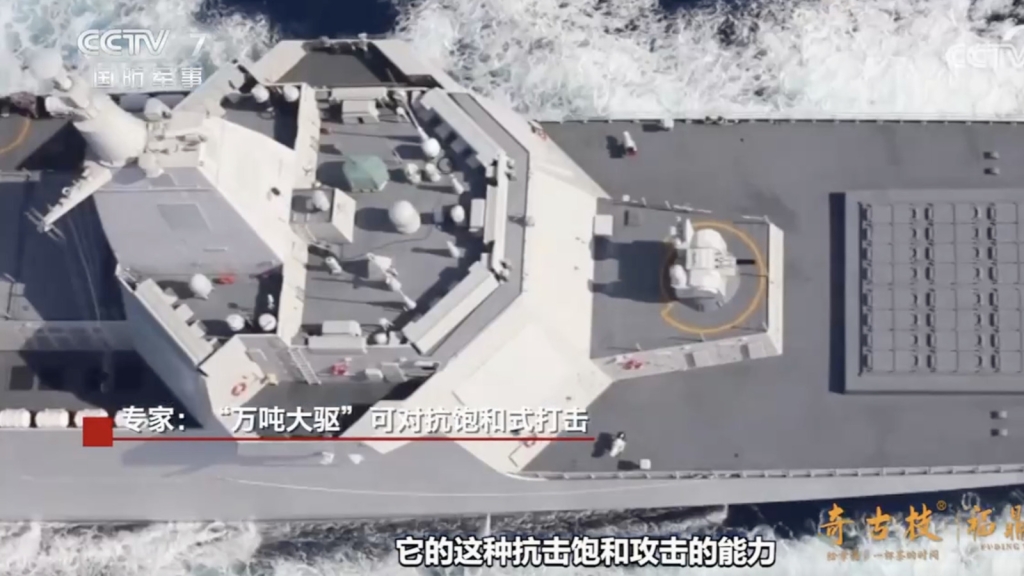
In an extraordinary and highly unusual move, China’s state broadcaster CCTV aired a 27-minute documentary on January 29, 2026, offering an unprecedented look at the PLA Navy’s Type 055 guided-missile destroyer, the Yanan. The footage showed the warship in action, launching electronic jamming missiles during a simulated encounter with foreign aircraft near Taiwan—a rare admission of real-time military activity in one of the world’s most sensitive maritime regions.
The Type 055 destroyer is no ordinary vessel. Weighing in at roughly 11,000 tons, it’s one of the most formidable warships in China’s rapidly expanding naval arsenal. Western military analysts often classify these ships as cruisers rather than destroyers due to their massive size, advanced weaponry, and operational capabilities. Each Type 055 is armed with 112 vertical launch cells capable of firing a lethal mix of surface-to-air missiles, anti-ship cruise missiles, and potentially even hypersonic weapons. Stretching over 590 feet in length and capable of reaching speeds of 30 knots, these ships are engineering marvels—floating fortresses that rival the most advanced warships operated by the United States Navy.
What makes this footage particularly striking is not just the display of hardware, but the transparency. China is notoriously secretive about its military operations, especially those occurring near Taiwan. The decision to broadcast such a detailed account of a naval engagement—complete with crew communications, radar activation, and missile launches—signals a shift in Beijing’s communication strategy, possibly aimed at demonstrating military readiness and technological superiority amid rising regional tensions.
Not a One-Ship Show
The Yanan didn’t operate alone. In the footage, the destroyer coordinates with the Shandong, China’s first domestically built aircraft carrier. Before firing its electronic warfare missiles, the Yanan calls on the Shandong to dispatch three aircraft to verify the presence and movements of the approaching foreign planes. This inter-ship coordination underscores a critical evolution in modern naval warfare: no single vessel is an island. Success now depends on seamless integration across air, surface, and electronic domains.
Crew member Wang Liang, featured in the broadcast, emphasized this point clearly. He described modern naval combat as a “system of systems,” where every platform—from destroyers to carriers to aircraft—must function in concert. Wang framed the PLA Navy as operating on the front lines of both conventional and “invisible warfare,” a term that likely refers to electronic and cyber operations that can disable enemy systems without firing a single kinetic weapon.
This isn’t the first time CCTV has aired such footage. Earlier in the same series, the Nanchang, the very first Type 055 destroyer, was shown operating alongside the Liaoning, China’s first aircraft carrier. In that clip, the Nanchang actively maneuvered to block two foreign vessels attempting to infiltrate the carrier group’s formation. Together, these broadcasts paint a picture of a navy that is not only growing in size but also in sophistication and strategic coordination.
The Fleet Behind All of This
The Yanan and Nanchang are just two ships in what is now the largest navy in the world by sheer number of vessels. Currently, eight Type 055 destroyers are in active service, all commissioned by 2023. Four are stationed with the North Sea Fleet in Qingdao, while the other four operate under the South Sea Fleet from Zhanjiang, giving China a powerful presence in the contested South China Sea. A second batch of these destroyers is already under construction at shipyards in Dalian and Shanghai, with new ships expected to enter service later this year. These newer models are rumored to feature upgraded power generation systems and improved weaponry, including the YJ-20 hypersonic anti-ship ballistic missile, which China successfully tested live for the first time in late 2025.
The timing of this broadcast is no coincidence. It comes amid escalating tensions around Taiwan, fueled by the United States’ approval of approximately $11.1 billion in arms sales to the island in December 2025. Japan has also entered the fray, with Prime Minister Sanae Takaichi suggesting that a Chinese attack on Taiwan could trigger a military response from Tokyo. Beijing has strongly condemned both moves, viewing them as direct challenges to its sovereignty claims.
By showcasing the Yanan’s capabilities so publicly, China appears to be sending a clear message: it is prepared for high-intensity conflict and has the technological and operational edge to dominate the electromagnetic spectrum, not just the physical battlefield. Electronic warfare, once a supporting element, is now front and center in China’s naval doctrine.
As the PLA Navy continues to expand and modernize, the world is watching closely. The Yanan’s public debut may be a one-off event—or it could be the start of a new era of transparency from Beijing, one where military might is displayed not in secret parades, but in real-time operational footage. Either way, the message is unmistakable: China’s navy is here, it’s formidable, and it’s ready to project power farther and faster than ever before.
china navy, type 055 destroyer, yan an warship, electronic warfare missiles, pla navy, south china sea, taiwan tensions, cctv military footage, shandong aircraft carrier, hypersonic weapons, naval modernization, pla navy coordination, electromagnetic warfare, us vs china navy, military transparency, naval power projection, aircraft carrier strike group, anti-ship ballistic missile, naval shipbuilding, maritime security
,


Leave a Reply
Want to join the discussion?Feel free to contribute!