
Cowboys, lassos, and nudity: AI startups turn to stunts for attention in a crowded market | US news
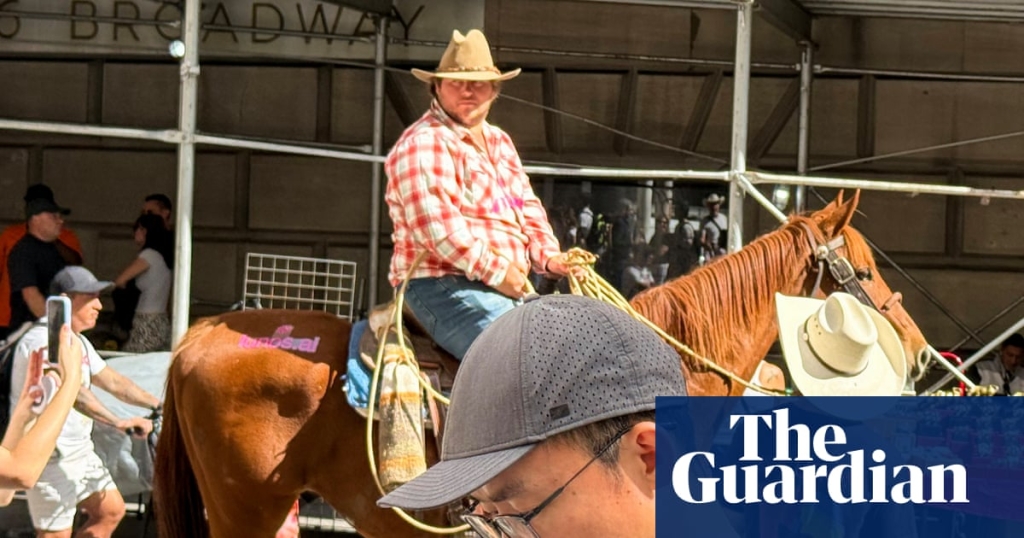
In the crowded world of AI startups, where hundreds of companies promise to revolutionize workflows and automate tedious tasks, standing out has become a Herculean challenge. Enter Lunos, a New York City-based AI startup that decided to take an unconventional approach to launch its brand: lassoing Wall Street’s iconic Charging Bull with a cowboy and a horse.
On a sweltering evening in late September, the Lunos team orchestrated a spectacle that would make even the most jaded New Yorker stop and stare. A cowboy, dressed in full ranch gear and sporting a western hat emblazoned with the Lunos logo, galloped toward the bronze bull in lower Manhattan. With a flick of the wrist, he lassoed the bull’s horns as onlookers—both invited guests and curious passersby—watched in awe. The cowboy and his horse then circled the statue, handing out branded cowboy hats and stress balls.
The goal was simple yet bold: to deliver Lunos’s pitch of “taming the wild west” of accounts receivables in the most literal, public way possible. Lunos uses AI to automate invoices, track balances, and follow up on payments, but in a sea of sameness, the team knew they needed to do something extraordinary to capture attention.
“We were trying to figure out, in a sea of sameness, how we could stand out as a startup to be reckoned with,” said Alex Mann, Lunos’s head of growth.
This stunt is part of a broader trend among AI companies turning to provocative marketing to differentiate themselves in an overcrowded, capital-rich sector. In 2025 alone, AI startups raised roughly $202.3 billion globally, up from $114 billion the year before, according to Crunchbase. With so much money flowing into the industry, the competition for attention has never been fiercer.
But Lunos isn’t the only company taking a creative approach to marketing. Virio, an AI marketing startup, hired cowboys to walk two horses around the Moscone Center in San Francisco during HubSpot Inbound, a major marketing conference. The aim was to catch the attention of founders and C-suite leaders at companies with 50 or more employees, Virio’s target customers. Co-founder Emmett Chen-Ran walked beside the horses holding a Virio banner reading “Content that drives pipeline.” While the stunt didn’t unfold exactly as planned—few people walked by, and the horses moved too quickly for most to capture good photos—the company still generated more than 300 qualified website visitors and gained visibility after “countless” people recognized the team inside the conference.
Personal AI, a small language model startup, took a different approach. At the HubSpot AI Summit in San Francisco, CEO Suman Kanuganti walked onstage topless wearing only gym shorts. He opened with the line “LLMs are naked” splashed across the screen behind him. Kanuganti argued that the large models powering ChatGPT and Gemini leave users feeling “exposed” and “insecure.” Personal AI, which allows businesses to create individuated AI models by training on their own documents, he said, is the “missing gear.” As he slowly dressed, each item of clothing symbolized a layer of protection he personally trusted. The point was to show that, just as people select clothing from familiar brands, businesses should have access to AI systems built with transparent guardrails: privacy, safety, and reliability.
These stunts reflect a shift in how AI companies are approaching marketing. With so many companies promising similar outcomes—increased productivity, faster workflows, and better efficiency—traditional channels like trade shows, white papers, and digital ads are no longer enough to cut through the noise. Instead, companies are turning to spectacle, provocation, and even controversy to capture attention.
But this approach isn’t without its risks. Some startups, like Artisan AI, Cluely, and Friend, have faced backlash for ads implying their tools could replace human workers, help cheat in job interviews, or substitute for real friendships. Critics argue that these tactics amount to distasteful messaging orchestrated for “ragebaiting.”
Wary of similar accusations, business-focused AI startups like Lunos, Virio, and Personal AI are experimenting with less controversial gimmicks. For Lunos, the Wall Street stunt was a way to make a bold statement without crossing ethical lines. For Virio, the goal was to create viral content that would drive engagement on LinkedIn. For Personal AI, the provocative stage performance was a visual metaphor for the company’s core message about privacy and security.
Marketing experts say the rise of these tactics speaks to the pressure facing enterprise AI startups in a rapidly expanding sector. Emily Heyward, co-founder and CEO of Red Antler, a marketing agency for startups, said founders feel trapped in a “land grab mentality,” desperate to seize attention before a rival does, even if the product is still maturing. “Few, if any, of these businesses are currently delivering on their ultimate product vision,” Heyward said. “It’s really about drumming up enough noise that people try you versus the other guy, then stick with you as the tech evolves.”
Tom Goodwin, co-founder of All We Have Is Now, a business consulting firm, takes a more cynical view. He argues that there is “a degree of desperation and urgency” driving many of these stunts. AI is subversive, he says, which lends itself to marketing that is provocative and attention-grabbing. “These companies are terrified that no one’s going to notice them,” Goodwin said. He goes further, arguing that there is “a degree of lack of morality” embedded in some AI products, pointing to intellectual property theft, job displacement, and the dismissal of human values.
While these startups insist their tactics were strategic and effective in driving sales, the results have been mixed. Virio’s stunt didn’t unfold as planned, but the company still generated website traffic and gained visibility. Personal AI’s stage performance helped cement the company’s positioning and secure additional conference bookings. For Lunos, the impact was immediate: thousands of people visited the site, LinkedIn posts about the Wall Street stunt drew hundreds of likes and comments, and word-of-mouth referrals spiked across CFO Slack groups. In the three months following the launch, inbound leads filled the sales pipeline with hundreds of qualified prospects. The publicity even triggered an influx of job applications, including McKinsey consultants seeking leadership roles across business operations.
As Mann put it, the stunt “opened the door for us to think creatively about how we want to design future activation campaigns,” a sign that the pressure to stand out is unlikely to fade.
In a world where AI startups are vying for attention in an increasingly crowded market, the line between innovation and gimmickry is becoming blurrier. Whether it’s lassoing Wall Street’s Charging Bull, walking horses around a conference center, or stripping down on stage, these companies are betting that bold, memorable stunts will be the key to capturing the hearts—and wallets—of their target audiences.
Tags:
AI startups, marketing stunts, Wall Street Bull, viral content, enterprise AI, accounts receivables, productivity, automation, LinkedIn engagement, brand differentiation, provocative marketing, business software, AI funding, startup growth, creative campaigns.
Viral Phrases:
- “Taming the wild west of accounts receivables”
- “Lassoing Wall Street’s iconic Charging Bull”
- “Content that drives pipeline”
- “LLMs are naked”
- “Land grab mentality”
- “Ragebaiting”
- “Opening the door for creative campaigns”
- “Fear becomes a marketing tool”
- “Standing out in a sea of sameness”
- “Drumming up enough noise”
,

Leave a Reply
Want to join the discussion?Feel free to contribute!