
Damage to Chinese Spacecraft Was Worse Than Reported
Cracked Window in Space: The Terrifying Truth Behind China’s Shenzhou Spacecraft Incident
In the vast, silent expanse of space, a tiny crack in a spacecraft window became the focal point of a high-stakes drama that unfolded last November aboard China’s Tiangong space station. What began as a routine mission quickly transformed into a nail-biting situation that tested the limits of human ingenuity and highlighted the growing dangers of space debris.
The Discovery That Changed Everything
It was early November when Chinese astronauts aboard the Tiangong space station made a discovery that would send shockwaves through the space community. Through state media reports, the world learned that the crew had found “tiny cracks” in the viewport window of their Shenzhou return spacecraft. The culprit? Most likely a collision with space debris—one of the many invisible hazards lurking in Earth’s orbit.
At first glance, these might have seemed like minor imperfections. But in the unforgiving environment of space, even the smallest crack can spell disaster. The implications were immediately clear: the spacecraft, designed to safely return the crew to Earth, was now potentially compromised.
The Musical Chairs of Space Survival
The discovery forced China’s space agency to make an unprecedented decision—delaying the crew’s return and triggering what can only be described as a cosmic game of musical chairs. With the cracked spacecraft deemed unsafe for crewed flight, the situation demanded quick thinking and even quicker action.
The solution came in the form of an emergency replacement spacecraft, launched to the station without a crew on board. This daring move allowed the astronauts to transfer to a safe vehicle and ultimately return to Earth. But the incident raised troubling questions about the safety of human spaceflight and the growing menace of space debris.
The Cracks That Went Deeper Than Expected
As the dust settled, new details emerged that painted an even more alarming picture of the incident. According to revelations from the Shenzhou-20 crew, some of the cracks had actually penetrated through the window—a fact that was not immediately disclosed to the public.
“My first thought was whether a small leaf had somehow stuck to the outside of the window,” recalled Chen Dong, a crew member of the Shenzhou-20 mission, during a recent interview aired by China Central Television (CCTV). The absurdity of the comparison—a leaf in the vacuum of space—highlights the surreal nature of the discovery.
“But then I quickly realized that couldn’t happen because we were in space. How could there possibly be a fallen leaf there?” Chen continued, his words capturing the moment of dawning realization that something was seriously wrong.
Peering Into the Abyss
To assess the damage, the crew employed a “pen-shaped microscope” connected to a tablet, allowing them to examine the cracks in unprecedented detail. What they saw was both fascinating and terrifying.
“We could see very clearly the small cracks [with the microscope],” Chen recalled. “Several were relatively long, and one was shorter. We could also see that some of the cracks had penetrated through.”
The visualization of these microscopic fissures, visible only through specialized equipment, underscores the delicate nature of spacecraft engineering. In space, where the vacuum is absolute and temperatures swing wildly between extremes, even the smallest breach can have catastrophic consequences.
The Science of Survival
Wang Jie, another crew member who had previously worked as an aerospace technician, provided crucial context about why the situation, while serious, wasn’t immediately life-threatening.
“I wasn’t really nervous,” Wang explained, demonstrating the calm professionalism required of astronauts. “The outermost layer of the viewport is a protective layer, and inside it there are two pressure-bearing layers, and we are safe as long as the cabin pressure doesn’t change.”
This layered approach to spacecraft design—multiple barriers between the crew and the void of space—proved its worth in this incident. The viewport’s construction, with protective and pressure-bearing layers, created a safety margin that bought time for engineers to devise a solution.
Engineering a Fix in Orbit
The China National Space Administration responded to the crisis with characteristic efficiency. Along with the emergency replacement spacecraft, they launched what they termed a “porthole crack repair device.”
“Astronauts installed it inside the Shenzhou-20 capsule, effectively improving the spacecraft’s heat protection and sealing capabilities during reentry,” the CNSA stated in an official announcement. This innovative solution—essentially a patch applied in the harsh environment of space—demonstrates the remarkable adaptability of space engineering.
The repair device wasn’t just a temporary fix; it was designed to enhance the spacecraft’s performance during the critical reentry phase, when temperatures can reach thousands of degrees as the vehicle plunges through Earth’s atmosphere.
The Return That Almost Wasn’t Routine
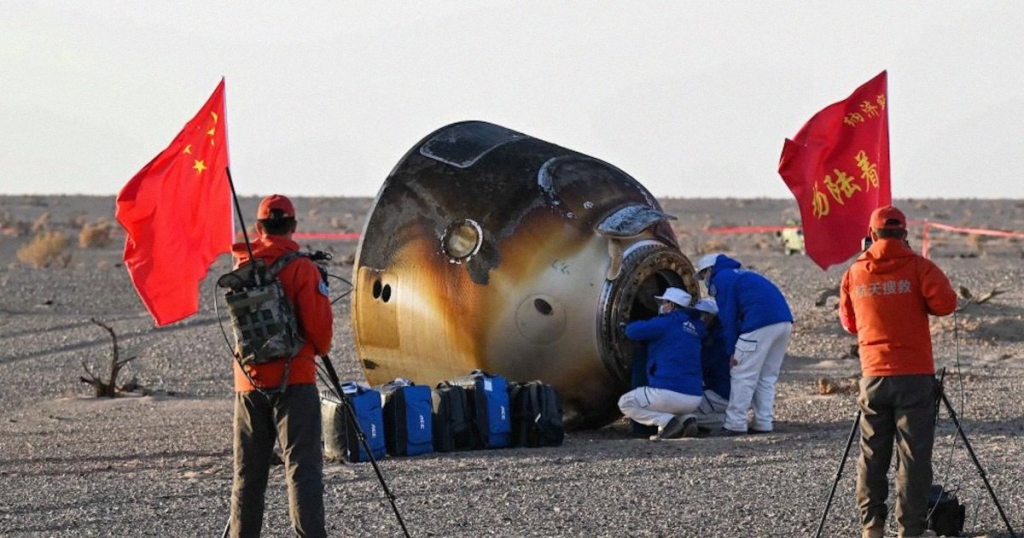
On January 19, the repaired spacecraft returned to Earth, landing in Mongolia’s vast steppes. But even this final phase of the mission wasn’t without its challenges. Without a crew on board to separate the main parachute, ground teams faced a tense moment as they worried the capsule might be dragged across the terrain upon landing.
Teams had to act quickly, racing against time to secure the spacecraft and prevent any damage during touchdown. This post-landing drama, while less publicized than the initial discovery of the cracks, highlights the complexity and risk inherent in every phase of space missions.
The Aftermath: A Spacecraft Tested
Following the landing, the CNSA conducted a thorough examination of the spacecraft’s exterior. Their assessment? The capsule’s condition was “generally normal” post-reentry, a testament to both the quality of the original construction and the effectiveness of the emergency repairs.
This outcome provides valuable data for future spacecraft design and emergency procedures. The incident has likely influenced how space agencies worldwide approach viewport construction, damage assessment, and in-orbit repairs.
The Broader Implications: Space Debris as an Existential Threat
While the crew emerged unharmed and the mission ultimately succeeded, the incident serves as a stark reminder of the growing threat posed by space debris. As humanity expands its presence in space, launching more satellites, space stations, and crewed missions, the orbital environment becomes increasingly crowded and dangerous.
Especially concerning are plans for enormous megaconstellations of satellites. Companies are launching cargo to orbit at an unprecedented rate, creating what some experts describe as a minefield in Earth’s orbit. Each piece of debris, no matter how small, travels at velocities that make even paint flecks potentially lethal to spacecraft.
The incident with the Shenzhou spacecraft’s cracked window is more than just an isolated event—it’s a warning sign of the challenges that lie ahead as we push further into space. As we continue to explore and exploit the final frontier, we must also develop better ways to protect our assets and our astronauts from the invisible dangers that surround us.
What This Means for the Future of Space Exploration
The successful resolution of this crisis demonstrates both the resilience of current space technology and the ingenuity of the engineers and astronauts who operate it. However, it also highlights the need for continued investment in debris tracking, spacecraft shielding, and emergency response capabilities.
As more nations and private companies enter the space arena, international cooperation on space debris mitigation becomes increasingly crucial. The Shenzhou incident serves as a case study in crisis management, but it also underscores the importance of preventing such crises whenever possible.
The window crack that could have ended in tragedy instead became a story of human triumph over adversity—but it’s a triumph that came with valuable lessons about the fragility of our presence in space and the urgent need to address the growing problem of orbital debris.
Tags:
Space debris, Tiangong space station, Shenzhou spacecraft, China National Space Administration, viewport crack, orbital debris, space station emergency, spacecraft repair, human spaceflight safety, space junk threat, Chinese astronauts, emergency spacecraft, space exploration risks, orbital minefield, megaconstellation impact, space technology innovation
Viral Sentences:
- “A tiny crack in space became a cosmic crisis that tested human ingenuity to its limits.”
- “Space debris: the invisible killer lurking in Earth’s orbit, one crack away from catastrophe.”
- “When a leaf-like crack in a spacecraft window threatened lives, China’s space agency delivered an emergency fix from orbit.”
- “The musical chairs of space survival: how a cracked window turned a routine mission into a high-stakes drama.”
- “Some cracks penetrated through—the terrifying truth behind China’s spacecraft emergency that the world almost didn’t know.”
- “From viewport to void: how space debris nearly turned a spacecraft into a death trap.”
- “The pen-shaped microscope that saved lives: how astronauts discovered the cracks that could have killed them.”
- “Space is getting crowded, and the Shenzhou incident proves Earth’s orbit is becoming a minefield.”
- “Multiple pressure-bearing layers saved the day—but for how long can we rely on engineering against orbital debris?”
- “The return that almost wasn’t routine: how ground teams raced to secure a spacecraft without its crew.”
,

Leave a Reply
Want to join the discussion?Feel free to contribute!