
Data Center DC Embraces 800V Power Shift
Data Center Power Revolution: How AI’s Energy Demands Are Forcing a Complete Overhaul of Infrastructure
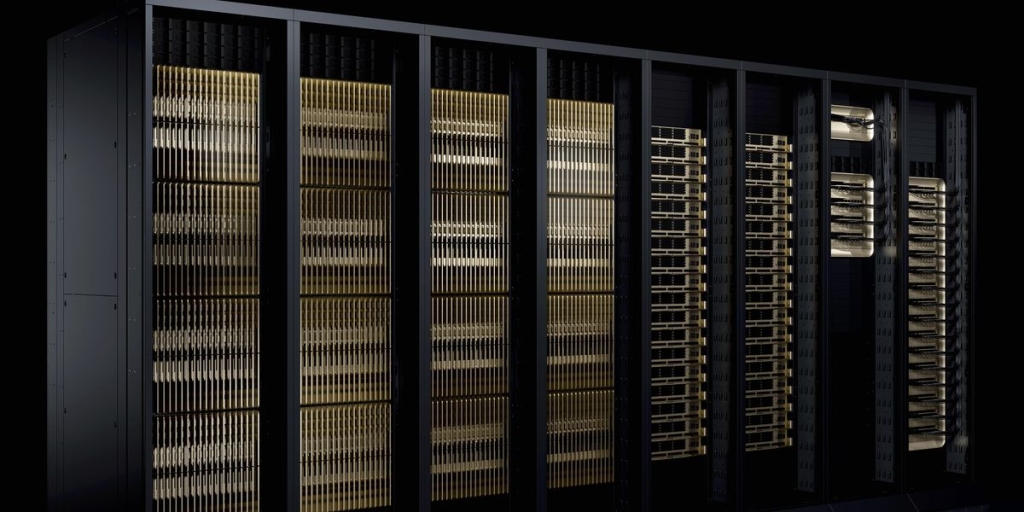
The recent Nvidia GTC conference showcased groundbreaking advancements in AI chip architectures, but a critical bottleneck has emerged: as these chips become exponentially more powerful, the rest of the data center infrastructure is struggling to keep pace. The power delivery ecosystem is now racing to catch up, with major announcements from Delta, Vertiv, and Eaton revealing new designs specifically engineered for the AI era.
The AC-DC Conversion Crisis
Today’s data centers were built around alternating current (AC) utility power, but this traditional approach is becoming increasingly untenable. The electrical journey involves multiple energy-draining conversions: power enters as medium-voltage AC (1kV to 35kV), steps down to low-voltage AC (480V or 415V) via transformers, converts to DC inside uninterruptible power supplies (UPS) for battery storage, converts back to AC, and finally converts again to low-voltage DC (typically 54V) at the server level.
“Each power conversion between the electric grid or power source and the silicon chips inside the servers causes some energy loss,” explains Luiz Fernando Huet de Bacellar, vice president of engineering and technology at Eaton.
For traditional data centers drawing around 10 kW per rack, this double conversion process worked adequately. But AI workloads are pushing requirements toward 1 MW per rack—a thousand-fold increase that exposes the fundamental inefficiencies of the current system.
The Copper Problem
At AI-scale power requirements, the physical limitations become staggering. According to Nvidia’s calculations, a single 1 MW rack could require up to 200 kg of copper busbar. Scale that to a 1 GW data center, and you’re looking at 200,000 kg of copper—not to mention the energy losses and connector requirements that come with such massive copper infrastructure.
“Every conversion incurs some power loss,” notes Chris Thompson, vice president of advanced technology and global microgrids at Vertiv. “As power requirements grow, the sheer size of the converters and the connector requirements of copper busbars become untenable.”
The High-Voltage DC Solution
The industry’s response is a fundamental shift toward high-voltage direct current (DC) power distribution. By converting 13.8 kV AC grid power directly to 800 VDC at the data center perimeter, most intermediate conversion steps are eliminated.
This architectural change delivers multiple benefits:
- Fewer power conversion stages mean higher system reliability
- Reduced heat dissipation from fewer power supply units
- Improved energy efficiency through minimized conversion losses
- Smaller equipment footprint
- Significantly reduced copper requirements
Switching from 415V AC to 800V DC enables 85% more power transmission through the same conductor size. This efficiency gain comes from higher voltage reducing current demand, which lowers resistive losses. The result: 45% less copper needed, 5% improvement in efficiency, and 30% lower total cost of ownership for gigawatt-scale facilities.
Industry Adoption and Innovation
According to a report from technology advisory group Omdia, higher voltage DC data centers have already appeared in China. In the Americas, the Mt. Diablo Initiative—a collaboration between Meta, Microsoft, and the Open Compute Project—is experimenting with 400V DC rack power distribution.
Several vendors are racing to lead this transformation:
Vertiv has developed an 800V DC ecosystem that integrates with NVIDIA Vera Rubin Ultra Kyber platforms, with commercial availability planned for the second half of 2026.
Eaton is advancing its 800V DC systems with a medium-voltage solid-state transformer (SST) that will serve as the core of its DC power distribution system.
Delta has released 800V DC in-row 660kW power racks with 480kW of embedded battery backup units.
SolarEdge is developing a 99% efficient SST paired with native DC UPS and DC power distribution layers.
The Standardization Challenge
Patrick Hughes, senior vice president of strategy at the National Electrical Manufacturers Association, emphasizes that most innovation currently occurs at the 400V DC level, though some companies are preparing for 800V DC.
The industry faces a critical challenge: it needs a complete, coordinated ecosystem including power electronics, protection systems, connectors, sensing technology, and service-safe components that scale together rather than in isolation. This requires retooling manufacturing capacity for DC-specific equipment, expanding semiconductor and materials supply, and establishing clear, long-term demand commitments.
“Many are taking a cautious approach, offering limited or adapted solutions while waiting for clearer standards, safety frameworks, and customer commitments,” Hughes explains. “Building the supply chain will hinge on stabilizing standards and safety frameworks so suppliers can design, certify, manufacture, and install equipment with confidence.”
The Future of Data Center Power
The transition from AC to DC power distribution represents more than just a technical upgrade—it’s a fundamental reimagining of how we deliver energy to the most demanding computational workloads ever created. As AI continues to push the boundaries of what’s possible, the infrastructure supporting it must evolve just as rapidly.
The companies that can deliver efficient, scalable DC power solutions will likely define the next generation of data center architecture, enabling the AI revolution while addressing its substantial energy challenges.
Tags: #AI #DataCenters #PowerDelivery #Nvidia #DCArchitecture #EnergyEfficiency #HighVoltageDC #AIInfrastructure #DataCenterDesign #PowerElectronics
Viral Phrases:
- “AI’s energy demands are forcing a complete overhaul of infrastructure”
- “The copper problem: 200,000 kg for a single data center”
- “From AC to DC: The power revolution nobody saw coming”
- “Every conversion incurs energy loss—and AI can’t afford that”
- “The bottleneck nobody talks about: power delivery”
- “When your chips are faster than your power grid”
- “The 800V solution to the 1MW problem”
- “Data centers are about to get a lot more efficient”
- “The supply chain challenge holding back the AI revolution”
- “Why traditional data centers can’t handle AI workloads”
- “The future is DC: High-voltage power distribution”
- “Copper requirements are becoming untenable”
- “AI factories need new power architectures”
- “The race to 800V DC”
- “Energy efficiency at gigawatt scale”
,

Leave a Reply
Want to join the discussion?Feel free to contribute!