
Disappearing megafauna may have prompted a stone tool revolution
The Ancient Tool Revolution: How Declining Megaherbivores Sparked Human Ingenuity 200,000 Years Ago
In a groundbreaking discovery that’s sending shockwaves through the archaeological community, researchers have uncovered compelling evidence that the decline of Earth’s largest animals may have been the catalyst for one of humanity’s most significant technological leaps.
The Great Technological Shift
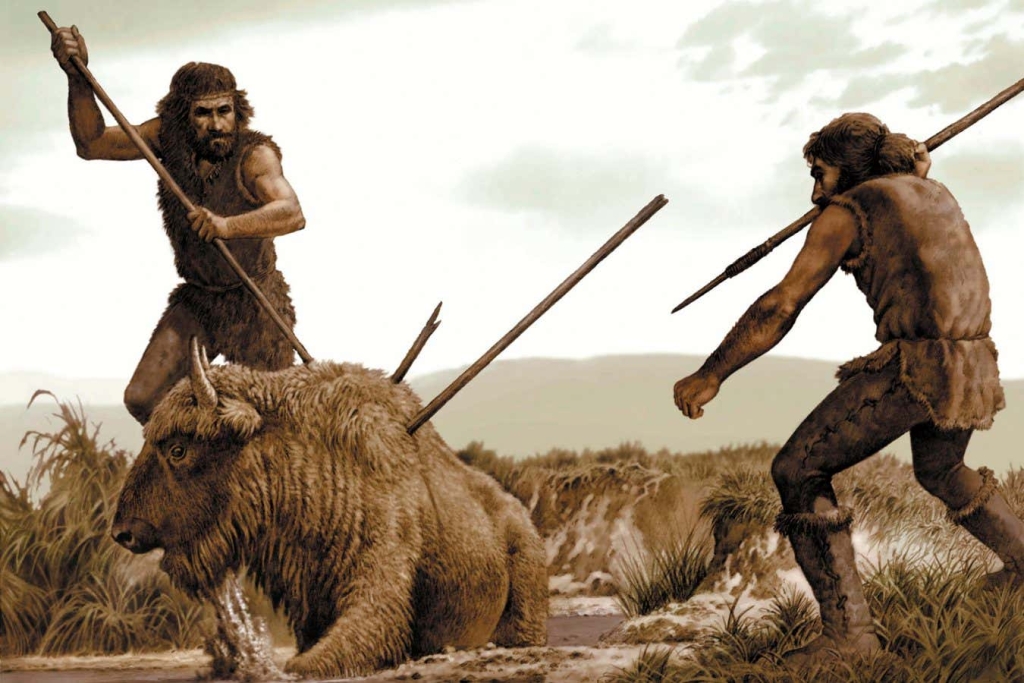
For over a million years, our early human ancestors relied on a remarkably consistent toolkit. Heavy-duty stone implements—massive hand axes, cleavers, scrapers, and stone balls—dominated the archaeological record across Africa, Europe, and Asia. These tools, some weighing several kilograms, were perfectly suited for hunting and butchering the colossal megaherbivores that roamed the ancient landscape: elephantine creatures, hippopotamus relatives, and rhino ancestors that could weigh over a ton.
But approximately 200,000 years ago, something extraordinary happened. These heavy tools vanished from the archaeological record in the Levant region, replaced almost overnight by an entirely new arsenal of lightweight, sophisticated implements. Sharp blades, precision scrapers, and specialized cutting tools began appearing in unprecedented numbers and variety.
The Missing Link: Vanishing Giants
Now, researchers led by Vlad Litov at Tel Aviv University have connected these technological dots in a way that’s revolutionizing our understanding of human evolution. By meticulously cataloging archaeological finds from 47 sites across the Levant spanning the entire Paleolithic era (3.3 million to 12,000 years ago), the team discovered a startling correlation.
As heavy tools disappeared from the record, so did the massive prey animals they were designed to hunt. The relative abundance of megaherbivores weighing over 1,000 kilograms plummeted dramatically. Meanwhile, smaller, more agile prey animals became increasingly prevalent in the archaeological record.
“It’s as if the entire ecosystem underwent a fundamental restructuring,” explains Litov. “And our ancestors had to adapt or perish.”
The Cognitive Revolution
This isn’t just about changing tools—it’s about changing minds. The research suggests that hunting smaller, faster prey required entirely different strategies: coordinated group hunting, complex planning, and the development of specialized tools for different tasks.
“Think about the difference,” Litov elaborates. “A single elephant could feed a band of 35 hunter-gatherers for months. But to get the same caloric return from smaller animals like fallow deer, you’d need to hunt dozens of them. That requires a completely different approach to survival.”
The implications are profound. Rather than intelligence driving technological innovation, as previously theorized, this research suggests that environmental pressures—specifically the disappearance of large prey—may have been the primary catalyst for cognitive advancement.
Global Patterns, Local Solutions
Interestingly, the pattern wasn’t universal. In regions where large prey remained available, such as southern China, heavy-duty tools persisted until as recently as 50,000 years ago. This suggests that the technological shift was a direct response to changing environmental conditions rather than an inevitable march of progress.
Expert Reactions: A Paradigm Shift
The findings are generating intense debate among experts. “I would argue there is more to it than just prey size,” cautions Ceri Shipton from University College London. His research indicates that sophisticated planning and cognitive abilities were already emerging during the Middle Paleolithic, with evidence of mass hunting strategies for medium-sized animals like horses and bison.
Nicolas Teyssandier from the French National Centre for Scientific Research offers another perspective: “If humans adapted to new fauna, this reflects adaptation rather than pure intelligence. It was equally intelligent to produce and select heavy-duty technologies for hunting and consuming large megaherbivores.”
The Energy Equation
Litov acknowledges that cognitive capabilities were likely present in early human species like Homo erectus, which appeared roughly 2 million years ago. However, he emphasizes that the shift from large to small prey created unique pressures that may have accelerated brain development.
“The energy economics are crucial,” he explains. “When your primary food source disappears, you must fundamentally rethink your entire survival strategy. This creates intense selective pressure for enhanced problem-solving abilities, social cooperation, and technological innovation.”
The Social Dimension
The research also highlights the social aspects of this transition. Hunting small, elusive prey requires coordination, communication, and shared knowledge in ways that mammoth hunting does not. A single hunter might bring down a young elephant, but catching dozens of deer requires teamwork, planning, and the transmission of complex hunting strategies across generations.
“This wasn’t just about individual intelligence,” Litov emphasizes. “It was about collective intelligence—the ability to work together, share information, and build on each other’s knowledge.”
Looking Forward
As we face our own era of rapid environmental change, this ancient story offers powerful lessons about adaptation, innovation, and the relationship between environmental pressures and cognitive development.
The research, published in a leading scientific journal, represents a significant shift in how we understand human evolution. Rather than viewing technological and cognitive advancement as a linear progression driven by inherent intelligence, it suggests that our ancestors’ greatest innovations may have been responses to environmental challenges—and that adaptability, not just raw intelligence, was the key to survival.
Tags & Viral Phrases:
- Ancient humans, megaherbivore decline, cognitive revolution, stone tool technology, human evolution, Paleolithic hunting, archaeological breakthrough, brain development, environmental adaptation, technological innovation, Homo sapiens origins, coordinated hunting, social intelligence, evolutionary pressure, survival strategies, lightweight toolkits, precision tools, megaherbivore extinction, human ingenuity, archaeological discovery, cognitive advancement, environmental change, adaptive systems, collective intelligence, survival innovation, ancient technology, evolutionary biology, Paleolithic era, human origins, archaeological evidence, scientific breakthrough, brain evolution, hunting strategies, tool development, environmental pressures, cognitive science, evolutionary adaptation, ancient humans, megaherbivore decline, cognitive revolution, stone tool technology, human evolution, Paleolithic hunting, archaeological breakthrough, brain development, environmental adaptation, technological innovation, Homo sapiens origins, coordinated hunting, social intelligence, evolutionary pressure, survival strategies, lightweight toolkits, precision tools, megaherbivore extinction, human ingenuity, archaeological discovery, cognitive advancement, environmental change, adaptive systems, collective intelligence, survival innovation, ancient technology, evolutionary biology, Paleolithic era, human origins, archaeological evidence, scientific breakthrough, brain evolution, hunting strategies, tool development, environmental pressures, cognitive science, evolutionary adaptation
,


Leave a Reply
Want to join the discussion?Feel free to contribute!