
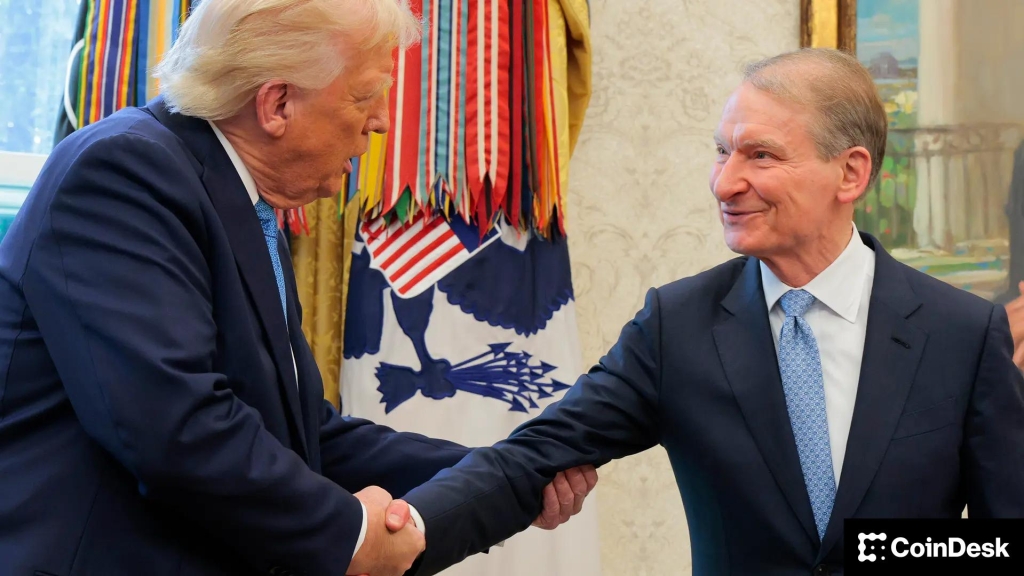
Donald Trump’s crypto legacy in two words: Paul Atkins
White House Gives Crypto Industry an Ultimatum: Strike a Deal on Stablecoin Yields by March 1st or Risk Losing the Bigger Prize
In a high-stakes move that could reshape the future of digital assets in the United States, the White House has set a March 1st deadline for the banking industry and cryptocurrency firms to reach a deal on stablecoin yields. The ultimatum comes as part of a broader push to advance the Clarity Act, a landmark market structure legislation designed to provide the crypto industry with a solid legal foundation in the U.S.
The Clarity Act, which was passed by the House seven months ago, has faced repeated delays in the Senate, with multiple deadlines coming and going without resolution. The latest March 1st deadline has also passed without a deal, leaving the industry in a state of uncertainty. However, the White House’s move signals that it is not waiting for Congress to act, and the crypto world is feeling the pressure to compromise on stablecoin rewards in exchange for the bigger prize of regulatory clarity.
Legislation Isn’t the Only Path to Clarity
While the crypto industry has been fixated on the passage of new legislation as the next catalyst for growth, it’s becoming increasingly clear that this isn’t the only path forward. The existing laws that govern the Securities and Exchange Commission (SEC) and the Commodity Futures Trading Commission (CFTC) are broad and flexible, giving these agencies the authority to act now.
Under the leadership of President Donald Trump, the SEC and CFTC are taking proactive steps to provide the regulatory clarity the industry desperately needs. Trump’s appointment of Paul Atkins as SEC Chair and Michael Selig as CFTC Chair has been a game-changer, as both regulators are committed to working together to create a harmonized framework for digital assets.
Paul Atkins: The New Sheriff in Town
Paul Atkins, a seasoned regulator with a deep understanding of the crypto industry, has wasted no time in signaling his intentions. Since taking office in April 2025, Atkins has made it clear that the SEC has the authority to grant the crypto industry the rulemaking it needs to operate. He has also emphasized that the agency will act with or without new legislation, a stance that has been echoed by the CFTC under the leadership of Michael Selig.
The collaboration between Atkins and Selig is a stark contrast to the discord that characterized the relationship between former SEC Chair Gary Gensler and former CFTC Chair Rostin Benham. Gensler’s adversarial approach to crypto regulation created uncertainty and stifled innovation, while Benham’s calls for new legislation went unheeded. The new leadership team, on the other hand, is committed to working together to create a clear and consistent regulatory framework.
Harmonization: The Key to Success
One of the key reasons why Atkins has not yet posted draft rules for public comment is likely because he wants to do so in concert with the CFTC. The two agencies are working to harmonize their approaches to digital asset regulation, ensuring that there is no confusion about when and if a digital asset can move from SEC jurisdiction to the CFTC’s.
This harmonization effort is reminiscent of the historic Shad-Johnson Accord of 1981, which established a framework for cooperation between the SEC and the CFTC. An official memorandum of understanding (MOU) between the two agencies is expected soon, further solidifying their commitment to working together.
The Road Ahead: Draft Rules and Beyond
By this fall, Project Crypto—the joint initiative between the SEC and CFTC—is expected to submit draft rules for public comment. These rules will be amended based on public feedback and, most likely, finalized by next spring. This will be the first time that an administration has actually written rules with decentralized financial networks in mind.
Under the new rules, it should be possible for exchanges like Kraken, Coinbase, and Crypto.com to finally say that all their operations are registered with an agency and under state supervision. It should also be possible for new enterprises to raise funds with token sales, with some tokens enjoying rights that entrepreneurs avoided during the regulation-by-enforcement era.
Fait Accompli: The Crypto Industry’s Path to Mainstream Adoption
While the crypto industry has always been open to new participants, the president’s family’s involvement in digital assets—through memecoins, a stablecoin, and bitcoin miners—has created political headwinds. However, the White House’s ultimatum and the SEC and CFTC’s proactive approach suggest that the industry is on the cusp of a major breakthrough.
If the SEC and CFTC collaborate effectively, whatever arrangement they devise may eventually become law anyway. After all, Congress codified the Shad-Johnson Accord in the early 80s. So, the lobbyists may ultimately get the legislation they want, but only after crypto has gone mainstream anyway—without Congress.
In the end, Trump’s decision to appoint Paul Atkins may have already been sufficient to give the industry enough legal whitespace to reach its potential. The crypto world is facing growing pressure to relent on stablecoin rewards to win the bigger prize of regulatory clarity, and the clock is ticking.
Tags:
White House, Crypto Industry, Stablecoin Yields, Clarity Act, SEC, CFTC, Paul Atkins, Michael Selig, Regulatory Clarity, Digital Assets, Market Structure Legislation, Decentralized Finance, Token Sales, Exchanges, Regulatory Framework, Harmonization, Shad-Johnson Accord, Project Crypto, Mainstream Adoption
Viral Phrases:
“Strike a deal or risk losing the bigger prize”
“The new sheriff in town”
“Harmonization is the key to success”
“Fait accompli: The crypto industry’s path to mainstream adoption”
“The clock is ticking”
“Regulation by enforcement era”
“Legal whitespace to reach its potential”
“Growing pressure to relent on stablecoin rewards”
“Game-changer for the crypto industry”
“Proactive steps to provide regulatory clarity”
“Collaboration between SEC and CFTC”
“Stifled innovation under Gensler”
“Trump’s decision to appoint Paul Atkins”
“Digital assets go mainstream without Congress”
“Legal foundation for the crypto industry”
,


Leave a Reply
Want to join the discussion?Feel free to contribute!