
Earth’s Magnetic Field Has an “Astonishing” Wild Side Scientists Missed Until Now
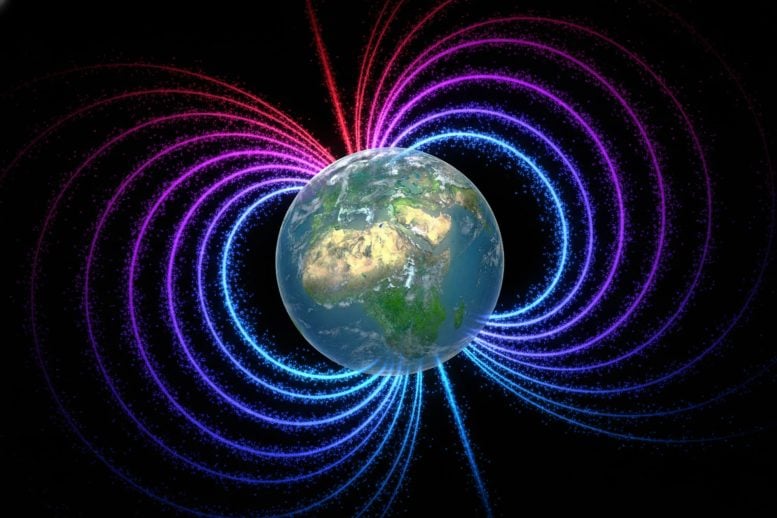
Deep beneath the ocean floor, ancient sediments whisper a story that challenges long-held assumptions about Earth’s magnetic field. What scientists once thought was a relatively stable and predictable system may, in fact, have a far wilder side than anyone realized.
At the heart of this discovery lies the planet’s outer core—a vast, churning sea of molten iron and nickel. As these metals circulate, they generate electric currents, which in turn produce Earth’s protective magnetic shield. This invisible force field stretches far into space, deflecting harmful solar radiation and cosmic particles that would otherwise strip away our atmosphere and make life as we know it impossible.
For decades, the scientific consensus held that the magnetic field reversed its polarity—flipping north and south—at a fairly consistent pace, roughly every few hundred thousand years. These reversals were thought to occur over a span of several thousand years, with the field weakening, becoming more complex, and then re-establishing itself in the opposite orientation.
But new research, drawing on magnetic signatures locked within deep-sea sediments, suggests the process may be far more variable—and sometimes astonishingly slow. In some instances, the field may have remained in a transitional, weakened state for tens of thousands of years, or even longer. This revelation comes from analyzing the orientation and intensity of magnetic minerals in sediment cores collected from the ocean floor, which act like tiny compasses, recording the direction and strength of the field at the time the sediments were deposited.
The implications are profound. If the magnetic field can linger in a weakened, unstable state for extended periods, it could mean that Earth—and any life on its surface—was more vulnerable to space weather events, such as solar storms, than previously believed. Such prolonged instability could also affect animal navigation, which relies on the magnetic field, and even influence atmospheric chemistry.
What makes this finding particularly striking is that it overturns the textbook view of magnetic reversals as relatively rapid, discrete events. Instead, the evidence points to a more chaotic and drawn-out process, with the field sometimes meandering unpredictably before finally settling into a new orientation.
Scientists are now racing to understand the underlying mechanisms driving these slow, erratic changes. Some suspect that complex fluid dynamics deep within the core—perhaps influenced by mantle convection or even large-scale tectonic events—could be responsible. Others wonder if external factors, such as asteroid impacts or massive volcanic eruptions, might occasionally disrupt the core’s flow, triggering prolonged instability.
As researchers continue to drill deeper and analyze older sediments, the hope is to build a more complete picture of Earth’s magnetic history. Each new core sample adds another piece to the puzzle, revealing just how dynamic and surprising our planet’s invisible shield can be.
In the end, this discovery is a humbling reminder that even the most fundamental features of our world can harbor secrets—and that the more we learn, the more we realize how much remains to be uncovered.
#Tags
Earth’s magnetic field, magnetic reversal, outer core, molten iron, nickel, electric currents, polarity flip, deep-sea sediments, sediment cores, magnetic minerals, space weather, solar storms, animal navigation, mantle convection, tectonic events, asteroid impacts, volcanic eruptions, Earth’s core, planetary magnetism, geomagnetic instability, scientific discovery, geology, geophysics, Earth science, environmental science, planetary protection, cosmic radiation, atmospheric chemistry, core dynamics, geological record, ocean floor, magnetic history, scientific research, technology news, viral science, Earth’s secrets, planetary mysteries.,


Leave a Reply
Want to join the discussion?Feel free to contribute!