
Endangered Galapagos Seabird Makes 3,000-Mile-Detour to California : ScienceAlert
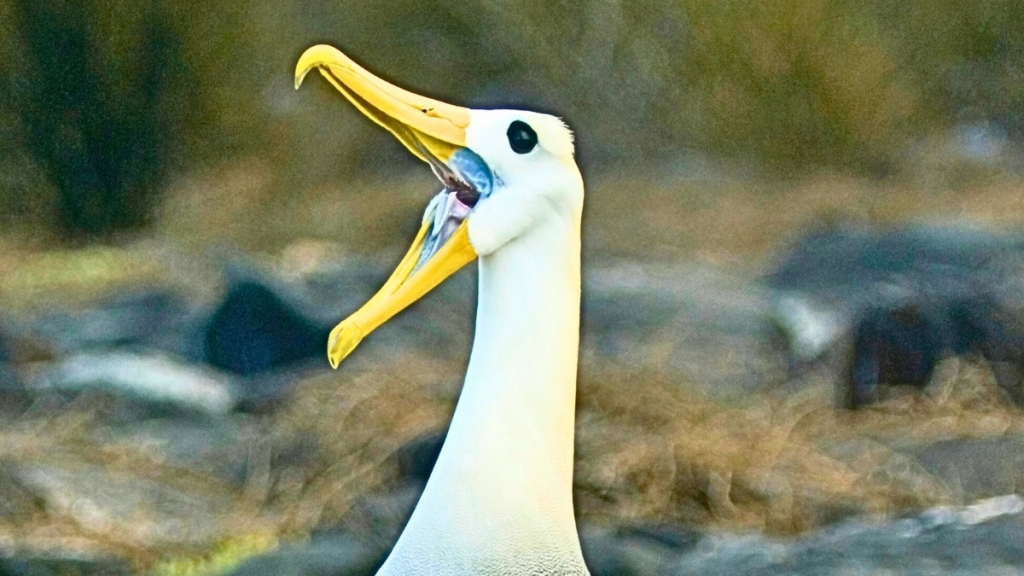
Los Angeles, California — In an extraordinary event that has stunned the scientific community and captivated bird enthusiasts worldwide, researchers aboard a research vessel off the central California coast recently spotted a waved albatross, marking only the second recorded sighting of this rare species north of Central America. This unexpected appearance has sparked intense curiosity and speculation about the mysterious journey of this critically endangered bird, known for its vast wingspan and remarkable ability to soar over the open ocean for hours without flapping its wings.
The waved albatross, scientifically known as Phoebastria irrorata, is instantly recognizable by its distinctive yellow bill, striking black button-like eyes, and an impressive wingspan that can reach up to 8 feet (2.4 meters). This majestic seabird spends much of its life gliding effortlessly over the ocean, covering thousands of miles in search of food. However, what makes this sighting so remarkable is the bird’s incredible journey from its native breeding grounds in the Galapagos Islands, located approximately 3,000 miles (4,800 kilometers) away, to the waters off the coast of California.
The bird was spotted 23 miles (37 kilometers) off the coast of Point Piedras Blancas, a remote and scenic area roughly midway between San Francisco and Los Angeles. To ornithologists, this is considered a “vagrant” bird—a term used to describe a species that has strayed far outside its typical range. Such occurrences are rare and often provide valuable insights into the behavior and adaptability of these incredible creatures.
Marine ornithologist Tammy Russell, who was on board the research vessel during the sighting, described the experience as nothing short of miraculous. “I can’t even believe what I saw,” Russell wrote on social media, adding that she was still in shock. Russell, a contract scientist with the Farallon Institute and a postdoctoral scholar at the University of California, San Diego, Scripps Institution of Oceanography, emphasized that the bird’s presence so far from its usual habitat raises intriguing questions about its journey and motivations.
One of the most pressing questions is how and why this waved albatross ventured so far north. Russell noted that the same bird was reportedly spotted off the Northern California coast in October, suggesting that it has been lingering in the area for some time. “It doesn’t seem to be in a hurry to get back south,” she observed. The bird’s extended stay in California has led researchers to speculate about its possible reasons for straying so far from home.
Several theories have been proposed to explain the bird’s unusual behavior. One possibility is that it was driven northward by a powerful storm or unusual weather patterns. Seabirds like the waved albatross are highly sensitive to changes in wind and ocean currents, and a strong storm could have easily pushed it off course. Another theory is that the bird simply has a “rambling spirit,” a term used to describe individuals that wander farther than others of their species. This behavior is not uncommon among seabirds, which are known for their ability to travel vast distances in search of food.
Russell also suggested that the bird might not have bred during the last season, which could explain its extended journey. Waved albatrosses typically lay their eggs in the spring, and the chicks leave the nest by January. If this particular bird did not breed, it might have taken the opportunity to explore new territories before returning to the Galapagos to reunite with its mate for the next breeding season. “Who knows how long it will stay around or if it will ever return?” Russell mused. “But that’s why these sightings are so special.”
Marshall Iliff, the eBird project leader at Cornell University’s Lab of Ornithology, echoed Russell’s sentiments, noting that seabirds like albatrosses are capable of traveling great distances in search of food. “The odd individual routinely may turn up far from home, even in the wrong hemisphere or exceptionally in the wrong ocean,” Iliff explained. He added that food shortages or other environmental factors could prompt a bird to wander, but in this case, there is no evidence to suggest that the sighting is anything more than a fluke.
The waved albatross is classified as critically endangered by the International Union for Conservation of Nature (IUCN), making this sighting even more significant. According to the American Bird Conservancy, the species has a highly restricted range, nesting exclusively on lava fields in the Galapagos Islands amid scattered boulders and sparse vegetation. The birds have a lifespan of up to 45 years and primarily feed on fish, squid, and crustaceans.
Russell also pointed out that if multiple waved albatrosses were being sighted in California, it could be a sign that the species is being driven northward by environmental factors such as climate change and marine heatwaves. In a recent study, Russell wrote about five species of booby that have become increasingly common off the California coast due to warming temperatures and changing ocean conditions. If the waved albatross is following a similar pattern, it could indicate a broader shift in the distribution of marine species.
“This sighting provides valuable baseline data for understanding how the waved albatross might be responding to environmental changes,” Russell said. “If this is a sign of the species moving north, it could have important implications for conservation efforts.”
As scientists continue to monitor the bird’s movements, the sighting has sparked widespread interest and excitement among birdwatchers and nature enthusiasts. The waved albatross’s unexpected appearance serves as a reminder of the incredible adaptability and resilience of these remarkable creatures, as well as the importance of protecting their fragile habitats.
In the coming months, researchers will be closely watching to see if the bird returns to the Galapagos or continues its journey elsewhere. Regardless of its fate, this rare and awe-inspiring encounter has left an indelible mark on the scientific community and serves as a testament to the wonders of the natural world.
Tags:
Waved albatross, rare bird sighting, California coast, Galapagos Islands, critically endangered species, marine ornithology, vagrant bird, climate change, marine heatwaves, birdwatching, scientific discovery, Tammy Russell, Farallon Institute, Scripps Institution of Oceanography, Cornell Lab of Ornithology, eBird, conservation, wildlife, ocean currents, storm-driven migration, rambling spirit, seabird behavior, lava fields, nesting, lifespan, fish, squid, crustaceans, environmental factors, baseline data, adaptability, resilience, natural world, scientific community, nature enthusiasts, awe-inspiring encounter.
Viral Phrases:
“Second recorded sighting north of Central America,” “8-foot wingspan,” “3,000 miles from home,” “Critically endangered species,” “Rambling spirit,” “Storm-driven migration,” “Marine heatwaves,” “Climate change impact,” “Baseline data for conservation,” “Awe-inspiring encounter,” “Adaptable and resilient creatures,” “Rare and mysterious journey,” “Wonders of the natural world,” “Unexpected appearance,” “Scientific community excitement,” “Nature enthusiasts captivated,” “Fragile habitats,” “Remarkable adaptability,” “Indelible mark on science,” “Testament to nature’s wonders.”
,


Leave a Reply
Want to join the discussion?Feel free to contribute!