
FailHub – Issue #1 – by Vlad Khambir
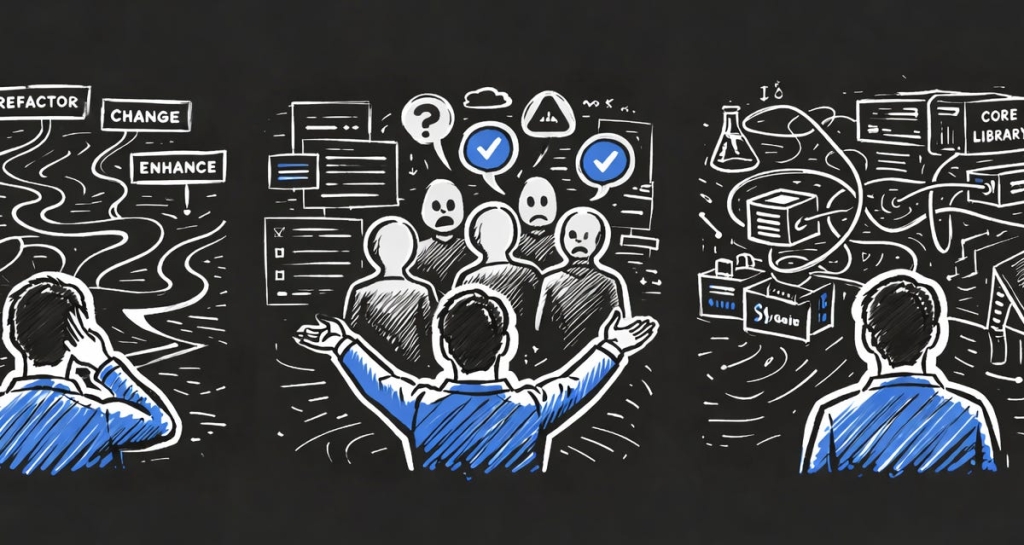
Tech Teams, Silent Scope Creep, and the Architecture Trap: Three Real-World Failures That Cost Time, Trust, and Code Quality
In the fast-moving world of technology, failure isn’t the enemy—unlearned failure is. That’s the premise behind FailHub, a growing community project that turns painful lessons into powerful insights. Each week, three tech professionals share their real, unvarnished mistakes so others can avoid them. This week’s stories hit close to home for anyone who’s ever watched a project drift, a “done” feature unravel, or an elegant refactor blow up in their face.
Story 1: The Invisible Expansion
It started with a clear plan. Requirements were defined, the team was aligned, and the scope felt “mostly agreed upon.” But that tiny gap—”mostly”—became the crack through which the project slowly crumbled.
At first, the changes seemed harmless: a “small clarification” here, a quality improvement there. Each tweak looked minor in isolation. But together, they quietly transformed the project’s trajectory. The team kept moving forward, but the destination kept shifting.
The fatal flaw wasn’t the changes themselves—it was the silence around them. No one pushed back. No one called out the growing scope. The team’s flexibility, often praised as a strength, became its weakness. By saying yes to every addition, they signaled that boundaries didn’t exist.
The Lesson: Clear boundaries and explicit goals aren’t constraints—they’re safeguards. When scope starts creeping, you must speak up. Open dialogue about trade-offs—speed vs. quality, features vs. deadlines—empowers better decisions. Without defended boundaries, they disappear.
Story 2: The Illusion of Agreement
On the surface, everything looked perfect. Stakeholders nodded in meetings, the team agreed, and questions were scarce. Work progressed rapidly, without friction.
Then came the reveal. The “finished” product exposed a brutal truth: everyone had a different definition of “done.” For some, it meant the core feature worked. For others, it meant production-ready code with tests, edge cases, polished UI, analytics, and documentation.
The team thought they were finished. The business thought they weren’t even close. The gap wasn’t technical—it was communicative. The Definition of Done lived only in people’s heads, not in shared understanding.
The Lesson: “Done” must be explicit and measurable. Break work into the smallest demonstrable pieces. Show progress frequently, not just talk about it. Early feedback is cheap; late feedback is catastrophic.
Story 3: The Architecture Trap
A developer faced a common dilemma: core logic tangled in an old, massive wrapper class. From a textbook architecture perspective, this was wrong. Business logic belonged in view models, not buried in dependencies.
So they refactored. They split responsibilities, moved logic, and made the code “cleaner.” But the result was chaos. Dependencies multiplied, data flow became opaque, and maintainability plummeted. The architecture looked better on paper but worked worse in reality.
The wrapper wasn’t perfect, but it worked. The developer had applied principles without respecting the project’s context—its age, dependencies, team dynamics, and business realities.
The Lesson: Architecture decisions can’t happen in a vacuum. Sometimes, an imperfect but stable solution beats a formally correct one that breaks the system. Context is the ultimate principle.
Why These Stories Matter
These aren’t isolated incidents. They’re patterns. Scope creep, misaligned definitions, and over-architecture plague tech projects everywhere. The difference between teams that fail and teams that succeed often comes down to whether they learn from failure.
FailHub exists to accelerate that learning. By sharing stories openly, the tech community can spot these patterns earlier, push back sooner, and build better systems—not just better code.
Tags & Viral Lines
- Scope creep silently kills projects
- “Done” means different things to different people
- Architecture purity vs. practical stability
- The cost of unspoken assumptions
- Why saying “yes” to everything destroys teams
- Learning from failure is a competitive advantage
- Tech teams need boundaries, not just flexibility
- The most expensive rework happens at the end
- Context beats textbooks every time
- Share your failure, save someone else’s project
- FailHub: turning mistakes into momentum
- The silent killer of tech projects
- When “mostly agreed” becomes “mostly broken”
- Clean code that breaks the system
- The illusion of progress
- Pushback isn’t obstruction—it’s protection
- Demo early, demo often, demo honestly
- The architecture trap: when theory breaks reality
- Boundaries make teams stronger, not slower
- The true cost of flexibility without limits
,


Leave a Reply
Want to join the discussion?Feel free to contribute!