
Former astronaut on lunar spacesuits: “I don’t think they’re great right now”
NASA’s Lunar Spacesuit Evolution: From Apollo’s “Big Bags of Air” to Next-Gen Mobility
NASA astronaut Kate Rubins recently provided fascinating insights into the evolution of lunar spacesuits, comparing the current generation to the Apollo-era suits and revealing both the challenges and advancements in spacesuit technology for upcoming Artemis missions.
The Apollo Legacy: “Big Bags of Air”
When reflecting on the Apollo-era suits, Rubins didn’t mince words: “The suits that we have are definitely much better than Apollo. They were just big bags of air. The joints aren’t in there, so it was harder to move.”
The Apollo suits, while revolutionary for their time, lacked the sophisticated joint systems that modern astronauts rely on. Their primary advantage was weight—they were significantly lighter than today’s suits. However, this came at the cost of mobility, making even simple tasks challenging for astronauts who had to essentially operate within pressurized balloons.
The Weight Challenge on the Moon
One of the most intriguing aspects Rubins highlighted was how weight translates to the lunar surface. While the Moon’s gravity is roughly one-sixth that of Earth, meaning a 300-pound spacesuit would feel like 50 pounds, astronauts still must contend with mass and momentum.
“You can divide the weight of the suit by six to get an idea of how it might feel to carry it around on the lunar surface,” Rubins explained. “While it won’t feel like 300 pounds, astronauts will still have to account for their mass and momentum.”
The Physiological Shift: From Microgravity to Walking
Perhaps the most significant change astronauts will experience is transitioning from microgravity operations to ambulating—walking—on the lunar surface. This shift fundamentally changes which muscle groups are engaged.
“Instead of kind of floating in microgravity and moving your mass around with your hands and your arms, now we’re ambulating,” Rubins noted. “We’re walking with our legs. You’re going to have more strain on your knees and your hips. Your hamstrings, your calves, and your glutes are going to come more into play.”
This transition represents both an opportunity and a challenge. On one hand, humans are naturally built for walking and running, making certain tasks more intuitive. “I think, overall, it may be a better fit for humans physically because if you ask somebody to do a task, I’m going to be much better at a task if I can use my legs and I’m ambulating,” she said.
However, the partial gravity environment introduces new complexities. Astronauts will need to bend, twist, and perform tasks in ways they haven’t had to in microgravity, requiring adaptation and new training protocols.
Engineering the Impossible: Surviving Lunar Extremes
The engineering challenges of creating a functional lunar spacesuit are staggering. These suits must protect astronauts from one of the most hostile environments imaginable.
“It’s an incredibly hard engineering challenge,” Rubins emphasized. “You have to keep a human alive in absolute vacuum, warm at temperatures that you know in the polar regions could go as far down as 40 Kelvin (minus 388° Fahrenheit). We haven’t sent humans anywhere that cold before.”
The temperature extremes are just the beginning. Astronauts will experience intense heat when exposed to direct sunlight and must contend with dangerous radiation levels. All of this protection requires substantial material, creating a fundamental tension between protection and mobility.
The Center of Gravity Conundrum
One of the most fascinating challenges Rubins described involves the suit’s center of gravity. The life support system backpack adds significant mass high on the astronaut’s back, shifting their center of gravity upward and backward from what they’re accustomed to on Earth.
“When you move around, it’s like wearing a really, really heavy backpack that has mass but no weight, so it’s going to kind of tip you back,” she explained. Engineers have attempted to compensate by adding weights to the front of suits, but the fundamental shift remains.
This altered center of gravity affects everything from walking to picking up rocks. Astronauts must relearn movements that have been second nature their entire lives, a process that requires extensive training and adaptation.
Testing: From Pools to Parabolic Flights
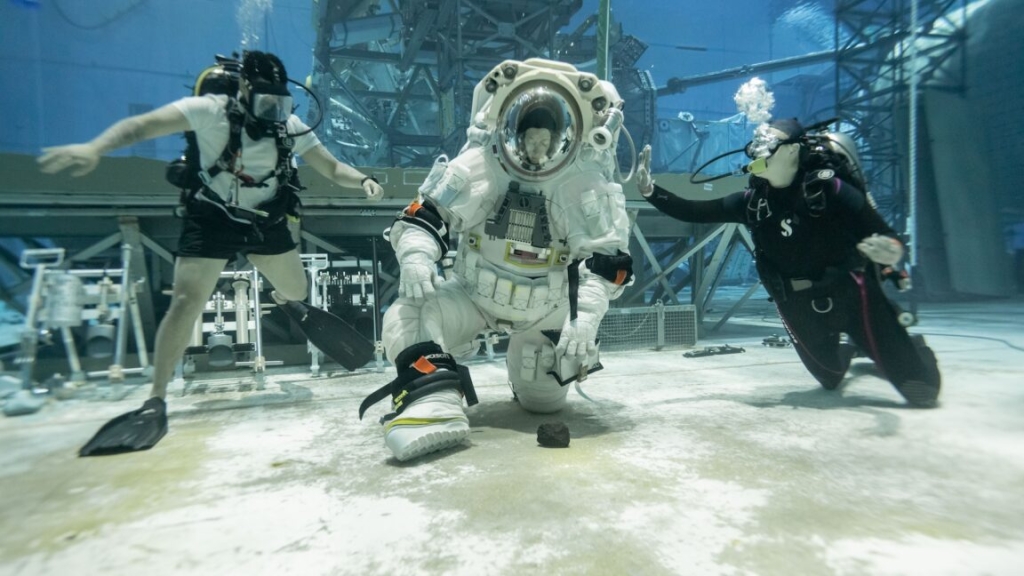
NASA employs various testing environments to prepare astronauts for lunar operations. The Neutral Buoyancy Laboratory, a massive pool in Houston, simulates weightlessness for spacewalk training. A gravity-offloading device helps astronauts practice basic movements.
However, Rubins identified parabolic flights as the optimal testing environment for understanding how suits handle momentum. These flights create brief periods of lunar gravity, allowing suit developers and astronauts to experience the closest approximation to actual lunar conditions without leaving Earth.
The Universal Challenge: No Perfect Solution Yet
Importantly, Rubins emphasized that these challenges aren’t specific to any particular suit manufacturer. Whether discussing NASA’s xEMU (Exploration Extravehicular Mobility Unit), the Mark III suit, or suits from commercial providers like Axiom, the fundamental difficulties remain consistent.
“This isn’t really anything about a specific vendor,” she clarified. “These are just the difficulties of designing a spacesuit for the lunar environment.”
The Artemis missions represent humanity’s return to the Moon after more than half a century, and the spacesuits are critical to mission success. While significant advancements have been made since Apollo, the engineering challenges remind us that exploring the cosmos still pushes the boundaries of human ingenuity and technological capability.
As NASA continues to refine spacesuit designs and training protocols, astronauts like Rubins are helping bridge the gap between engineering specifications and practical usability, ensuring that when humans return to the lunar surface, they’ll be equipped not just to survive, but to thrive and conduct meaningful scientific work in one of the most extreme environments imaginable.
Tags
Lunar spacesuits, Artemis missions, NASA spacesuit evolution, Apollo vs modern suits, lunar surface operations, spacesuit engineering challenges, center of gravity in space, Kate Rubins interview, xEMU spacesuit, Mark III suit, Axiom spacesuit, Neutral Buoyancy Laboratory, parabolic flight testing, lunar gravity, spacesuit mobility, human factors in space exploration, extreme environment protection, spacesuit center of gravity, ambulation in space, lunar surface walking
Viral Sentences
“The suits that we have are definitely much better than Apollo. They were just big bags of air.”
“It’s an incredibly hard engineering challenge. You have to keep a human alive in absolute vacuum.”
“When you move around, it’s like wearing a really, really heavy backpack that has mass but no weight, so it’s going to kind of tip you back.”
“We haven’t sent humans anywhere that cold before. They are also going to be very hot. They’re going to be baking in the sunshine.”
“It’s still a hard engineering challenge. And I’m not talking about any specific suit.”
“You can divide the weight of the suit by six to get an idea of how it might feel to carry it around on the lunar surface.”
“I think, overall, it may be a better fit for humans physically because if you ask somebody to do a task, I’m going to be much better at a task if I can use my legs and I’m ambulating.”
“Those are some of the challenges that we’re facing engineering-wise.”
“Instead of kind of floating in microgravity and moving your mass around with your hands and your arms, now we’re ambulating.”
“NASA trains astronauts for spacewalks in the Neutral Buoyancy Laboratory, an enormous pool in Houston used for simulating weightlessness.”
,

Leave a Reply
Want to join the discussion?Feel free to contribute!