
Four New Astronauts Arrive at ISS, Restoring a Full Crew For Research : ScienceAlert
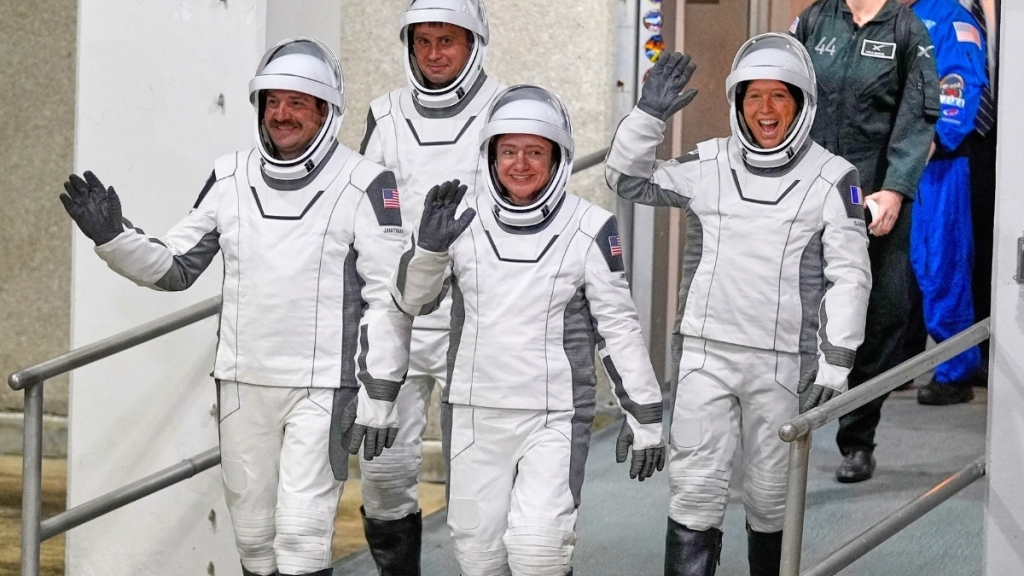
SpaceX Crew-8 Successfully Replenishes International Space Station After Medical Emergency
In a dramatic yet triumphant return to full operational capacity, the International Space Station (ISS) welcomed four new astronauts on Saturday, February 14, 2026, restoring its crew complement after an unprecedented medical emergency forced an early evacuation last month.
The SpaceX Dragon capsule, named “Endeavour,” docked flawlessly with the orbiting laboratory at an altitude of 277 miles (446 kilometers) above Earth, delivering NASA astronauts Jessica Meir and Jack Hathaway, French astronaut Sophie Adenot, and Russian cosmonaut Andrei Fedyaev. Their arrival marks the resumption of normal operations following NASA’s first in-space medical evacuation in 65 years of human spaceflight.
The Crisis That Shook the Space Station
The emergency unfolded on January 7, 2026, when one of four astronauts who had launched to the ISS aboard SpaceX’s Crew-7 mission in August 2025 suffered what NASA officials described as a “serious health issue.” The nature of the medical emergency remains undisclosed due to privacy concerns, but the severity prompted an immediate decision to return all four crew members to Earth more than a month ahead of schedule.
This unexpected departure left only three astronauts aboard the ISS—NASA’s Loral O’Hara and two Russian cosmonauts, Sergey Prokopyev and Dmitri Petelin—to maintain the station’s critical systems and scientific experiments. The reduced crew forced NASA to suspend all spacewalks and significantly scale back research activities, creating a tense period for mission control and raising questions about the station’s long-term sustainability.
A Multinational Team Takes the Helm
The newly arrived quartet brings diverse expertise and international representation to the orbiting laboratory. Jessica Meir, a marine biologist who previously flew to the ISS in 2019, returns for her second mission. During her first visit, she made history as part of the first all-female spacewalk alongside fellow NASA astronaut Christina Koch.
Andrei Fedyaev, a former Russian military pilot, is no stranger to space either, having previously served aboard the ISS. Sophie Adenot, a French military helicopter pilot, becomes only the second French woman to fly in space, following in the footsteps of Claudie Haigneré. Jack Hathaway, a captain in the US Navy, brings fresh perspective as a first-time flyer.
The Docking and Welcome Ceremony
The Dragon capsule approached the ISS with precision, guided by advanced autonomous docking systems that have become routine for SpaceX missions. As the capsule connected to the station’s Harmony module, anticipation built among the seven astronauts who would soon reunite.
When the hatches finally opened, the moment was filled with emotion and celebration. “Bonjour!” Sophie Adenot called out in her native French, her voice carrying through the station’s communication system. The seven astronauts—four newcomers and three remaining crew members—embraced warmly, exchanged high-fives, and began the process of integrating their skills and personalities for the months ahead.
“Let’s get rolling,” Jessica Meir declared, capturing the determined spirit of the assembled team as they prepared to resume full scientific operations.
The Medical Mystery and Its Aftermath
NASA’s decision to evacuate the entire crew rather than just the affected astronaut has raised eyebrows in the space community. The space agency has steadfastly refused to identify which astronaut fell ill or provide details about the medical condition, citing strict privacy protections.
The evacuated crew spent their first night back on Earth in a hospital before returning to their home base in Houston, Texas. Despite the dramatic nature of the incident, NASA officials have stated that they did not modify their standard preflight medical screening procedures for the Crew-8 astronauts who replaced them.
This approach has drawn both support and criticism from medical experts and space policy analysts. Some argue that the incident highlights the need for more comprehensive in-space medical protocols, while others praise NASA’s commitment to crew privacy and its confidence in existing safety measures.
Impact on Station Operations
During the period of reduced crew capacity, the ISS operated at minimal functionality. Scientific experiments were put on hold, routine maintenance was delayed, and the station’s research output dropped significantly. The pause in spacewalks was particularly concerning, as these extravehicular activities are crucial for station maintenance and the installation of new equipment.
With the arrival of Crew-8, NASA has announced the immediate resumption of all normal operations. The seven-person crew will conduct dozens of experiments across various scientific disciplines, perform necessary maintenance tasks, and prepare for upcoming commercial missions that will continue to support the ISS through its planned operational lifetime, currently extending to 2030.
International Cooperation in Challenging Times
The successful resolution of this crisis demonstrates the strength of international partnerships that underpin the ISS program. Despite geopolitical tensions on Earth, NASA, Roscosmos (Russia’s space agency), and the European Space Agency have maintained seamless cooperation throughout the emergency and its aftermath.
The presence of astronauts and cosmonauts from the United States, France, and Russia aboard the station serves as a powerful symbol of what nations can achieve when they work together toward common goals. This spirit of collaboration has been a hallmark of the ISS program since its inception and continues to be essential as the station enters its third decade of continuous human occupancy.
Looking Ahead
The Crew-8 astronauts are scheduled to remain aboard the ISS for eight to nine months, during which time they will oversee a busy schedule of scientific research, technology demonstrations, and station maintenance. Their mission will include studies on the effects of long-duration spaceflight on the human body, experiments in materials science, Earth observation projects, and technology demonstrations that could pave the way for future deep space exploration.
As the ISS continues to serve as humanity’s primary outpost in low Earth orbit, incidents like the recent medical emergency serve as reminders of both the challenges and the resilience of human space exploration. The successful handling of this situation, from the initial medical response to the smooth integration of the replacement crew, demonstrates that NASA and its international partners are prepared to face whatever challenges may arise as they push the boundaries of human presence in space.
The return to full strength of the International Space Station represents not just a technical achievement, but a reaffirmation of humanity’s commitment to peaceful cooperation and scientific discovery beyond the confines of our home planet.
Tags: International Space Station, SpaceX, NASA, medical emergency, space evacuation, Jessica Meir, Sophie Adenot, Andrei Fedyaev, Jack Hathaway, Roscosmos, European Space Agency, space exploration, human spaceflight, ISS operations, crew rotation, space medicine, orbital laboratory, international cooperation, spacewalks, scientific research
Viral Phrases: “Space station returns to full strength,” “unprecedented medical evacuation,” “first all-female spacewalk,” “dramatic return to Earth,” “seven astronauts unite in orbit,” “NASA’s 65-year spaceflight history,” “seamless international cooperation,” “pushing boundaries of human presence,” “humanity’s outpost in space,” “resilience of space exploration,” “peaceful cooperation beyond Earth,” “scientific discovery in orbit,” “crisis demonstrates preparedness,” “multinational team takes the helm,” “docking with precision,” “emotional welcome ceremony,” “medical mystery in space,” “impact on station operations,” “looking ahead to future missions,” “reaffirmation of human commitment”
,

Leave a Reply
Want to join the discussion?Feel free to contribute!