
Giant Gravity Anomaly Under Antarctica Is Getting Stronger, Scientists Reveal : ScienceAlert
Earth’s Gravity Field Holds a Mysterious ‘Hole’ Under Antarctica—And It’s Getting Deeper
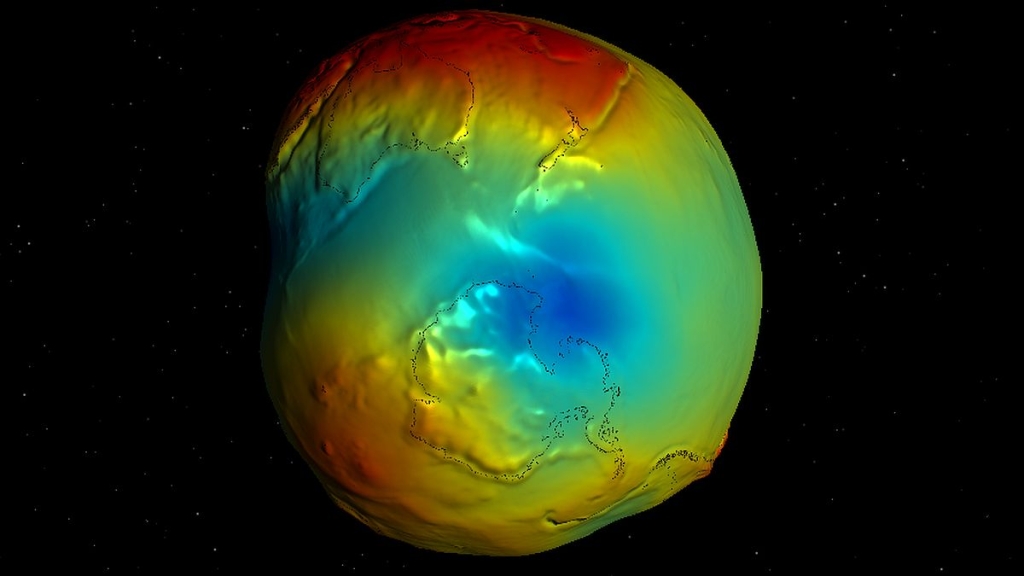
If you could see Earth’s gravity field, it wouldn’t look like a perfect sphere. Instead, it would resemble a lumpy potato, with bulges and dips scattered across its surface. Among these gravitational oddities, one of the most striking is a massive “gravity hole” lurking beneath Antarctica—a region where the gravitational pull is weaker than anywhere else on the planet.
Now, a groundbreaking new study reveals that this gravitational depression isn’t just sitting still—it’s deepening over time, driven by slow, relentless movements deep within Earth’s mantle, like a giant shifting in its sleep.
The research, led by geophysicist Alessandro Forte of the University of Florida, offers fresh insights into how Earth’s interior dynamics influence gravity, sea levels, and even the stability of massive ice sheets. “If we can better understand how Earth’s interior shapes gravity and sea levels, we gain insight into factors that may matter for the growth and stability of large ice sheets,” Forte explains.
The Bumpy Potato: Earth’s Uneven Gravity Field
Earth’s gravity isn’t uniform because the planet’s mass isn’t evenly distributed. Different rock types have different densities, creating subtle variations in gravitational pull. While these differences are tiny—if you weighed yourself at a geoid high versus a geoid low, the scale would differ by just a few grams—they’re scientifically significant.
The Antarctic Geoid Low is one of the most prominent examples of this phenomenon. It’s a region where gravity is measurably weaker, and its existence has puzzled scientists for years. But why is it there, and why is it getting stronger?
Peering Inside Earth: The Role of Earthquakes
To unravel the mystery, Forte and his colleague, geophysicist Petar Glišović of the Paris Institute of Earth Physics, turned to earthquakes. Seismic waves from quakes travel through Earth, bending and speeding up or slowing down as they encounter materials of different densities. “Imagine doing a CT scan of the whole Earth, but we don’t have X-rays like we do in a medical office,” Forte says. “We have earthquakes. Earthquake waves provide the ‘light’ that illuminates the interior of the planet.”
Using this seismic data, the researchers created a 3D density model of Earth’s mantle and extrapolated it into a new map of the entire planetary geoid. When compared to gold-standard gravity data collected by satellites, their model was a close match—a promising start.
Rewinding Time: The Evolution of the Gravity Hole
The next challenge was to understand how the Antarctic Geoid Low evolved over time. To do this, the team fed their model into a physics-based simulation of Earth’s mantle convection, essentially rewinding the clock to see how the geoid changed over the past 70 million years.
They then let the model run forward to see if it could reproduce the geoid we observe today. The results were striking: the model not only matched the current geoid but also aligned with real changes in Earth’s rotational axis, known as True Polar Wander. This suggests the model accurately captures the geoid’s evolution.
A 70-Million-Year-Old Mystery
The findings reveal that the Antarctic Geoid Low isn’t a recent phenomenon. It’s been lurking near Antarctica for at least 70 million years. However, its position and strength have changed dramatically over time. Around 50 million years ago, the anomaly began to shift and deepen, coinciding with a sharp bend in Earth’s polar wander.
According to the model, the gravity hole formed as tectonic slabs subducted beneath Antarctica and sank deep into the mantle. Over the past 40 million years, a broad region of hot, buoyant material rose upward, further strengthening the geoid low.
A Possible Link to Antarctic Glaciation
Here’s where things get even more intriguing. The timing of the geoid low’s deepening coincides with the onset of widespread glaciation in Antarctica, which began around 34 million years ago. While this connection is speculative, it raises fascinating questions. The geoid influences sea level—so as the geoid shifted downward around Antarctica, the local sea surface would have lowered with it. This could have played a role in the growth of the Antarctic ice sheet.
Of course, this is just a hypothesis that requires further testing. But it highlights how interconnected Earth’s systems are: from mantle convection to gravity to ice sheet dynamics, everything is linked.
A Window Into Earth’s Interior
The gravity hole under Antarctica may be subtle, but it’s a powerful reminder of the dynamic processes shaping our planet. Even the slowest movements deep within Earth can leave a lasting impression on the world above.
As Forte and Glišović’s research shows, understanding these processes isn’t just about satisfying scientific curiosity—it’s about gaining insights into the forces that shape our planet’s past, present, and future.
Their findings, published in Scientific Reports, open new avenues for exploring the complex interplay between Earth’s interior and its surface. And while the Antarctic gravity hole may not affect your daily life, it’s a testament to the hidden forces that make our planet the dynamic, ever-changing world it is.
Tags: Earth’s gravity, Antarctic Geoid Low, mantle convection, seismic waves, True Polar Wander, ice sheet stability, tectonic slabs, geophysics, planetary science, gravitational anomalies, Earth’s interior, sea level changes, glaciation, Scientific Reports, Alessandro Forte, Petar Glišović, Paris Institute of Earth Physics, University of Florida, CT scan of Earth, earthquakes as X-rays, gravity hole, lumpy potato Earth, Earth’s dynamic processes, interconnected systems, planetary dynamics, geoid evolution, mantle dynamics, Earth’s hidden forces.
Viral Sentences: Earth’s gravity field looks like a lumpy potato. A massive gravity hole is deepening under Antarctica. Earthquakes act as X-rays for Earth’s interior. The Antarctic Geoid Low has existed for 70 million years. Mantle convection shapes Earth’s gravity and sea levels. The gravity hole may have influenced Antarctic glaciation. Earth’s interior dynamics are linked to ice sheet stability. True Polar Wander aligns with the gravity hole’s evolution. Tectonic slabs sinking into the mantle create gravitational anomalies. The slowest processes deep inside Earth leave lasting impressions.
,


Leave a Reply
Want to join the discussion?Feel free to contribute!