
GMKtec NucBox K13 mini PC review
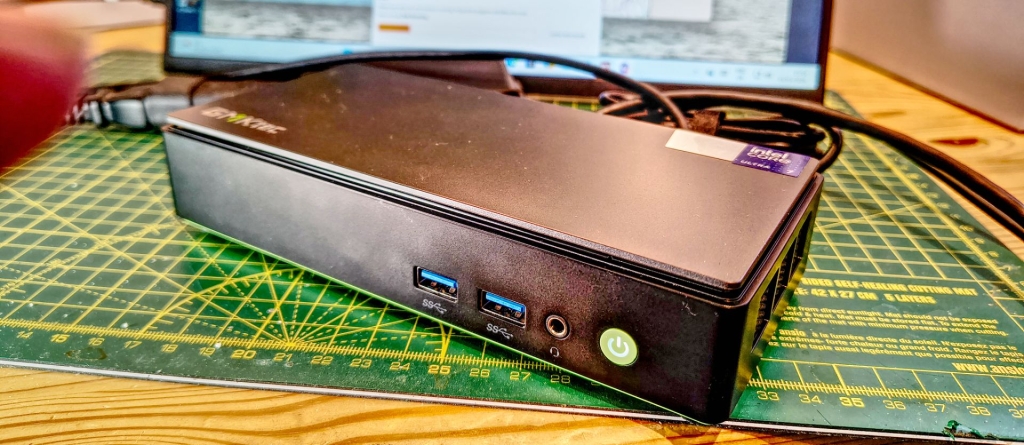
GMKtec NucBox K13 Mini PC: A Lunar Lake Powerhouse in a Slim Docking-Station Design
Why You Can Trust TechRadar
We spend hours testing every product or service we review, so you can be sure you’re buying the best. Find out more about how we test.
GMKtec NucBox K13: 30-Second Review
The GMKtec NucBox K13 marks a significant milestone as the first mini PC I’ve reviewed featuring Intel’s Core Ultra 7 256V processor. Built on TSMC’s advanced 3nm process technology (not Intel’s struggling fabs), this Lunar Lake-era chip represents GMKtec’s debut with the latest generation of AI-capable, efficiency-first processors. The result? A surprisingly capable mini PC that punches well above its weight class.
What sets the K13 apart from competitors is its unique form factor. Rather than sticking to the standard 4-inch cube design, GMKtec opted for a shape reminiscent of a docking station. This alternative layout provides ample room for thoughtful port placement and enough internal space to accommodate a second M.2 PCIe Gen 4 slot—a feature rarely seen in mini PCs at this price point.
The expandability is impressive: by replacing the included 512GB or 1TB M.2 NVMe drive and utilizing the second slot, you can add up to 16TB of storage to this system. However, there’s a trade-off: the memory is fixed at 16GB of LPDDR5X 8533 MT/s, soldered directly to the motherboard.
This limitation, combined with the absence of an OCuLink port, prevents the K13 from joining our elite best mini PC collection. While you can connect an external GPU via USB4, the 40 Gbps bandwidth falls short of OCuLink’s 64 Gbps capabilities.
Despite these drawbacks, the K13 remains a powerful, compact system with significant potential for power users. The main considerations for potential buyers are memory requirements (AI tasks typically demand substantial RAM) and how this system’s price compares to alternatives offering 32GB or more.
GMKtec NucBox K13: Price and Availability
- How much does it cost? From $670/£540/€610
- When is it out? Available now
- Where can you get it? Direct from GMKtec and via online retailers
The NucBox K13 is available directly from the GMKtec website, as well as through online retailers like Amazon.com and Amazon.co.uk.
Two configurations are available, both featuring 16GB of soldered LPDDR5X RAM. The base model includes a 512GB SSD for $669.99, while the 1TB variant costs $719.99. Both are currently offered below their stated MSRPs of $899.99 and $949.99, respectively.
UK pricing stands at £536 and £580, with European prices at €609.99 and €659.99. Based on current exchange rates, US prices are approximately 7% higher on average—an unexplained discrepancy that GMKtec maintains across markets.
Amazon shoppers should exercise caution: the price on Amazon.com through the GMKtec Store matches the MSRP of $949.99 for the 1TB option, while the UK Amazon.co.uk price is equally inflated at £788.96 for the 512GB version. Unless significant coupons bring these prices in line with GMKtec’s direct store pricing, purchasing directly from GMKtec offers substantially better value.
In terms of alternatives using the same platform, only two options exist, both manufactured by Acer: the Acer Veriton NUC (VN1502G) and Acer Veriton NUC AI. However, both alternatives are priced north of $1000 and can be difficult to find.
Within this context, the GMKtec NucBox K13 represents excellent value when purchased directly from the manufacturer. However, other platforms are available at similar price points, some offering more processing power and features that the K13 doesn’t match.
GMKtec NucBox K13: Specs
| Item | Spec |
|——|——|
| CPU | Intel Core Ultra 7 256V (8C/8T, up to 4.8 GHz, Lunar Lake, TSMC 3nm) |
| GPU | Intel Arc 140V (8 Xe2 cores, up to 64 TOPS GPU compute) |
| NPU | Intel AI Boost, 47 TOPS; Total system AI: 115 TOPS (INT8) |
| RAM | 16 GB LPDDR5X 8533 MT/s (soldered, on-package, non-upgradeable) |
| Storage | 512 GB or 1 TB M.2 2280 PCIe 4.0 (pre-installed) |
| M.2 Expansion | 1x additional M.2 2280 PCIe 4.0 slot (up to 8 TB per slot; 16 TB total) |
| Display Outputs | 1x HDMI 2.1 (4K@120Hz), 2x USB4 (DP 1.4 Alt Mode) — triple 4K support |
| Front Ports | 2x USB 3.2 Gen 2 Type-A, 3.5mm audio jack, power button |
| Rear Ports | 1x HDMI 2.1, 2x USB4 40Gbps (PD 3.0 100W), 1x USB 2.0, 5 GbE RJ-45, 3.5mm audio, DC-in, reset button |
| Networking | Wi-Fi 6E (up to 2.4 Gbps), Bluetooth 5.2, 1x 5 GbE LAN |
| Power (TDP) | 17W–37W configurable |
| OS | Windows 11 Pro (pre-installed); Linux supported |
| Dimensions | 186 x 88 x 33.2 mm |
| Weight | 523 g |
| Included Accessories | 30W USB-C PD adaptor, 120W DC power brick, VESA mount bracket, HDMI cable, manual |
GMKtec NucBox K13: Design
The NucBox K13 makes a striking physical statement. At just 33.2mm tall, it’s the slimmest mini PC in GMKtec’s current lineup, achieving this impressive thinness without resorting to the brutal cost-cutting measures typically associated with ultra-slim designs. The chassis is clean and purposeful, with a form factor that would look perfectly at home mounted behind a monitor or tucked beside a display on a reception desk.
Since Intel declined to lead by example in the NUC market, we’ve witnessed increased diversity in mini PC designs, and the K13 exemplifies this trend perfectly.
With a footprint of 186 x 88mm, the K13 is actually slightly wider than GMKtec’s standard cube-format mini PCs—a reasonable compromise for the reduced height. The overall volume remains modest, and the 523g weight makes it light enough to carry easily.
The front panel maintains a restrained aesthetic: two USB 3.2 Gen 2 Type-A ports and a 3.5mm audio jack sit alongside the power button. While including a USB4 port on the front might have been useful, both USB4 ports are positioned on the back. These aren’t cut-down variants—they both support PD 3.0 (100W) and DisplayPort Alt Mode, enabling connection of up to three monitors when combined with the HDMI 2.1 port.
Also on the back are a 5GbE LAN port, a USB 2.0 port, and a second 3.5mm audio jack. The choice of a single 5GbE port over dual 2.5GbE will appeal to some users while disappointing others, particularly those wanting to segment their LAN. Given that you can add inexpensive 2.5GbE LAN ports to the USB 3.2 Gen 2 or USB4 ports using adapters, this becomes a non-issue for most users.
Cooling is managed by dual copper heat pipes and a single turbine fan—a configuration proven effective in slim NUC form factors, with Intel’s conservative power budget providing significant assistance. With a TDP ceiling of 37W, the K13 won’t heat up a room, and under normal desktop workloads, the fan remains rarely audible.
GMKtec claims the design incorporates dust-resistant architecture, though the specific implementation isn’t immediately apparent from internal inspection.
Access inside is remarkably straightforward—the easiest I’ve experienced this year. A single tiny screw, assisted by magnets, holds the entire underside in place. Once removed, both M.2 PCIe 4.0 2280 slots become accessible, along with a 2230 slot for the Wi-Fi adapter and the motherboard clock battery. No memory access is available, as it’s permanently soldered to the mainboard.
The VESA mounting bracket is included as standard, and the K13’s slim profile makes it an excellent candidate for monitor mounting. This deployment adds minimal depth to the back of a display while keeping desk surfaces uncluttered.
In some promotional images, GMKtec shows the K13 positioned on its end, but I strongly advise against this orientation. Without feet on either end, airflow through the vents on those surfaces would be blocked regardless of orientation, potentially leading to overheating.
Overall, this dock-style system represents a successful alternative to the common squashed-cube form factor favored by many manufacturers.
GMKtec NucBox K13: Hardware
The K13 is powered by Intel’s Core Ultra 7 256V, a Lunar Lake processor that represents a significant departure from Intel’s previous approaches. Unlike earlier Core Ultra generations that were straightforward evolutions, Lunar Lake is a complete architectural rethink.
The on-package memory architecture, conceptually borrowed from Apple’s playbook, places LPDDR5X memory directly alongside the compute die, dramatically reducing memory latency and improving bandwidth efficiency. The result is a processor that delivers performance well above its 17W–37W power envelope, particularly in graphics and AI workloads.
The Arc 140V integrated graphics represent a notable improvement over the Iris Xe graphics that preceded them. Combined with the 47 TOPS NPU and 64 TOPS GPU compute, the total AI processing capability reaches 115 TOPS—a meaningful figure rather than just marketing speak.
The CPU features eight cores arranged in a hybrid layout comprising four Lion Cove performance cores and four Skymont efficiency cores, with none of these cores supporting hyperthreading.
What’s truly fascinating about Lunar Lake chips is how they differ from previous AMD and Intel processors. Before this generation, it wasn’t uncommon to see hyperthreading-enabled cores performing similarly to those without this feature, often due to code attempting to distribute processes across different threads, where data passing between threads on the same core caused delays that negated the benefits of duality.
That issue doesn’t occur on this chip since each core handles only one thread. However, as discussed in the benchmarks, this processor can sometimes appear to operate as if it were only a four-core processor, since certain tasks won’t utilize the efficiency cores.
What remains undeniable is the strong single-threaded performance, with the 3nm fabrication enabling excellent thermal distribution that allows liberal use of turbo mode.
The real story, however, is the memory architecture. Rather than connecting to system RAM across a relatively slow off-package bus, Lunar Lake integrates LPDDR5X memory directly into the package using Intel’s Foveros packaging technology.
The K13’s 16GB of LPDDR5X runs at 8533 MT/s, delivering a theoretical peak bandwidth of approximately 137 GB/s. To put this in context, the Ryzen 7 7735HS (used in the NucBox K16) achieves roughly 100 GB/s with its LPDDR5X 6400 MT/s configuration. The K13 is approximately 37% faster in raw memory bandwidth, and the Arc 140V iGPU utilizes every bit of it.
The Arc 140V integrated graphics are built on Intel’s Xe2 (Battlemage) architecture, representing a generational leap over the Xe-LP graphics found in 12th- and 13th-generation Core processors. With eight Xe2 Execution Unit clusters, the Arc 140V delivers performance broadly comparable to a GTX 1650 in rasterized gaming—a significant step up from the Radeon 680M and a humbling improvement over Intel’s previous integrated efforts.
Hardware ray tracing is supported, as are XeSS upscaling, AV1 hardware encoding, and the full suite of Intel’s media pipeline. Quick Sync, in particular, remains one of the strongest hardware video encode/decode implementations available in integrated silicon.
To be clear, it’s not quite as powerful as AMD’s Radeon 8060S, but for an integrated GPU, this represents the pinnacle of Intel’s current integrated graphics capabilities.
Another strength of this silicon is its integrated NPU, which can work alongside the CPU and GPU for AI processing. The NPU delivers 47 TOPS, meeting Microsoft’s Copilot+ PC requirement and enabling local inference for AI features including live captions, Cocreator in Paint, and the suite of Recall-adjacent productivity tools that Microsoft is gradually rolling out for Windows 11.
When the CPU, GPU, and NPU work in conjunction through AI compute, throughput reaches 115 TOPS. That’s a meaningful figure for anyone running local large language models, AI-assisted code completion, or automation workflows. It’s ideal for the Clawdbot agent if you’re feeling confident using that notorious tool.
Another factor in its AI usefulness is the second M.2 slot, making the K13 a credible candidate for a local AI inference workstation where fast NVMe access to model weights proves valuable.
This platform has seen duty on some expensive laptops but remains almost unknown in the mini-PC space. Its appearance here suggests that Intel is trying to clear existing Lunar Lake chip stock before releasing something new (Panther Lake), so this might not be the only small system we see it used on.
GMKtec NucBox K13: Performance
Since no other machine I’ve encountered uses the Intel Core Ultra 7 256V from September 2024, I thought comparing it with another NUC utilizing a Core Ultra 200-series chip might provide interesting insights into what makes the K13 different from most small PCs.
The ECS LIVA Z11 Plus uses the Intel Core Ultra 7 255H, an Arrow Lake-H chip from early 2025. On paper, the Z11’s chip has a significant core advantage, but its memory bandwidth is lower, and the base clock speed of the 256V (2.2GHz) exceeds the 255H by over 2GHz.
What the comparison reveals is that the Arc 140V GPU, with the extra bandwidth of LPDDR5 8533 MT/s, delivers more graphics performance for those tasks. However, the single-core speed of the 255H is superior, and with extra cores, it wins all multi-threaded tasks. As graphics tests become more demanding, as in Time Spy and Steel Nomad Lite, the 255H maintains a significant advantage.
One curious observation is that the ECS LIVA Z11 Plus featured only one 2280 M.2 slot, though it was rated for PCIe Gen 4×4 bandwidth like those on the K13. However, ECS used only a Gen 3 drive on that system, which couldn’t achieve half the read or a third of the write speed of the drive used on the K13.
That choice in the K13 was a major factor in the better PCMark and WEI scores, since SSD speed was what dragged down those results on the Z11.
What I haven’t included are AI results, since while I have them for the K13, they weren’t collected for the Z11.
What’s worth noting is that the NPU on the 255H is only rated for 13 TOPS, whereas the one in the 256V delivers 47 TOPS. For users employing AI Compute, that’s a substantial difference, making the 256V the processor you’ll want.
GMKtec NucBox K13: Final Verdict
The GMKtec NucBox K13 is, in the bluntest possible terms, the mini PC that Intel’s Lunar Lake deserved from the outset. GMKtec has done due diligence by pairing the chip with the fastest possible memory configuration, designing a chassis that leverages Lunar Lake’s efficiency, and adding 5GbE connectivity.
The weaknesses are real but hardly fatal. Sixteen gigabytes of soldered RAM will give some buyers pause, particularly in a machine otherwise configured for demanding workloads. The absence of OCuLink limits eGPU flexibility, but it’s not a port commonly found on cheap NUC models.
The LAN configuration supports 550 MB/s file transfers with the right infrastructure. And with USB adapters, it remains possible to make the K13 useful as a dual-homed firewall.
But if your use case is modern, efficiency-focused desktop computing—perhaps content creation, AI experimentation, clean-desk professional work, or a powerful behind-monitor media machine—then K13 makes a compelling argument.
Its iGPU is the best Intel integrated graphics available in a mini PC at this price, its AI credentials are genuine rather than marketing-department aspirational, and it achieves all of this while remaining practically silent under most workloads.
There’s plenty to like here, and relatively few reasons to avoid this machine, not least the price.
Should I Buy a GMKtec NucBox K13?
Buy it if…
- You want Intel’s best integrated graphics in a mini PC
- AI workloads are important to you (115 TOPS total)
- You need a slim, dock-style form factor
- Expandable storage up to 16TB appeals to you
- Silent operation under normal workloads is important
Don’t buy it if…
- You need more than 16GB of RAM
- OCuLink for eGPUs is essential for your workflow
- You prefer AMD’s multi-core performance dominance
- You need dual 2.5GbE ports for network segmentation
GMKtec NucBox K13: Price Comparison
Tags: #MiniPC #Intel #LunarLake #AI #NUC #GMKtec #CompactComputing #TechReview #Hardware #Performance
Viral Sentences:
- “The mini PC Intel’s Lunar Lake deserved from the start”
- “115 TOPS of AI power in a 523g package”
- “The slim dock that out-performs chunky cubes”
- “16GB soldered RAM: limitation or liberation?”
- “Intel’s Arc 140V: finally catching up to AMD”
- “The 3nm advantage: TSMC delivers where Intel couldn’t”
- “5GbE in a $670 mini PC? Yes, please!”
- “Silent computing meets AI acceleration”
- “The expandable 16TB mini PC secret”
- “Why this Lunar Lake beats pricier alternatives”
,

Leave a Reply
Want to join the discussion?Feel free to contribute!