
Google Maps Adds Gemini AI-Powered ‘Ask Maps’ Feature and 3D Immersive Navigation
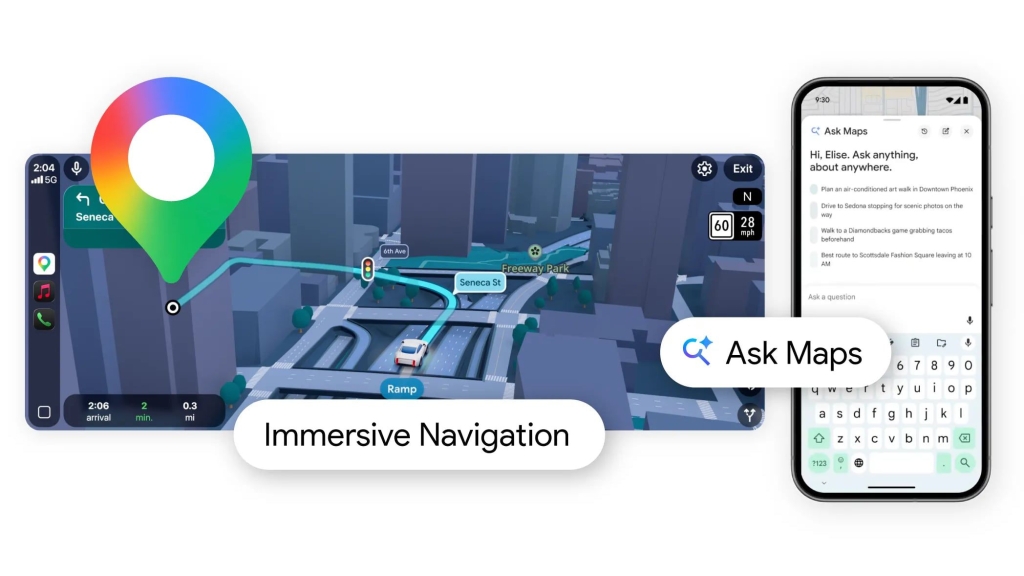
Google Maps Gets a Major AI Boost with Gemini Integration: Ask Maps and Immersive Navigation Transform Navigation Forever
In a groundbreaking update that could forever change how we interact with digital maps, Google has unveiled its most ambitious enhancement to Google Maps in over a decade. The tech giant has integrated its powerful Gemini AI directly into Google Maps, introducing two revolutionary features: Ask Maps and Immersive Navigation. This isn’t just another incremental update—it’s a fundamental reimagining of what a mapping application can do, transforming Google Maps from a simple navigation tool into an intelligent, conversational travel companion.
The Gemini Revolution in Your Pocket
Imagine being able to ask your map application complex, nuanced questions that would have previously required hours of research, cross-referencing multiple sources, and endless scrolling through reviews. That’s exactly what Google has achieved with Ask Maps. This feature leverages Gemini’s advanced natural language processing capabilities to understand context, interpret complex queries, and provide tailored responses that feel genuinely helpful rather than robotic.
Gone are the days of typing vague search terms and hoping for relevant results. Now you can ask questions like “Where can I find a quiet coffee shop with outdoor seating that’s open late and has good Wi-Fi for working?” or “What are the best hiking trails near me that are suitable for beginners and have scenic viewpoints?” Google claims these are the kinds of questions “a map could never answer before.”
The magic happens through Gemini’s ability to synthesize information from Google’s massive database of over 300 million places, combining that with community-generated reviews, real-time data, and your personal preferences. The AI doesn’t just find a single answer—it builds a custom map experience tailored to your specific needs, complete with multiple options and contextual information that helps you make informed decisions.
Trip Planning Reimagined
For travelers and planners, Ask Maps represents a quantum leap forward. The feature can analyze your saved places, previous searches, and even your travel history to provide highly personalized recommendations. Planning a weekend getaway? Ask Maps can create a comprehensive itinerary that accounts for your interests, budget, travel time between locations, and even optimal timing for activities based on crowd patterns and local events.
What makes this particularly powerful is the contextual awareness. If you’ve been searching for Italian restaurants and art museums, Ask Maps understands these patterns and can suggest experiences that align with your demonstrated preferences. It’s like having a local expert who knows not just the geography, but understands your tastes and can anticipate your needs.
Immersive Navigation: A 3D Revolution
While Ask Maps transforms how we search for places, Immersive Navigation completely reinvents the actual act of getting from point A to point B. Google describes this as the biggest update to driving in Google Maps in over a decade, and the visual demonstrations are nothing short of stunning.
The new 3D view brings maps to life with photorealistic renderings of buildings, overpasses, and terrain. But this isn’t just eye candy—Google has engineered these visuals to serve practical purposes. When navigating complex intersections or highway interchanges, the app will automatically highlight crucial details like lane markings, crosswalks, traffic lights, and stop signs, making it easier than ever to understand exactly where you need to be.
The “spatial understanding” that Google mentions isn’t marketing fluff—it’s a genuine technical achievement. By analyzing real-world imagery from Street View and aerial photography using Gemini models, Google Maps now has a much deeper comprehension of the three-dimensional space it’s helping you navigate. This means the app can provide more accurate distance estimations, better predict potential obstacles, and offer more nuanced route suggestions.
Smarter Routing for the Real World
The enhanced navigation goes beyond pretty visuals. Google Maps now provides a broader view of your entire route, giving you context about what’s coming up miles ahead. This is particularly valuable for long-distance travel where understanding the bigger picture helps with planning stops, fuel breaks, and meal times.
Perhaps most impressively, the app now offers more detailed comparisons when presenting alternate routes. Instead of simply showing you travel time differences, Google Maps will break down the tradeoffs—one route might be faster but has more traffic lights, while another is slightly longer but offers better scenery or more reliable travel times during rush hour. This level of granular comparison was previously unavailable in mainstream navigation apps.
The route preview feature is another game-changer, especially for urban drivers. Before you even start your journey, you can see exactly where you’ll need to navigate complex parking structures, identify optimal drop-off points for rideshare services, or plan your approach to busy venues. This pre-trip intelligence can save significant time and reduce the stress of navigating unfamiliar areas.
The Technology Behind the Magic
What makes these features possible is Google’s sophisticated use of Gemini AI to process and understand real-world imagery. The system analyzes Street View data and aerial photographs to extract meaningful information about the physical environment—understanding not just where buildings are, but their heights, architectural features, and how they relate to surrounding infrastructure.
This spatial intelligence extends to understanding traffic patterns, pedestrian flows, and even subtle environmental factors that might affect your journey. The AI can identify areas prone to flooding during heavy rain, recognize construction zones from imagery, and understand how different times of day affect traffic flow in specific areas.
Global Rollout with Thoughtful Phasing
Google is taking a measured approach to deployment. Ask Maps is launching first in the United States and India on both iOS and Android platforms, with desktop users to follow shortly. This phased approach allows Google to gather feedback and refine the experience before expanding to other regions and languages.
Immersive Navigation is rolling out today in the United States, though not all users will see it immediately. Google is implementing a gradual expansion over the coming months, with availability extending to eligible iOS and Android devices, plus CarPlay and Android Auto integration. This careful rollout strategy ensures system stability and allows Google to optimize performance across different device types and network conditions.
The Future of Navigation Has Arrived
These updates represent more than just feature additions—they signal a fundamental shift in how we interact with digital mapping technology. By integrating advanced AI directly into the core navigation experience, Google is blurring the lines between a simple mapping tool and an intelligent travel assistant that can understand context, learn from interactions, and provide genuinely helpful guidance.
The implications extend far beyond individual users. Businesses can expect to see changes in how customers discover and interact with their locations. Urban planners and transportation authorities might find new tools for understanding movement patterns and optimizing infrastructure. And as these technologies mature, we can expect even more sophisticated applications, from augmented reality navigation to predictive routing that anticipates your needs before you even ask.
What’s particularly exciting is that this is just the beginning. As Gemini continues to evolve and Google accumulates more data about how people use these features, we can expect even more intelligent, personalized, and helpful navigation experiences in the future. The days of static, one-size-fits-all maps are officially over—welcome to the era of AI-powered, conversational navigation.
tags: Google Maps Gemini, AI navigation, Ask Maps feature, Immersive Navigation, 3D maps, smart routing, Gemini AI integration, conversational maps, trip planning AI, spatial understanding, Street View AI, CarPlay navigation, Android Auto, Google Maps update, AI-powered maps, personalized navigation, real-time traffic AI, mapping technology 2025, intelligent routing, augmented reality navigation, travel planning AI
viral phrases: “Maps that think for you,” “Your map just got a brain,” “Navigation that actually understands you,” “The future of finding your way,” “Maps that can answer questions you never thought to ask,” “Driving directions with spatial superpowers,” “AI that knows the road better than you do,” “Your personal navigation genius,” “Maps that plan your trip before you do,” “The end of getting lost as we know it,” “Navigation that sees in 3D,” “Maps that learn what you like,” “Your co-pilot just got smarter,” “The map that talks back,” “Driving directions with X-ray vision,” “Maps that predict traffic before it happens,” “Navigation that thinks three steps ahead,” “The map that never says ‘recalculating’,” “AI that turns maps into travel agents,” “Your road trip just got a brain transplant”,


Leave a Reply
Want to join the discussion?Feel free to contribute!