
Gravitational wave signal proves Einstein was right about relativity
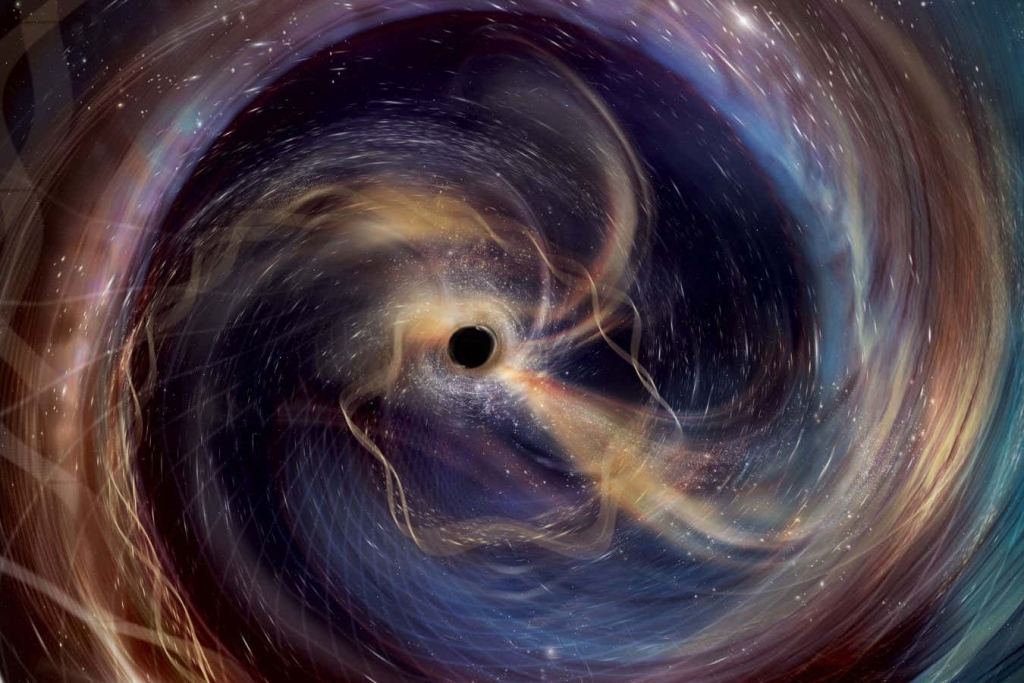
Einstein’s Theory of General Relativity Passes Another Cosmic Test with the Loudest Black Hole Collision Ever Recorded
In a groundbreaking discovery that has sent ripples through the scientific community—quite literally—researchers have confirmed once again that Albert Einstein’s theory of general relativity holds true, even in the most extreme conditions of the universe. The event in question? The loudest collision ever recorded between two black holes, a cosmic spectacle that has provided scientists with an unprecedented opportunity to test Einstein’s predictions in exquisite detail.
The collision, detected in 2025, was labeled GW250114, and it was captured by an international network of ultra-sensitive gravitational wave detectors, including the Laser Interferometer Gravitational-Wave Observatory (LIGO) in the United States and the Virgo detector in Italy. These detectors, far more advanced than when LIGO made its first historic detection in 2016, picked up a powerful ripple in the fabric of space-time—a gravitational wave—produced by the merger of two black holes.
This event was not just any gravitational wave detection. GW250114 stands out as the clearest and most noise-free data ever recorded for such an event, making it a unique testbed for some of the most well-established theories in physics. In fact, just last year, researchers used data from GW250114 to test Stephen Hawking’s theorem, which proposed that the event horizon of a merged black hole—the boundary beyond which light cannot escape—would not be smaller than the sum of its parent black holes. The results? Hawking’s theorem was confirmed with nearly 100% confidence.
Now, a team led by Keefe Mitman at Cornell University has taken this a step further, using the same data to test Einstein’s theory of general relativity. Einstein’s equations describe how any object with mass moves through space-time, and when applied to the merger of two black holes, they predict a specific sequence of events: the black holes spiral around each other, crash together in a colossal burst of energy, and then vibrate at distinct frequencies, much like a bell ringing after being struck. These vibrations, known as ringdown modes, have been too faint to detect in previous events—until now.
GW250114 was so loud that scientists could finally test these ringdown modes in detail. Mitman and his team simulated Einstein’s equations and predicted the frequencies and amplitudes of these black hole vibrations. When they compared their predictions to the actual data, the match was incredibly precise. “The amplitudes that we measure in the data agree incredibly well with the predictions from numerical relativity,” Mitman said. “Einstein’s equations are really hard to solve, but when we do solve them and we observe predictions of general relativity in our detectors, those two agree.”
Laura Nuttall of the University of Portsmouth, UK, summed it up succinctly: “The upshot is Einstein is still correct. Everything seems to look like what Einstein says about gravity.”
However, despite the clarity of GW250114, the frequencies were still so faint that Mitman’s team couldn’t rule out the possibility that they might differ from Einstein’s predictions by less than about 10%. This limitation is primarily due to the sensitivity of our current detectors. As technology improves, these error bars are expected to shrink, potentially revealing whether Einstein’s theory holds up under even more scrutiny. “As we observe more and more events, or see louder single events, what could happen is that those error bars could just shrink to being around zero, or it could shrink to being away from zero,” Mitman explained. “If it shrinks to being away from zero, that’s much more interesting.”
This discovery not only reaffirms Einstein’s genius but also opens the door to future tests of general relativity and other fundamental theories of physics. As gravitational wave detectors become even more sensitive, scientists will be able to probe the universe’s most extreme environments with unprecedented precision, potentially uncovering new physics that could revolutionize our understanding of the cosmos.
Tags:
Einstein, general relativity, black holes, gravitational waves, GW250114, LIGO, Virgo, space-time, ringdown modes, Stephen Hawking, cosmic collision, scientific breakthrough, physics, astronomy, universe, space exploration, cutting-edge science, mind-blowing discovery, Einstein was right, gravitational wave detection, black hole merger, space-time ripples, cosmic vibrations, scientific validation, physics revolution, astronomical event, space-time fabric, gravitational wave astronomy, cosmic phenomena, scientific milestone, Einstein’s equations, numerical relativity, space-time curvature, cosmic test, gravitational wave event, black hole physics, space-time ripples, cosmic vibrations, scientific breakthrough, mind-blowing discovery, Einstein was right, gravitational wave detection, black hole merger, space-time ripples, cosmic vibrations, scientific validation, physics revolution, astronomical event, space-time fabric, gravitational wave astronomy, cosmic phenomena, scientific milestone, Einstein’s equations, numerical relativity, space-time curvature, cosmic test, gravitational wave event, black hole physics.
,


Leave a Reply
Want to join the discussion?Feel free to contribute!