
High-tech player in collectibles: Startup uses robotics and AI to sort, analyze and sell trading cards
Gradient Collects: The AI-Powered Trading Card Revolution That’s Processing 100,000 Cards Daily
In a nondescript office building across from the Seattle Sounders’ training facility in Renton, Washington, a technological revolution is quietly transforming a $15 billion industry. Gradient, a startup co-founded by longtime friends Tim Clothier and Matt Lubbers, has developed an AI-powered robotics system that’s processing up to 100,000 trading cards per day—a feat that would have taken Clothier himself 15 years to accomplish manually.
The story begins with a simple problem: Clothier’s living room view of Mount Rainier was obstructed by a mountain of trading cards. Not just any collection, but approximately 7 million cards accumulated over decades of passionate collecting. His garage was stacked with boxes, and his sorting pace of 25,000 cards per week meant decades of work ahead.
“My friends, when they’re over, I’ll be sorting and they kind of run the other way,” Clothier admits. “Matt’s very inquisitive and he started asking questions, and he said, ‘What do you think technology could do for you?'”
That question sparked a four-year journey that has culminated in Gradient’s sophisticated operation, which now processes cards for collectors nationwide. The company has raised $6 million from friends and family, including Sounders majority owner Adrian Hanauer, whom Clothier has known since he was 15 years old.
The Technology Behind the Magic
Gradient’s system represents a remarkable fusion of robotics, computer vision, and artificial intelligence. At the heart of the operation are eight custom robotic sorters that hum with precision, moving cards back and forth on a custom rigging apparatus that resembles something from a rock concert stage.
The robots operate with remarkable delicacy. Custom 3D-printed trays hold the cards, while buttery soft suction fingers gently lift each card without causing damage. Under bright lights, the machines rapidly move cards to flatbed scanners that capture images of the card backs, while cameras positioned overhead photograph the card fronts. Every single card is physically and digitally cataloged.
The captured images are instantly sent to a nearby server room housing three custom supercomputers—utilizing a high-density configuration similar to NVIDIA’s H100 or H200 chips—with six GPUs each. These machines handle all AI model training and inference testing, crunching through 500,000 images daily to analyze and score cards against a database of 30 million variants.
“We saw that there wasn’t much tech, at the time, in this industry. That’s what got us excited,” Lubbers explains. “What if we could process cards extremely fast? What if we could reduce the amount of time someone, a customer or even expert, took to identify or price or list the card? That’s what we built.”
Beyond Simple Sorting: A Complete Ecosystem
Gradient isn’t just another robotic sorter in an increasingly crowded field. While companies like TCG Machines produce robotic sorters used by card shops to process thousands of cards per hour, Gradient has built a complete ecosystem around its technology.
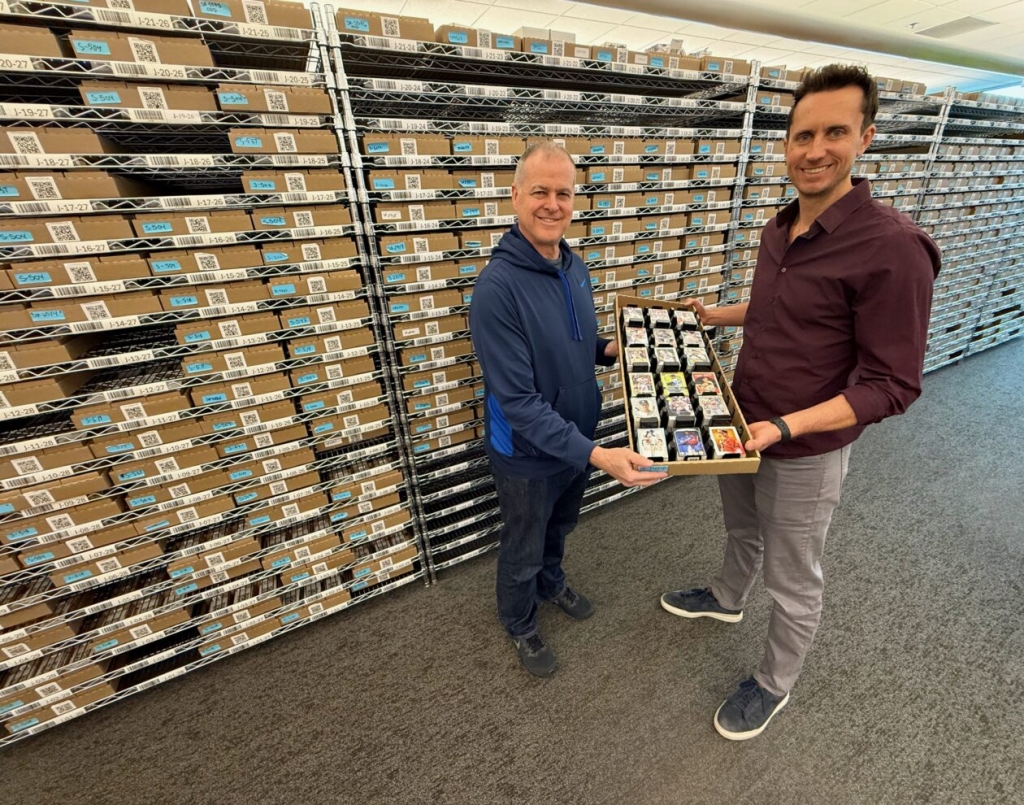
The company’s sprawling Renton space looks like any startup tech company office, with notable exceptions. Boxes upon boxes full of trading cards are stacked everywhere, with 10 million cards currently stored and room for three times that amount. Rolling racks line the space, each containing boxes of cards featuring sports heroes past and present across baseball, football, basketball, hockey, and more.
Employees shuffle through some cards by hand at tables, while others work at computer stations digitally flipping through card files or writing the code that manages the workflow. The environment is a unique mix of card geeks and engineers.
The Business Model: Subscriptions and Services
Gradient offers different subscription price tiers to attract various customer types and collection sizes:
- Pay-as-you-go card scanning: 40 cents per card
- Premium level: $9.99 per month for up to 10,000 cards
- Pro level: $29.99 per month for up to 30,000 cards
- Commercial level: $99.99 per month for up to 100,000 cards
All levels include secure storage and other perks. Customers gain access to a personal web portal where they can manage their collections, see images of their cards, read card details, list them on eBay through Gradient’s store, and monitor active and sold listings.
Gradient takes between 16% and 20% per sale, depending on the subscription level, with 13% or 14% covering costs with eBay. The company is also building its own marketplace to give customers the option of listing with Gradient, eBay, or both.
The Market Opportunity
Gradient is entering a market experiencing significant growth. The U.S. trading card market is valued at approximately $15 billion, with particular strength in sports trading cards, gaming cards, and collectibles. The company’s largest customer so far has given Gradient more than 500,000 cards to process.
The timing is particularly interesting as the industry sees increasing AI-powered platforms like Ludex, CollX, Card Boss, and eBay’s own scan-to-list feature already used by collectors to instantly grade and price cards with quick scans via mobile phone apps.
The Human Element
Despite the heavy automation, Gradient maintains a human touch. The company streams live auctions on eBay where hosts excitedly open packs of Pokémon cards from a makeshift in-house studio located behind piles of boxes. These live streams have become popular viewing, combining the excitement of opening new packs with the potential for discovering valuable cards.
The company employs 25 people, creating a unique workplace culture that blends technical expertise with genuine passion for collectibles. Employees range from computer vision experts to longtime collectors who understand the nuances of different card types and values.
The Future Vision
Looking ahead, Gradient’s vision extends beyond simple processing and storage. The company aims to become the central hub for the trading card ecosystem, offering services that range from digitization and authentication to marketplace integration and community building.
“Our job is to help you digitize and inform you what you have, and then you get to choose what you wanna do with it,” Lubbers says. This philosophy recognizes that collectors have different goals—some want to preserve their collections digitally, others want to sell valuable cards, and many fall somewhere in between.
The technology could also expand into other collectible markets, from comic books to vintage toys, wherever there’s a need to process large volumes of items quickly and accurately.
Why It Matters
Gradient represents more than just a clever solution to a personal problem. It’s emblematic of how AI and robotics are transforming industries that might seem resistant to technological disruption. The trading card market, often associated with nostalgia and analog collecting, is being modernized through sophisticated technology that makes the hobby more accessible and potentially more profitable for collectors.
For the millions of people who have boxes of trading cards stored away—in attics, basements, or closets—Gradient offers a way to finally unlock the value and stories contained within those collections. Whether those cards represent childhood memories, investment opportunities, or simply accumulated clutter, Gradient provides a path to understanding and potentially monetizing what might otherwise remain forgotten treasures.
The company’s success could also inspire similar approaches in other collectible markets, demonstrating how technology can preserve the emotional connection to physical objects while adding layers of convenience, accuracy, and market access that were previously impossible.
In an era where digital assets often overshadow physical collectibles, Gradient is proving that there’s still tremendous value—both sentimental and financial—in the tangible items that connect us to our past. By combining cutting-edge technology with a deep understanding of collector culture, Gradient is creating a bridge between the analog world of physical collectibles and the digital future of commerce and community.
Tags: AI trading cards, robotics collectibles, sports card technology, Gradient Collects, trading card processing, AI grading cards, robotic sorting, collectible card market, sports memorabilia tech, card collecting innovation, machine learning collectibles, automated card processing, trading card valuation, eBay card sales, Pokémon card sorting, baseball card technology, digital collectibles, card storage solutions, AI-powered collectibles, trading card marketplace
Viral Sentences:
- AI is now sorting 100,000 trading cards per day—what collectors used to spend years doing manually
- This startup is using robots to process millions of trading cards that were once just collecting dust
- The $15 billion trading card market is getting a high-tech makeover with AI and robotics
- From living room clutter to cutting-edge technology: How one collector’s problem became a business solution
- Robots are now handling your childhood treasures with more care than you ever could
- The future of collecting is here, and it’s powered by AI, not nostalgia
- What happens when you combine a card geek’s passion with an engineer’s precision? Gradient happens
- This company is making it possible to finally find out if those attic cards are worth anything
- The trading card industry is being disrupted by the same technology that powers self-driving cars
- Your forgotten card collection could be worth thousands—if you can just figure out what you have
- Gradient is turning card collecting from a hobby into a high-tech business opportunity
- AI is now the ultimate card dealer, sorting and valuing millions of cards with machine precision
- The robots are coming for your card collection—and they’re here to help
- This startup is proving that even the most analog hobbies can benefit from digital transformation
- From shoeboxes to supercomputers: The tech revolution in trading card collecting
- Gradient is making it possible to finally organize that mountain of cards in your garage
- The future of collectibles is automated, AI-powered, and surprisingly gentle with your treasures
- This company is building the Google of trading cards—where everything is findable and valuable
- Trading cards are getting the tech treatment, and collectors are finally getting their time back
- The robots aren’t replacing collectors—they’re empowering them with information and efficiency
,


Leave a Reply
Want to join the discussion?Feel free to contribute!