
Hold onto “dry powder” while prices swing, says one analyst
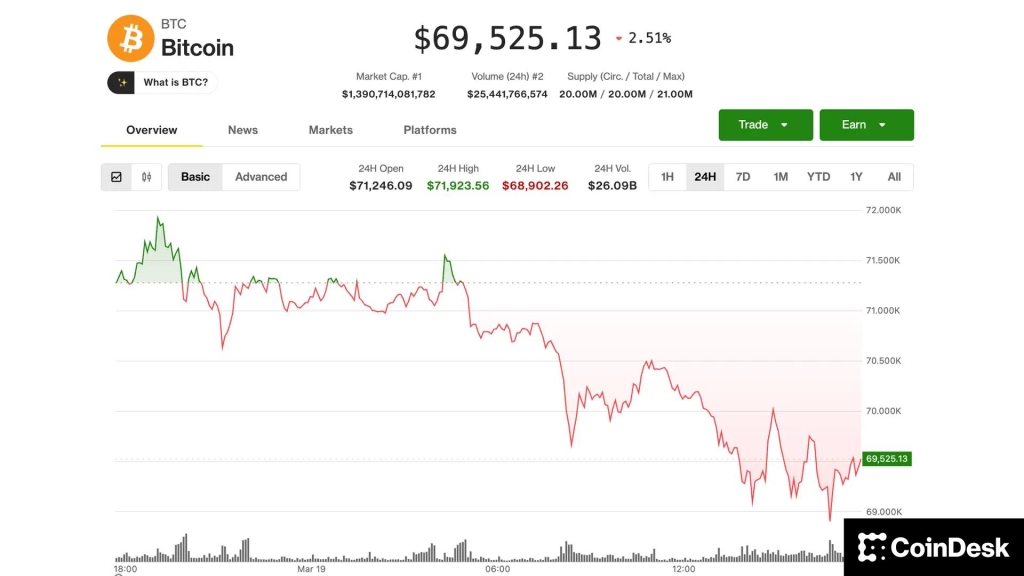
Bitcoin Holds Steady as Middle East Tensions Shake Global Markets
Bitcoin hovered near $69,000 on Thursday as escalating conflict in the Middle East sent shockwaves through global markets, with energy infrastructure under attack and investors scrambling for safety. The digital asset’s relative calm stood in stark contrast to the chaos unfolding across traditional markets, where risk-off sentiment dominated trading floors from New York to Tokyo.
Oil prices remained the epicenter of market volatility, with investors retreating from riskier positions as fresh headlines detailed attacks on critical energy infrastructure. Prices surged back toward the psychologically significant $100 per barrel mark after a Politico report revealed the United States is not considering a crude export ban—reversing earlier declines and reigniting inflation concerns that had briefly subsided. This reversal kept inflation worries firmly in focus, complicating the outlook for monetary policy and economic growth.
The energy shock rippled through traditional markets with particular force. Investors began seriously contemplating scenarios where central banks might delay anticipated rate cuts or, in more extreme cases, even consider rate hikes to combat inflationary pressures stemming from energy price spikes and supply chain disruptions. The S&P 500 and Nasdaq both slid nearly 1% in morning trading, hitting fresh 2026 lows and underscoring the depth of market anxiety.
However, the most dramatic moves came from the metals markets. Gold, traditionally viewed as the ultimate safe haven, plunged 5% to around $4,500 per ounce—its lowest level since early February. Silver followed suit with a 6.6% decline, extending a sharp unwinding after weeks of outsized gains that had pushed the precious metal to multi-year highs. The simultaneous weakness in both gold and bitcoin suggested broad-based de-risking rather than a flight to safety, a dynamic that puzzled many market observers.
Cryptocurrency markets, by comparison, displayed remarkable resilience. Bitcoin traded around $69,400, representing a modest 2.6% decline on the day—a relatively contained move given the surrounding market turmoil. Most major tokens followed a similar pattern: ether (ETH), XRP (XRP), BNB, and Solana (SOL) all posted losses, but remained under 3%. The broader CoinDesk 20 Index declined approximately 2.1%, significantly outperforming both traditional equities and precious metals.
Crypto-linked equities also moved lower, though their declines paled in comparison to broader market weakness. Coinbase (COIN) slipped 1.7%, while Bitcoin treasury company Strategy (MSTR) fell 2.6%. Stablecoin issuer Circle (CRCL) pulled back 6%, giving up some ground after an impressive three-week run that had seen its shares more than double. These relatively modest declines highlighted crypto’s growing maturity as an asset class capable of weathering broader market storms.
Bitcoin’s Unusual Performance Amid Geopolitical Chaos
The simultaneous drop in both gold and bitcoin points to broad de-risking rather than a rotation into safe havens, according to Alvin Kan, COO of Bitget Wallet. Rising energy prices are feeding into inflation expectations, reinforcing a “higher-for-longer” interest rate outlook and tightening liquidity—a difficult mix for risk assets across the board. This environment creates a challenging backdrop for all speculative investments, from technology stocks to cryptocurrencies.
Yet bitcoin has outperformed gold by approximately 20% during the initial phase of the Iran conflict, noted Bryan Tan, trader at Wintermute, an unusual dynamic for an asset typically treated as a riskier tech name. This relative strength suggests that some investors view bitcoin as a viable alternative to traditional safe havens, particularly given its decentralized nature and independence from government control. However, the lack of follow-through above $75,000 suggests markets remain cautious and rangebound, unwilling to commit to a clear directional bet amid ongoing uncertainty.
“When sentiment swings on each headline about the conflict, and correlation to oil prices are so elevated, being flat is a strong position,” Tan said. “We lean towards reserving dry powder until we see a meaningful confirmation in either direction or a material change in market conditions.” This cautious approach reflects the broader market’s struggle to price in geopolitical risk, with traders reluctant to make significant commitments until the conflict’s trajectory becomes clearer.
The cryptocurrency’s performance during this period of heightened geopolitical tension offers valuable insights into its evolving role within investment portfolios. While bitcoin has historically been viewed as a speculative asset closely correlated with technology stocks and risk sentiment, its behavior during the current crisis suggests a potential maturation process. The asset’s ability to hold relatively steady while traditional safe havens like gold experience significant volatility indicates that investors may be beginning to view bitcoin through a different lens—one that recognizes its unique properties as a decentralized, borderless store of value.
This shift in perception comes at a critical juncture for the cryptocurrency market, which has been working to establish itself as a legitimate asset class following years of volatility and regulatory scrutiny. The current crisis provides a real-world test of bitcoin’s thesis as “digital gold”—a hedge against both inflation and geopolitical instability. While the asset has not yet achieved the status of a true safe haven, its relative outperformance during this period of market stress suggests that it may be carving out a unique niche within the broader investment landscape.
As the Middle East conflict continues to evolve and its impact on global markets becomes clearer, bitcoin’s role as a potential safe haven or inflation hedge will likely face further scrutiny. Traders and investors will be watching closely to see whether the cryptocurrency can maintain its relative strength or whether it will succumb to broader risk-off sentiment if the conflict escalates further. In either case, bitcoin’s performance during this period of heightened geopolitical tension provides valuable data points for understanding its place within modern investment portfolios and its potential as a tool for navigating an increasingly uncertain global economic landscape.
Tags: #Bitcoin #Crypto #MiddleEastConflict #OilPrices #Gold #MarketVolatility #SafeHaven #Inflation #InterestRates #Geopolitics #DigitalAssets #InvestmentStrategy
Viral Phrases: Bitcoin holds ground, Oil hits $100, Gold crashes 5%, Crypto outperforms, Risk-off sentiment, Higher-for-longer rates, Middle East tensions, Energy infrastructure attacks, Market de-risking, Digital gold thesis, Geopolitical hedge, Crypto resilience, Safe haven debate, Market uncertainty, Investment positioning
,


Leave a Reply
Want to join the discussion?Feel free to contribute!