
How “Empty Space” Is Supercharging Atomically Thin Semiconductors
How “Empty Space” Is Supercharging Atomically Thin Semiconductors
A single layer of atoms may seem too thin to meaningfully interact with light, yet materials like tungsten disulfide are reshaping what is possible in nanophotonics. Researchers have now found a way to dramatically strengthen these interactions—an advance that could transform everything from ultra-fast computing to ultra-efficient solar cells.
Atomically thin semiconductors such as tungsten disulfide (WS₂) are emerging as key materials for next-generation photonic technologies. Although these materials are only a few atoms thick—often referred to as “two-dimensional” (2D)—they exhibit remarkable optical and electronic properties. WS₂, for example, can absorb and emit light with extraordinary efficiency, making it a promising candidate for applications in optoelectronics, quantum computing, and beyond.
However, there’s a catch: because these materials are so thin, their interaction with light is inherently weak. Light tends to pass through or around them without much engagement, limiting their practical use. This is where the latest breakthrough comes in.
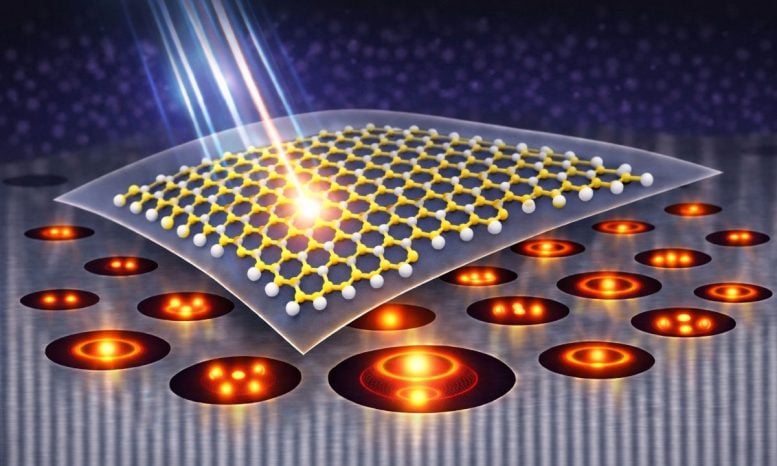
A team of researchers has developed a novel hybrid photonic platform that dramatically enhances the interaction between light and atomically thin semiconductors. The secret? Harnessing the power of “empty space”—or more precisely, engineered vacuum environments that trap and concentrate light in ways never before achieved.
The platform works by creating a special structure that captures light in the air, effectively increasing the time and intensity with which photons interact with the 2D material. This is done using a combination of carefully designed nanostructures and optical cavities that act like tiny mirrors, bouncing light back and forth in a confined space. The result is a “supercharged” interaction, where the normally weak bond between light and a single atomic layer becomes hundreds of times stronger.
This breakthrough has profound implications. For one, it opens the door to ultra-compact, energy-efficient photonic devices—think sensors, lasers, and modulators that are not only smaller than ever before but also far more powerful. It also paves the way for new types of quantum technologies, where precise control over light-matter interactions is essential.
Moreover, the approach is highly scalable and compatible with existing semiconductor manufacturing processes, meaning it could be integrated into next-generation electronics without requiring a complete overhaul of current systems.
In essence, what was once considered a limitation—the extreme thinness of these materials—has now become a superpower, thanks to clever engineering and a deep understanding of light’s behavior at the nanoscale. As researchers continue to push the boundaries of what’s possible, the future of computing, communication, and energy may well rest on the shoulders of these astonishingly thin materials.
viral tags & phrases:
AtomicallyThin #Nanophotonics #WS2 #TungstenDisulfide #LightMatterInteraction #HybridPhotonicPlatform #QuantumTech #NextGenSemiconductors #Nanotechnology #UltraFastComputing #EnergyEfficient #PhotonicsRevolution #VacuumEngineering #2DMaterials #SciTechDaily #Breakthrough #FutureOfTech #LightTrapping #SuperchargingSemiconductors #Innovation #ScienceNews #TechViral #CuttingEdge #LightInAir #OpticalCavities #Nanostructures #QuantumLeap #SemiconductorRevolution #TechBreakthrough #LightManipulation #AtomThick #FutureIsThin #Photonics #QuantumComputing #EnergyEfficiency #TechInnovation #SciTech #LightMatter #NanotechBreakthrough #FutureTech #ThinIsPowerful #LightEnhancement #QuantumMaterials #PhotonicsPlatform #TechAdvancement #LightControl #NextGenPhotonics #AtomThickTech #ScienceInnovation #TechFuture #LightInteraction #SemiconductorTech #PhotonicsBreakthrough #QuantumFuture #TechRevolution #LightEnhancementTech #Nanophotonic #QuantumLeapForward #FutureOfPhotonics #LightTrappingTech #AtomThinRevolution #TechAdvancement #PhotonicsInnovation #QuantumMaterialsTech #LightMatterBreakthrough #FutureOfSemiconductors #PhotonicsRevolution #TechBreakthrough #QuantumTechFuture #LightControlTech #NextGenPhotonics #AtomThinTech #ScienceBreakthrough #PhotonicsAdvancement #QuantumComputingFuture #LightManipulationTech #TechInnovation #PhotonicsFuture #QuantumMaterials #LightMatterEnhancement #FuturePhotonics #TechRevolution #PhotonicsBreakthrough #QuantumLeap #AtomThinMaterials #LightInteractionTech #NextGenTech #PhotonicsRevolution #TechAdvancement #LightControl #QuantumFuture #PhotonicsInnovation #TechBreakthrough #FutureOfTech #LightMatterInteraction #AtomicallyThinRevolution #PhotonicsBreakthrough #QuantumMaterials #LightTrapping #NextGenPhotonics #TechInnovation #PhotonicsFuture #QuantumTech #LightEnhancement #AtomThinTech #ScienceBreakthrough #PhotonicsAdvancement #QuantumComputingFuture #LightManipulation #TechRevolution #PhotonicsRevolution #TechBreakthrough #FutureOfTech #LightMatterInteraction #AtomicallyThinRevolution #PhotonicsBreakthrough #QuantumMaterials #LightTrapping #NextGenPhotonics #TechInnovation #PhotonicsFuture #QuantumTech #LightEnhancement #AtomThinTech #ScienceBreakthrough #PhotonicsAdvancement #QuantumComputingFuture #LightManipulation #TechRevolution
,


Leave a Reply
Want to join the discussion?Feel free to contribute!