
How worried should you be about an asteroid smashing into Earth?
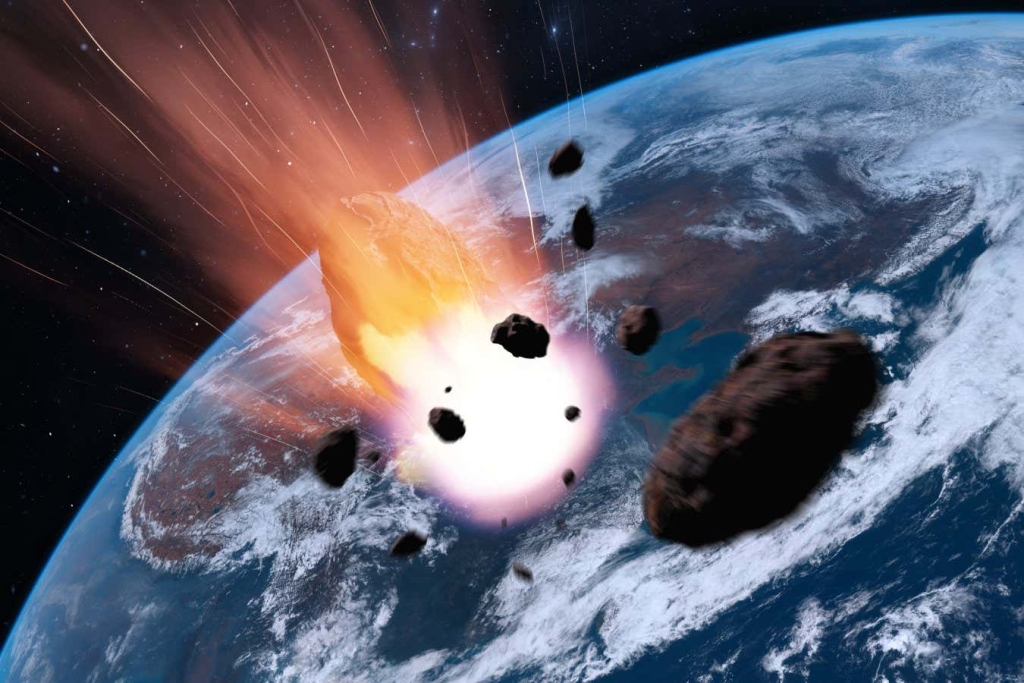
Earth’s Existential Threat: The Asteroid Dilemma
In the vast, cold expanse of space, a silent menace lurks—a space rock capable of wiping out a significant portion of life on Earth. This cosmic threat raises profound questions: Is this our inevitable fate? Can humanity find a way to avert disaster, or are we destined to share the dinosaurs’ fate? And should this existential risk keep you awake at night? Let’s explore what we know about this celestial danger.
The asteroid that ended the reign of dinosaurs 66 million years ago was colossal—at least 10 kilometers across. Its impact triggered megatsunamis, ignited massive forest fires, and plunged the world into darkness. Based on Earth’s crater record, such behemoths strike our planet roughly every 60 million years. For the next size class down—asteroids about 1 kilometer across—estimates suggest they hit Earth about every million years, with the most recent one occurring approximately 900,000 years ago. These statistics are enough to make anyone nervous.
However, what distinguishes humanity from the dinosaurs is our remarkable ability to observe space and interpret what we see. Researchers worldwide have harnessed this capability to determine how many asteroids exist and what proportion of them pose potential dangers.
The good news is reassuring: among the thousands of near-Earth objects that astronomers are tracking, only about 35 have more than a 1-in-a-million chance of hitting Earth in the next century. Even better, nearly all of these potential threats are less than 100 meters across. So, will an apocalyptic asteroid strike during our lifetimes? Almost certainly not.
Yet, the astute reader will notice caveats like “of the asteroids we’re tracking,” “small chances,” and “nearly” and “almost.” These qualifications persist because we cannot be certain we’ve detected every asteroid—a fact repeatedly demonstrated by breathless headlines announcing newly discovered rocks heading straight toward Earth. (Though these are usually near-misses that pass harmlessly by.)
To calculate the proportion of asteroids we’ve found, astronomers rely on three key figures: the number detected, the volume of sky searched, and the strength of our telescopes. Using these metrics, researchers estimate we’ve spotted all asteroids 10 kilometers across or larger that could threaten Earth. You can breathe that sigh of relief: it’s deeply unlikely we’ll suffer the same fate as the dinosaurs.
For asteroids measuring 1 kilometer across, we’ve detected approximately 80 percent, making it fairly unlikely any will appear unexpectedly. Anything smaller than 100 meters poses negligible danger—most would burn up in the atmosphere or cause minor damage if they hit, like the Chelyabinsk meteor in 2013.
However, the 100-meter “city-killers” present a more significant concern. We’ve detected less than half of those potentially lurking in space. If you’re going to worry about asteroids, these are the ones that merit concern.
Thankfully, another factor sets us apart from the dinosaurs: the spacefaring technology we’ve developed. This technology protects us in two crucial ways. First, space telescopes continuously monitor for incoming space rocks. While various telescopes keep watch during their other observations, a dedicated instrument called NEO Surveyor is scheduled to launch next year, which should dramatically improve our ability to track asteroids.
The second protective measure is our demonstrated capability to actually reach space. NASA’s 2022 Double Asteroid Redirection Test successfully smashed into an asteroid to alter its course, proving we can indeed move these space rocks if necessary. If we detect an incoming asteroid with sufficient advance warning—at least a couple of years—we should be able to adjust its trajectory so it passes harmlessly by.
If we were to fail in preventing an asteroid impact, it would constitute a natural disaster, albeit a predictable one. Chances are it would strike the ocean or an uninhabited area—after all, according to the World Economic Forum, less than 15 percent of the world’s land area (which is less than 4.3 percent of its total surface area) has been modified by humans, much less inhabited.
If an asteroid were heading for one of the few inhabited areas, we would have the same options available for any natural disaster: evacuate, mitigate, or shelter in place. Strengthening our disaster response capabilities would help prepare for this possibility, with the beneficial side effect of improving our response to many other disasters that are both more likely and harder to predict.
So, returning to our original questions: Is the asteroid threat inevitable? Absolutely. Is there a solution? Very possibly. Are we eventually to suffer the same fate as the dinosaurs? If so, it will be in the far-distant future. But worrying about that won’t change anything. Instead of stewing in anxiety, we can prepare now by learning how best to deal with natural disasters more generally—and letting astronomers keep their watchful eyes on the skies.
Tags: Asteroid impact, dinosaur extinction, near-Earth objects, NEO Surveyor, Double Asteroid Redirection Test, space defense, planetary defense, cosmic threats, space rocks, city-killers, Chelyabinsk meteor, World Economic Forum, natural disasters, existential risk, space exploration, astronomical monitoring, asteroid detection, impact prevention, disaster preparedness, space technology
Viral Sentences: Could this dramatic image ever happen for real? The asteroid that killed the dinosaurs 66 million years ago was at least 10 kilometres across. Of the thousands of near-Earth objects that astronomers are tracking, there are only about 35 with more than a 1-in-a-million chance of hitting Earth in the next 100 years. All of those still have extremely small chances of coming for us. The 100-metre “city-killers” are more of a problem, however. If we did fail to prevent the asteroid hitting Earth, it would be a natural disaster, but a predictable one. Shoring up our disaster response capabilities would help prepare for that possibility. Instead of stewing in our anxiety, we can prepare now by learning how best to deal with natural disasters more generally.
,


Leave a Reply
Want to join the discussion?Feel free to contribute!