
Huge Plume of Pollution Linked to Something That Will Not Make Elon Musk Happy
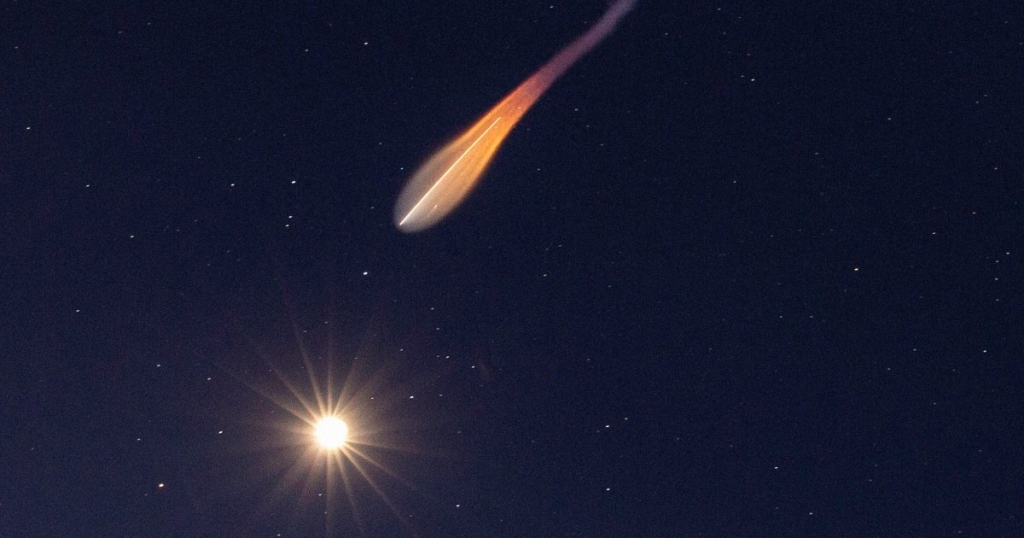
SpaceX Rocket Leaves Massive Lithium Cloud in Earth’s Upper Atmosphere, Sparking Environmental Alarm
In a discovery that has sent shockwaves through the scientific community, researchers have detected an unprecedented cloud of lithium and other pollutants injected into Earth’s upper atmosphere by the uncontrolled reentry of a SpaceX Falcon 9 rocket stage—marking what experts are calling “a new frontier in atmospheric pollution” that could have far-reaching consequences for our planet’s climate systems.
The Discovery That Changed Everything
Just over a year ago, the upper stage of a SpaceX Falcon 9 rocket plummeted back to Earth after delivering 23 Starlink satellites to low-Earth orbit. What appeared to be a routine mission—one of hundreds of rocket launches that have delivered nearly 10,000 broadband-beaming satellites into space—has now been revealed as something far more consequential.
Using cutting-edge resonance lidar technology in Germany, an international team of researchers observed a massive lithium plume from the uncontrolled reentry of this SpaceX rocket in February 2025 at an altitude of 62 miles west of Ireland. The findings, published in the prestigious journal Communications Earth & Environment, represent what the team calls “the first measurement of upper-atmospheric pollution resulting from space debris re-entry.”
The Scale of the Problem
To put this into perspective, the amount of lithium released by a single Falcon 9 rocket stage—approximately 66 pounds—dwarfs the natural deposition from small meteors, which deposit only 50 to 80 grams of the element daily. “So, a single Falcon 9 rocket has about [66 pounds], so this is quite a lot more,” explained Robin Wing, professor at the Leibniz Institute of Atmospheric Physics and coauthor of the groundbreaking paper.
The rocket bodies are constructed from a special aluminum-lithium alloy, an aerospace-grade material designed to reduce weight. However, the intense heat of reentry causes this material to break down, releasing its constituent elements into the atmosphere at altitudes where they can persist and potentially interact with critical atmospheric processes.
A Growing Crisis in the Making
This discovery comes at a time when satellite launches are becoming increasingly common. It’s not just SpaceX driving this trend—several other companies and governments are planning their own satellite constellations. The problem is compounded by the fact that these satellites have limited operational lifespans, requiring continuous launches of replacements.
What makes this particularly alarming is that we’re essentially conducting a massive, uncontrolled experiment on our planet’s upper atmosphere. The cumulative effect of thousands of rocket launches and satellite reentries could be fundamentally altering the chemical composition of the stratosphere and mesosphere in ways we don’t yet understand.
The Ozone Layer Connection
Perhaps the most concerning aspect of these findings relates to Earth’s protective ozone layer, which sits ten to 25 miles above the surface and absorbs the vast majority of harmful UV radiation from the Sun. A 2024 study found that satellites could be injecting harmful pollutants such as aluminum oxides into the upper atmosphere as they burn up during reentry.
“Our largest concern is aluminium and aluminium oxides interacting with the ozone layer,” Wing told the BBC, highlighting the potential for these space-age pollutants to interfere with one of Earth’s most critical protective mechanisms.
The Unknown Long-term Effects
Despite the growing body of evidence, there’s still much we don’t know about the long-term effects of these pollutants. The scientific community is racing to understand the implications before the problem becomes irreversible. “This is a new scientific field,” Wing emphasized. “It’s hard to speculate because it’s changing so quickly. I hope that if we start our measurements now, perhaps we can get ahead of the curve and identify any potential problems before they become serious.”
The research team’s paper concludes with a sobering warning: “This finding supports growing concerns that space traffic may pollute the upper atmosphere in ways not yet fully understood. Continued growth in satellite launches and re-entries may lead to cumulative effects, with implications for long-term atmospheric composition and climate interactions.”
The Bigger Picture
As humanity’s presence in space expands exponentially, we’re discovering that our activities have consequences that reach far beyond the vacuum of space itself. The upper atmosphere, once thought to be too vast to be significantly impacted by human activity, is now showing signs of stress from our growing space infrastructure.
The implications extend beyond just environmental concerns. This discovery raises fundamental questions about how we balance technological progress with planetary stewardship. As more companies and nations rush to establish their presence in orbit, the cumulative impact on Earth’s atmosphere could become one of the defining environmental challenges of the 21st century.
What Comes Next?
The scientific community is calling for immediate action to better understand and potentially mitigate these effects. This includes more comprehensive monitoring of atmospheric composition, development of cleaner rocket technologies, and perhaps most importantly, a serious reevaluation of the rapid expansion of satellite constellations.
As we stand at this critical juncture, the choices we make today about space exploration and satellite deployment could have consequences that echo through generations. The lithium cloud detected over Europe may be just the beginning of a much larger story about humanity’s impact on our planet’s most remote and fragile environments.
Tags
spacex pollution, lithium cloud, upper atmosphere, satellite constellations, ozone layer, environmental impact, rocket reentry, space debris, atmospheric chemistry, climate change, starlink satellites, falcon 9 rocket, space traffic, lidar detection, aerospace pollution, planetary protection
Viral Sentences
SpaceX just polluted Earth’s upper atmosphere with a massive lithium cloud! 🚨 Scientists detect unprecedented atmospheric contamination from rocket reentry. The space industry’s dirty little secret is finally exposed. 66 pounds of lithium dumped into our skies by a single rocket! Is space exploration destroying our ozone layer? The environmental cost of Elon Musk’s satellite dreams. Groundbreaking discovery reveals space junk is poisoning our atmosphere. Are we trading internet connectivity for atmospheric destruction? Scientists sound the alarm on space industry pollution. The final frontier might be killing our atmosphere. SpaceX’s rocket pollution could have climate implications we don’t understand yet. Space debris is the new invisible threat to Earth’s protective layers. The sky isn’t falling—but our rockets might be poisoning it. This changes everything we thought we knew about space exploration’s environmental impact.
,


Leave a Reply
Want to join the discussion?Feel free to contribute!