
I checked out one of the biggest anti-AI protests yet
London’s Anti-AI Protesters Take to the Streets: “Pull the Plug” on the Future of Technology
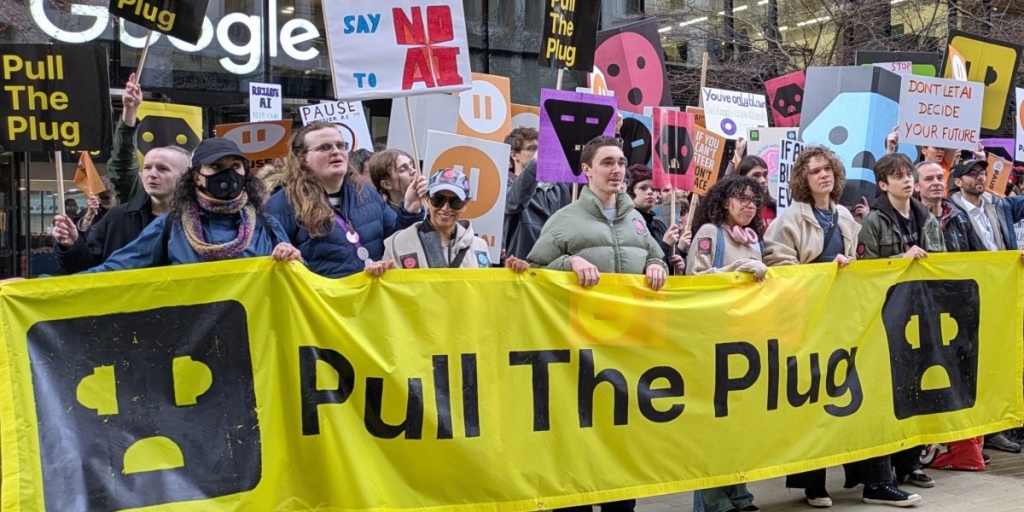
For a few electric hours on Saturday, February 28, London’s tech epicenter of King’s Cross transformed into a battleground of ideas as hundreds of anti-artificial intelligence protesters marched through the heart of Silicon Roundabout. The demonstration, billed as the largest anti-AI protest to date, saw two activist groups—Pause AI and Pull the Plug—channeling growing public anxiety about the technology that’s reshaping our world.
The scene was surreal: protesters chanting “Pull the plug! Pull the plug! Stop the slop! Stop the slop!” while waving signs that ranged from the philosophical to the apocalyptic. One woman wore a homemade billboard reading “WHO WILL BE WHOSE TOOL?” with the O’s cut out as eye holes. Others held placards declaring “Pause before there’s cause,” “EXTINCTION=BAD,” and the pointed “Demis the Menace” (a jab at Demis Hassabis, CEO of Google DeepMind). One sign simply stated: “Stop using AI.”
The concerns on display spanned the spectrum of AI anxiety. An older man wearing a sandwich board that read “AI? Over my dead body” expressed fears about unemployment: “The devil finds work for idle hands,” he told me, capturing the economic anxiety that many protesters shared.
This protest represents a significant escalation in anti-AI activism. When I first encountered protesters outside a London lecture hall where Sam Altman was speaking in May 2023, only two or three people heckled an audience of hundreds. By June 2024, Pause AI—a small international organization founded in 2023—drew dozens for a protest outside Google DeepMind’s London office. This march felt different.
Joseph Miller, who heads Pause AI’s UK branch and co-organized the protest, sees exponential growth in the movement. “We’ve been growing very rapidly. In fact, we also appear to be on a somewhat exponential path, matching the progress of AI itself,” he told me the day before the march.
Miller, a PhD student at Oxford studying mechanistic interpretability—a field focused on understanding what happens inside large language models during task execution—believes the technology may forever be beyond human control. “It doesn’t have to be a rogue superintelligence,” he explained. “You just need someone to put AI in charge of nuclear weapons. The more silly decisions that humanity makes, the less powerful the AI has to be before things go bad.”
Recent events have lent credibility to such fears. In the same week as the protest, the US government attempted to force Anthropic to let it use its LLM Claude for any “legal” military purposes. Anthropic stood its ground, but OpenAI signed a deal with the Department of Defense instead. (OpenAI declined to comment on the protest.)
For Matilda da Rui, another Pause AI member and co-organizer, AI represents humanity’s final challenge. She believes the technology will either solve every other problem we face or wipe us out entirely. “It’s a mystery to me that anyone would really focus on anything else if they actually understood the problem,” she said.
Despite the apocalyptic rhetoric, the march had a surprisingly pleasant, almost festival-like atmosphere. There was little anger and minimal sense that human survival was at stake. This could be attributed to the diverse range of concerns protesters brought to the streets.
A chemistry researcher I spoke with rattled off complaints ranging from conspiracy-adjacent (data centers emit infrasound below human hearing thresholds, inducing paranoia in nearby residents) to legitimate (AI-generated content is making it difficult to find reliable academic sources). His solution? Make it illegal for companies to profit from AI technology: “If you couldn’t make money from AI, it wouldn’t be such a problem.”
Most protesters acknowledged that tech companies probably wouldn’t be swayed by street demonstrations. Maxime Fournes, the global head of Pause AI, told me companies are “optimized to just not care about this problem.” However, he believes the movement can make life harder for AI developers by creating whistleblower protections, damaging the industry’s reputation, and “drying up the talent pipeline.”
The organizers pitched the march as a social event, encouraging curious bystanders to join. It worked. I met a finance worker who had come along with his roommate. “Sometimes you don’t have that much to do on a Saturday anyway,” he said. “If you can see the logic of the argument, if it sort of makes sense to you, then it’s like ‘Yeah, sure, I’ll come along.'”
He noted that protesting AI is easier than other causes: “With this, I feel like it’s very hard for someone to totally oppose what you’re marching for.” Unlike pro-Palestine protests where people might disagree with the cause, AI concerns are broadly accessible.
After winding through King’s Cross, the march ended in a Bloomsbury church hall where protesters wrote their names on stickers, stuck them to their chests, and made awkward introductions. They were there to figure out how to save the world. I had a train to catch, leaving them to their mission.
The protest revealed a growing movement that’s finding its voice and its numbers. Whether it can influence the trajectory of AI development remains to be seen, but one thing is clear: the conversation about artificial intelligence’s role in our future is no longer confined to tech conferences and academic papers. It’s now happening in the streets.
Tags: #AntiAI #PauseAI #PullThePlug #TechProtest #KingsCross #OpenAI #GoogleDeepMind #AIethics #TechActivism #LondonProtest
Viral Phrases: “Pull the plug! Pull the plug! Stop the slop! Stop the slop!” “WHO WILL BE WHOSE TOOL?” “EXTINCTION=BAD” “Demis the Menace” “AI? Over my dead body” “The devil finds work for idle hands” “Pause before there’s cause” “Stop using AI”
,


Leave a Reply
Want to join the discussion?Feel free to contribute!