
Iron Age Surgeons Fixed a Woman’s Shattered Jaw With Primitive Prosthetic—and She Survived
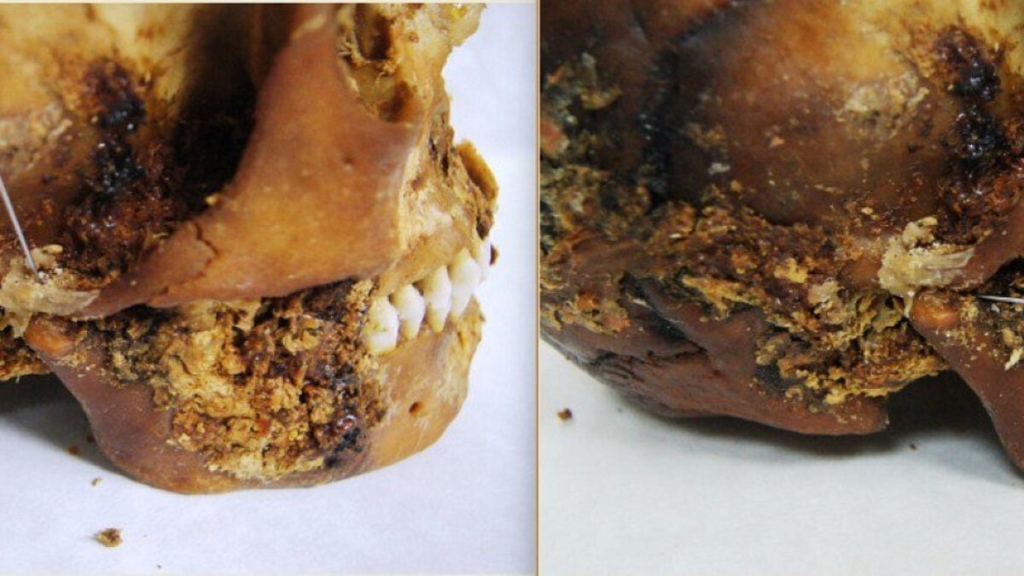
In 1994, Russian archaeologists made a discovery that would remain mysterious for decades: a tiny burial site containing the mummified remains of a young woman, her head adorned with a wig. Now, more than 30 years later, cutting-edge technology has revealed a remarkable secret—evidence of what may be the world’s oldest known jaw prosthesis.
The woman, believed to have been between 25 and 30 years old when she died, belonged to the Pazyryk culture, a nomadic people who roamed the steppes of southern Siberia during the Iron Age. Her remains were found on the Ukok Plateau, a region renowned for its exceptionally well-preserved archaeological finds thanks to the region’s permafrost.
What made this discovery truly extraordinary wasn’t just the age of the remains, but what modern science has uncovered about her final years. Researchers at Novosibirsk State University recently performed a CT scan on the skull, revealing signs of severe trauma and, more importantly, what appears to be a primitive prosthetic device.
“The CT scanner acted as a ‘time machine,’ providing non-destructive access to anatomical structures,” explained Vladimir Kanygin, head of the university’s Laboratory of Nuclear and Innovative Medicine. This non-invasive approach allowed researchers to peer beneath the surface without disturbing the delicate remains, which had been partially mummified and covered with patches of preserved skin.
The scans revealed a devastating injury to the woman’s right temporomandibular joint (TMJ), the hinge that connects the jaw to the skull. This injury was so severe that it would have rendered her unable to eat or speak normally. Yet the evidence suggests she didn’t die immediately from this trauma.
What makes this finding truly groundbreaking is the discovery of thin canals drilled into the joint, along with remnants of what researchers believe to be a surgical ligature made from horsehair or animal tendon. This primitive but sophisticated device would have served as a stabilizing prosthetic, allowing the woman to regain some jaw function.
Even more telling are the signs of extensive tooth wear on the left side of her mouth compared to the right. This asymmetry strongly suggests she survived for an extended period after the surgery, adapting to chew primarily on her functioning side. The growth of new tissues around the prosthetic area indicates the device remained in place for some time, providing at least partial restoration of jaw mobility.
The researchers speculate that the injury may have occurred during the woman’s nomadic lifestyle—perhaps from a fall while riding one of the horses that were central to Pazyryk culture. Whatever the cause, the fact that she survived long enough for tissues to heal around the prosthetic speaks volumes about the medical knowledge and care available to her.
This discovery fits into a broader pattern of sophisticated medical and cultural practices among the Pazyryk people. The famous “Siberian Ice Maiden,” another Pazyryk mummy discovered in a nearby tomb, was found with perfectly preserved tattoos that demonstrated remarkable artistic skill. The Pazyryk were also known for their exceptional craftsmanship, creating intricate leather garments stitched with fine parallel rows that required considerable dexterity.
These same motor skills that produced such fine clothing would have been invaluable for surgical procedures. The precision required to drill tiny canals and fashion a functional prosthetic from available materials suggests a sophisticated understanding of anatomy and healing.
Perhaps most fascinating is what this discovery reveals about Pazyryk values. Despite her likely lower social status—her burial was considered “ordinary” compared to the elaborate interment of the Siberian Ice Maiden—the woman received extensive medical intervention. Her facial injuries would have left her appearance significantly altered, potentially limiting her ability to contribute to her community in traditional ways.
Yet she was treated with care and respect. She received a proper burial in a wooden coffin, a valuable resource in the treeless steppes of southern Siberia. This suggests a society that valued human life intrinsically, regardless of an individual’s physical capabilities or social standing.
“We don’t know what her personal value to society consisted of,” reflected Natalia Polosmak, an archaeologist with the Russian Academy of Sciences. “In this society, everyone was valued in life simply for their existence and honored after death.”
This 2,500-year-old prosthetic represents more than just an ancient medical device—it’s a testament to human compassion, medical ingenuity, and the universal desire to heal and care for one another, even in the harshest of environments. As modern medicine continues to advance, this ancient example reminds us that the impulse to help others heal is as old as humanity itself.
Tags: ancient medicine, jaw prosthesis, Pazyryk culture, Siberian mummy, CT scan archaeology, Iron Age surgery, temporomandibular joint, medical history, nomadic healing practices, permafrost preservation, Russian archaeology, ancient prosthetics, surgical ligature, horsehair medical device, Ukok Plateau discovery, Siberian Ice Maiden, archaeological technology, prehistoric healthcare, ancient trauma treatment, nomadic medicine,


Leave a Reply
Want to join the discussion?Feel free to contribute!