
Is our galaxy’s black hole actually made of dark matter?
*The Galactic Core Enigma: Is Sagittarius A a Black Hole or a Dark Matter Clump?**
In a stunning twist that could reshape our understanding of the cosmos, a team of astrophysicists from Argentina’s National University of La Plata (UNLP) is challenging one of astronomy’s most fundamental assumptions: that the supermassive object at the center of our galaxy is a black hole. Instead, they propose that Sagittarius A* might be something far stranger—a dense, massive clump of dark matter.
The Dark Matter Mystery Deepens
Dark matter, the invisible substance that makes up approximately 85% of the universe’s total matter, has long been a cosmic puzzle. We know it exists because of its gravitational effects on visible matter and the way galaxies rotate, but we’ve never directly observed it. Now, researchers Valentina Crespi and Carlos Argüelles, along with their colleagues, have developed a model that suggests dark matter could form structures so dense and massive that they mimic the appearance of supermassive black holes.
“What we’re proposing is revolutionary,” explains Argüelles. “From Earth, you would see something very similar to what you would see in the black hole scenario—but if we went in a ship towards the center, we could go through with no problem. You will not die by being eaten by the black hole; you will go through peacefully.”
The Science Behind the Claim
The team’s model centers on fermionic dark matter—extremely light particles that could, under the right conditions, form a clump massive enough to match Sagittarius A*’s observed properties. Their calculations show that such a dark matter core would explain several key observations:
- The orbits of stars and gas clouds near Sagittarius A*
- The rotation patterns of our entire galaxy
- The 2022 image captured by the Event Horizon Telescope (EHT)
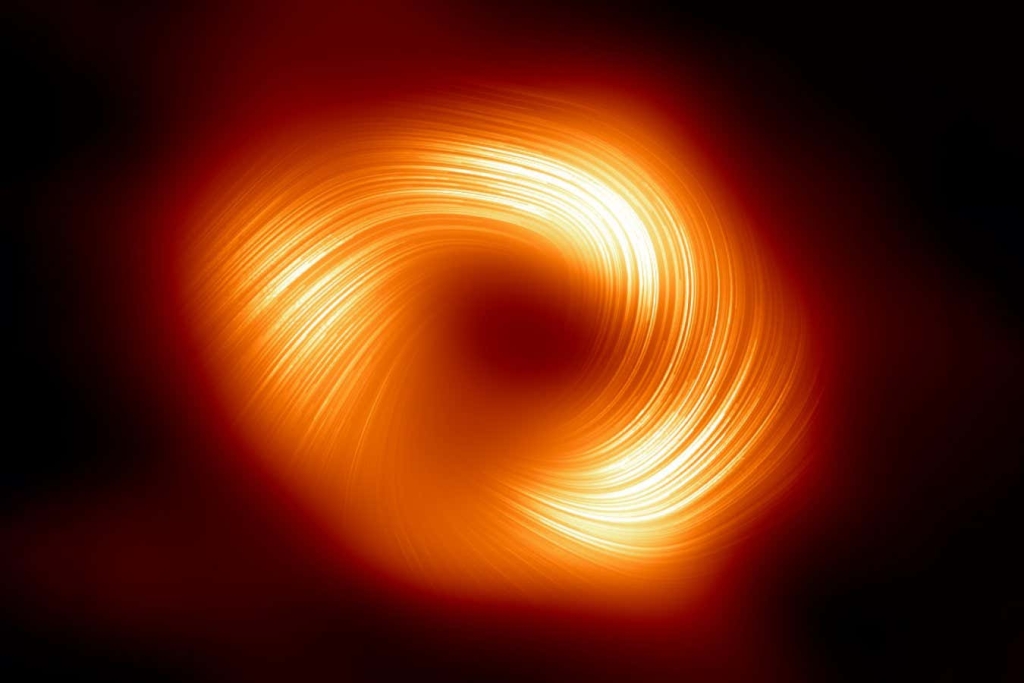
The EHT image, which shows a glowing ring of superheated matter around Sagittarius A*, could potentially be explained by the gravitational pull of a dark matter core rather than an event horizon.
Skepticism and Challenges
Not everyone is convinced. Gaston Giribet from New York University argues that while the dark matter hypothesis is intriguing, the black hole explanation remains simpler and fits the evidence. “Based on the fact that it is a simpler answer that fits the evidence, I personally believe that the celestial body at the center of our galaxy is very likely a black hole,” Giribet says.
Shep Doeleman, founding director of the EHT project at Harvard University, raises another concern. The spiral pattern of magnetic fields near the edge of Sagittarius A* appears consistent with a black hole rather than a dark matter core. Additionally, the model faces challenges when explaining observations “at the very doorstep of the event horizon.”
A Cosmic Scale Problem
Perhaps the most significant challenge to the dark matter hypothesis comes from comparing Sagittarius A to other supermassive black holes. The EHT has also imaged M87, a black hole about 6.5 billion times the mass of our sun—far larger than the 10 million solar mass limit for fermionic dark matter clumps. Yet the images of both objects look remarkably similar, raising questions about whether dark matter could explain all supermassive objects.
The Road Ahead
The researchers acknowledge that definitively proving Sagittarius A* is made of dark matter rather than being a black hole is currently impossible with existing technology. “Nowadays, with the instruments available, it is not yet possible to 100 percent discriminate if it’s indeed dark matter or not,” Crespi admits.
The next generation of the Event Horizon Telescope might get closer to answering this question, but even then, we’re likely decades away from certainty. “It will be decades before we can say for sure, if not longer,” Argüelles notes.
Implications for Our Understanding of the Universe
If Sagittarius A* is indeed a dark matter core, the implications would be profound. Fermionic dark matter isn’t predicted by the current standard model of cosmology, which favors heavier, slower-moving particles as dark matter candidates. A relatively nearby dark matter core would force scientists to reconsider not just black holes, but our entire understanding of the universe’s structure and evolution.
“This would be a paradigm shift,” says Crespi. “It would mean that dark matter can form much more complex structures than we ever imagined, and it would require a complete rethinking of our cosmological models.”
The Quest Continues
As astronomers continue to probe the mysteries of our galactic center, one thing is clear: the nature of Sagittarius A* remains one of the most fascinating questions in modern astrophysics. Whether it’s a black hole or a dark matter clump, solving this puzzle could unlock secrets about the fundamental nature of our universe.
The cosmic detective story continues, with scientists around the world eagerly awaiting the next breakthrough that could finally reveal what truly lies at the heart of our galaxy.
Tags: #DarkMatter #BlackHole #SagittariusA #EventHorizonTelescope #Cosmology #Astrophysics #SpaceDiscovery #GalaxyCenter #FermionicDarkMatter #CosmicMystery #NewPhysics #AstronomyBreakthrough #GalacticCore #DarkMatterClump #SpaceScience #UniverseMysteries #ScientificRevolution #CosmicEnigma #SpaceResearch #AstrophysicalDiscovery
Viral Sentences:
- “The black hole at the center of our galaxy might not be a black hole at all—it could be a clump of dark matter!”
- “Scientists propose that Sagittarius A* is actually a massive dark matter core, not a black hole.”
- “This discovery could revolutionize our understanding of the universe and the nature of dark matter.”
- “Imagine sailing through the center of the galaxy without being spaghettified—that’s what this dark matter theory suggests!”
- “The Event Horizon Telescope might have captured an image of dark matter, not a black hole.”
- “Dark matter could form structures so dense they mimic supermassive black holes.”
- “This theory challenges everything we thought we knew about black holes and dark matter.”
- “The center of our galaxy holds secrets that could rewrite the laws of physics.”
- “Scientists are debating whether Sagittarius A* is a black hole or the universe’s strangest dark matter clump.”
- “This discovery could explain how supermassive black holes grew so large in the early universe.”
,


Leave a Reply
Want to join the discussion?Feel free to contribute!